Appearance
Round to slightly oval kernels with tan-brown skins and a pale cream interior. The shell is hard, smooth, and warm brown.
Hazelnuts are the aromatic kernels of Corylus avellana, prized for their sweet, buttery, toasted flavor and exceptionally strong affinity with chocolate. They are fundamental to Italian pastry, gianduja, praline, gelato, tortes, biscotti, nut pastes, sauces, crusts, and premium finishing oils.
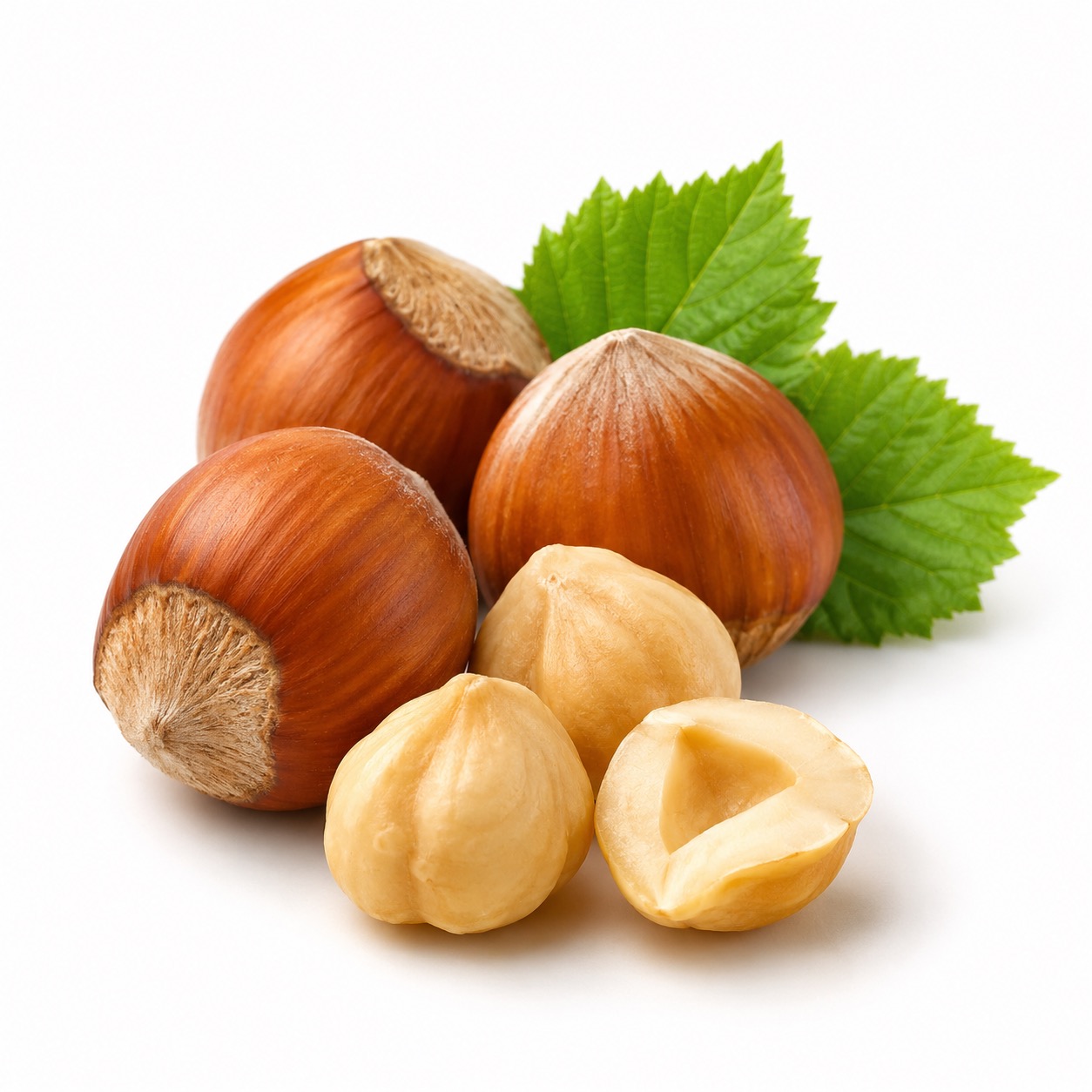
The hazelnut is the edible seed of the hazel tree. Its kernel is enclosed in a hard shell and develops a high concentration of natural oil as it matures. The European hazel, Corylus avellana, is the principal commercial species.
Round to slightly oval kernels with tan-brown skins and a pale cream interior. The shell is hard, smooth, and warm brown.
Firm and crisp when raw; increasingly brittle and aromatic after roasting. Ground nuts can range from coarse meal to smooth paste.
Sweet, nutty, buttery, roasted, earthy, and slightly cocoa-like after toasting.
Approximate values per 100 g of plain hazelnut kernels. Natural variation occurs by cultivar, origin, harvest, and storage.
| Nutrient | Per 100 g |
|---|---|
| Energy | 628 kcal |
| Protein | 15.0 g |
| Total Fat | 60.8 g |
| Carbohydrate | 16.7 g |
| Dietary Fiber | 9.7 g |
| Total Sugars | 4.3 g |
| Calcium | 114 mg |
| Iron | 4.7 mg |
| Magnesium | 163 mg |
| Potassium | 680 mg |
| Vitamin E | 15.0 mg |
Hazelnuts are energy-dense because of their high oil content. Their fat is predominantly unsaturated, and the kernel is also notable for dietary fiber, vitamin E, magnesium, and plant protein.
In professional pastry, hazelnuts contribute not only flavor but substantial fat, structure, mouthfeel, and caloric density. Recipe costing and nutrition should therefore use the actual gram quantity rather than a generic “handful.”
Hazelnuts mature in late summer and early autumn. In many commercial regions, nuts begin dropping in September and harvest is concentrated in September and October, with postharvest cleaning and drying continuing into autumn.
New-crop hazelnuts generally enter the market in autumn, when aroma and freshness are at their most distinctive.
Proper drying, shelling, refrigeration, freezing, and oxygen-controlled packaging allow high-quality kernels to be available throughout the year.
Commercial hazelnuts are allowed to mature fully and fall naturally from the tree before collection. After harvest, they are cleaned and dried before sale in shell or further processing.
The kernel fills the shell and accumulates oil as it reaches full maturity.
Ripe nuts detach and fall to the orchard floor, typically beginning in September.
Nuts are swept, collected, and separated from leaves, twigs, soil, and field debris.
Moisture is reduced for stability, then nuts may be sold in shell or cracked and separated into kernels.
Kernels may be roasted, skinned, chopped, ground, pressed for oil, or refined into paste, praline, and gianduja.
“Best” depends on the intended use. Production leadership, flavor reputation, kernel shape, roasting performance, confectionery quality, and protected regional cultivars are different measures.
Türkiye is the dominant world producer and exporter of hazelnuts. The Black Sea region, particularly provinces such as Ordu, Giresun, Samsun, Trabzon, Sakarya, and Düzce, forms the center of Turkish production.
The Turkish Tombul type is especially respected for confectionery and roasting quality.
Piedmont is famous for Tonda Gentile delle Langhe, prized for aroma, roasting character, fine texture, and its historic role in gianduja.
Oregon's Willamette Valley is the principal American commercial production region, supported by a temperate climate suited to European hazelnuts.
Azerbaijan, Georgia, Chile, France, Iran, China, and other temperate production regions contribute to international supply.
Roast hazelnuts until the aroma becomes pronounced and the skins begin to loosen. Avoid over-roasting: the high oil content can move quickly from toasted to bitter.
While warm, rub roasted nuts in a clean towel to remove loose skins. Complete removal is not always necessary; a small amount of skin can contribute roasted bitterness and color.
Pulse carefully for meal or flour. Continuous grinding releases oil and progressively transforms the nuts from meal into paste or butter.
For praline, combine roasted hazelnuts with cooked caramel, cool completely, then grind from coarse crumbs to a smooth flowing nut paste.
Keep cool, dry, and protected from moisture, insects, and strong odors.
Because of the high oil content, store airtight and cool. Refrigeration or freezing extends quality and slows rancidity.
Use more quickly. Roasting and grinding increase exposed surface area and accelerate oxidation.
This ingredient identity can connect recipe pages, Live Inventory, purchasing, Menu Builder, recipe costing, and the Tuscany Cuisine search engine.