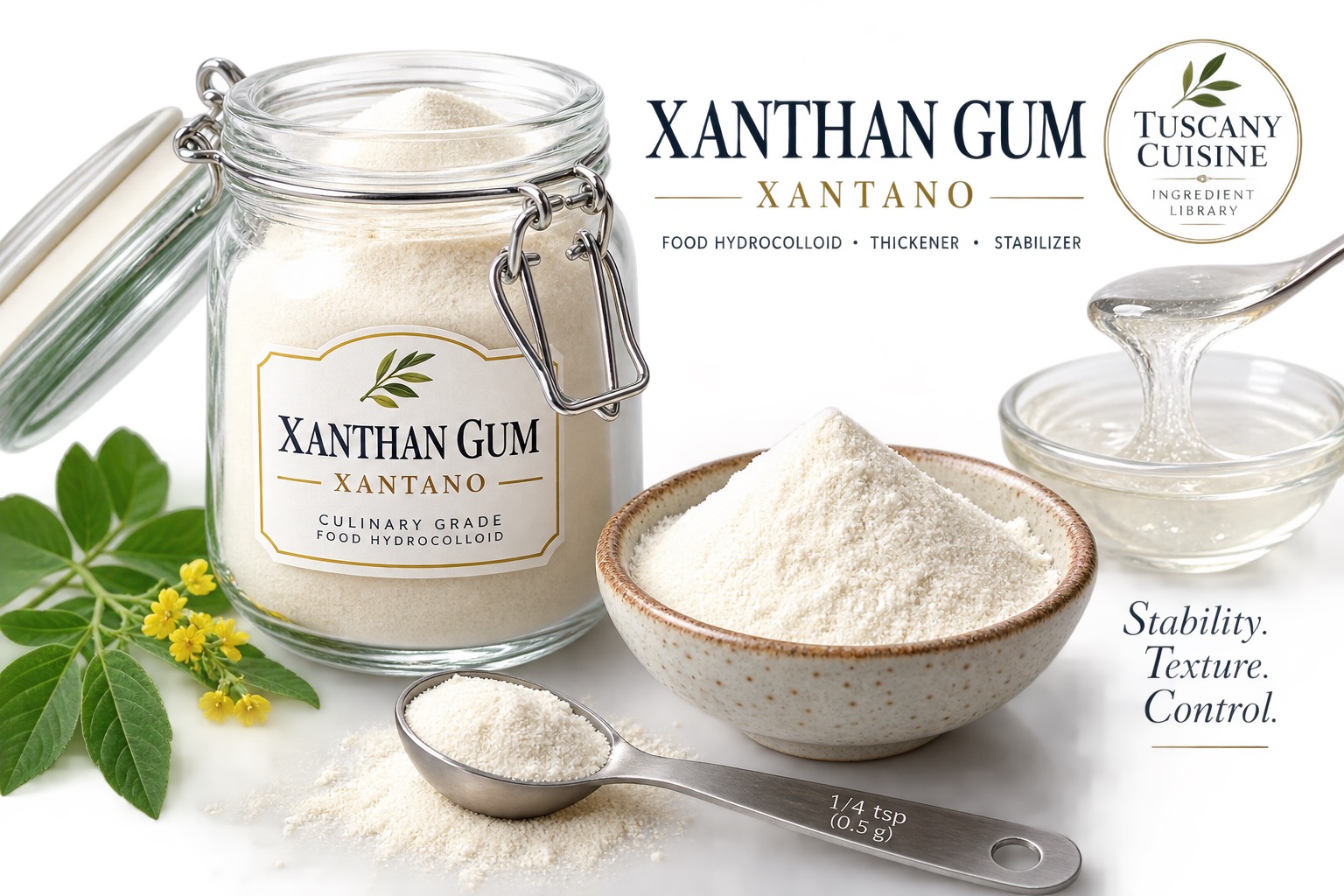
Gomma Xantana · E415 / INS 415 — a fermentation-derived hydrocolloid used
in professional kitchens and food manufacturing to control viscosity,
suspend particles, stabilize emulsions and build consistent texture in
sauces, dressings, beverages, purées, foams and modern culinary systems.
E415 / INS 415Cold & Hot ProcessShear-ThinningSauce StabilizerSuspension Power
What Is Xanthan Gum?
Xanthan gum is a high-molecular-weight polysaccharide made by
microbial fermentation. The U.S. FDA identifies xanthan
gum under 21 CFR 172.695 and lists technical functions that include
stabilizer, thickener, emulsifier/formulation aid and texturizer.
Commercial xanthan is produced by fermenting a carbohydrate source with
Xanthomonas campestris. The polysaccharide is recovered, purified,
dried and milled into the fine powder used by chefs and food manufacturers.
It hydrates in cold or hot water and can produce significant viscosity at
very low concentration.
Why Xanthan Works So Well in Warm Sauces
One of xanthan's strongest culinary advantages is process tolerance.
Warm & Hot Sauce Stability
Xanthan can maintain useful viscosity through heating and is resistant
to many acidic, salty and high-shear environments. That makes it useful
for tomato sauces, reductions, jus, glazes, hot emulsified sauces,
vinaigrettes, marinades and prepared sauce systems.
Shear-Thinning Flow
A xanthan-thickened sauce can feel stable while resting but becomes
easier to pump, whisk, spoon, pour or plate when shear is applied.
When the shear stops, viscosity builds back. This is why a small amount
can give excellent cling without making a sauce behave like a starch gel.
Chef application:
xanthan is especially valuable when you want to stabilize a warm sauce
without relying on a large quantity of starch, roux, cream or reduction.
It changes flow behavior as much as simple thickness.
Xanthan Gum vs. Guar Gum in Beverages & Juices
Your kitchen observation is useful — but the food-industry distinction needs one important nuance.
Guar Gum
Excellent Cold-Process Body
Guar gum comes from the endosperm of the guar bean,
Cyamopsis tetragonoloba. It hydrates rapidly in cold water and
produces high viscosity efficiently. For that reason it is widely used
in beverages, juices, dairy, ice cream, instant foods, bakery and
cold-process sauces where water binding and body are needed.
Xanthan Gum
Stronger Suspension & Process Robustness
Xanthan is also widely used in beverages. Its high suspension power,
acid tolerance and heat stability can help keep fruit particles, spices
or other solids distributed while contributing relatively little
viscosity under drinking shear. Transparent grades are even offered
specifically for beverage applications.
Important formulation principle:
preventing a vegetable or fruit juice from separating is not simply
“guar gum versus xanthan gum.” The correct stabilizer depends on whether the
problem is pulp settling, cloud loss, oil-flavor emulsion,
protein instability, water separation, mouthfeel, or syneresis.
In commercial beverages, formulators may choose xanthan, guar, pectin,
gellan, carrageenan, gum arabic, CMC or a blended stabilizer system.
Food Gums & Hydrocolloids: What Each One Does Best
Hydrocolloids overlap, but they are not interchangeable one-for-one.
Hydrocolloid
Source
Hydration
Best Applications
Key Difference
Xanthan Gum · E415
Microbial fermentation
Cold or hot
Warm sauces, dressings, marinades, soups, suspensions, beverages, gluten-free systems
Exceptional shear-thinning flow; robust under acid, salt, heat and shear
Excellent emulsifier with relatively little thickening
Cellulose Gum / CMC · E466
Cellulose derivative
Grade dependent
Beverages, frozen desserts, sauces, bakery, water binding
Versatile viscosity, water retention and ice-crystal/syneresis control
Pectin · E440
Plant cell walls, commonly citrus/apple
Type and formulation dependent
Jams, fruit gels, glazes, fruit preparations, acid dairy and beverage systems
Fruit-friendly hydrocolloid with sugar/acid/calcium-responsive types
Agar · E406
Red algae
Requires heating
Firm gels, jellies, aspics, plated gels, pastry
Forms a strong, relatively brittle gel with a much higher melting point than gelatin
Choosing a Gum by the Problem You Need to Solve
Start from the technical problem, not from the ingredient name.
Warm Sauce That Separates
Xanthan is a strong first candidate because it can stabilize the water phase,
improve cling and help keep oil droplets or particulates distributed.
Cold Juice Needs More Body
Guar can efficiently build cold viscosity. Xanthan may be preferred when
stronger suspension, acid/heat tolerance or shear-thinning behavior is needed.
Clear Drink With Pulp
Gellan can be useful because a weak fluid-gel network can suspend particles
without making the drink excessively thick or opaque.
Citrus Flavor Oil in Beverage
Gum arabic/acacia is a classic choice for stabilizing flavor-oil emulsions
while keeping bulk viscosity relatively low.
Dairy / Chocolate Milk Suspension
Carrageenan is frequently selected because certain grades interact with
milk proteins and can help suspend cocoa or other solids.
Ice Cream & Frozen Dessert
Guar, locust bean gum, carrageenan and cellulose gums are often used in
blends to manage water, ice crystals, body, meltdown and syneresis.
How to Disperse Xanthan Without Lumps
The biggest practical mistake is allowing the outside of the powder to hydrate before the particles are separated.
1Measure Precisely
Xanthan is powerful. Use a gram scale whenever possible.
2Pre-Disperse
Mix with sugar or other dry ingredients, or disperse into a compatible oil phase before water contact.
3Add Under Motion
Sprinkle gradually into a moving vortex rather than dumping the powder onto still liquid.
4Blend & Rest
Use an immersion blender or high shear as appropriate, then allow complete hydration and reassess viscosity.
Ingredion notes that many gums begin hydrating almost immediately; if hydration
occurs before the powder is dispersed, the outside becomes wet and traps dry
powder inside — the familiar “fish-eye” or gummy lump.
Culinary Starting-Point Dosage
These are practical development ranges, not regulatory or supplier specifications.
0.05–0.10%Very light suspension or subtle body
0.10–0.20%Light sauce, dressing or beverage stabilization
0.20–0.35%Medium sauce viscosity, purées and stronger suspension
0.35–0.60%Heavy texture; test carefully to avoid gummy or ropy mouthfeel
Always validate the actual food-grade product, particle size, process,
pH, salt, sugar, temperature, shear and final serving temperature.
Different xanthan grades and blended systems can behave differently.
Xanthan in Modern Culinary Technique
Sauces & Jus
Build cling and stabilize without heavy flour or starch character.
Vinaigrettes
Slow separation and hold herbs, spices or small particles in suspension.
Purées & Coulis
Control flow for clean plating while maintaining fresh flavor.
Foams & Siphons
Adjust base viscosity so gas bubbles and fine particles remain more stable.
Soups
Increase body without prolonged reduction or large starch additions.
Marinades
Improve cling and keep spices distributed rather than settling rapidly.
Gluten-Free Baking
Helps provide viscosity and structure when gluten is absent.
Frozen Systems
Can contribute water management and freeze-thaw stability in selected formulations.
Tuscany Cuisine Platform Ingredient Record
Xanthan Gum now has one reusable Tuscany Cuisine identity built around the
existing Live Inventory key xanthan_gum. Recipe pages should reuse
this identity rather than creating local or duplicate xanthan records.
One Ingredient · One IdentityXanthan GumE415HydrocolloidSauce StabilizerRecipe 170Live Inventory
Current Recipe Usage
Persimmon Foam with Almond Dusted Kale Chips uses
3 g xanthan gum in the base 8-serving recipe.
Its role is viscosity control and stabilization of the persimmon foam base
before the mixture is loaded into the siphon.
The FDA lists xanthan gum as a direct food additive under 21 CFR 172.695,
and Codex/JECFA classify xanthan as INS 415 with functions including
thickener and stabilizer. Purchase food-grade xanthan from an approved supplier
and follow the applicable supplier specification and legal use conditions for
the country and food category.
For professional purchasing, record the manufacturer, product grade,
lot number, country of origin, viscosity specification, microbiological
specification, allergen/cross-contact statement, certification requirements
and storage instructions. Transparent beverage grades, rapid-dispersion grades
and application-specific xanthan products are not automatically identical.