Salmon is one of the most important professional fish categories in the modern kitchen:
valued for flavor, fat balance, butchering versatility, curing potential, roasting quality
and strong global consumer recognition.
Species & ProvenanceButchering & Fillet AnatomyWild vs FarmedNutrition & Fat QualitySeasonalityRecipe System Connections
Professional Identity
“Salmon” is a culinary group rather than one single market identity. In professional purchasing,
the chef must separate species, origin, farming method, fat level, color, size, cut form and intended use.
A Scottish Atlantic salmon fillet behaves differently from a leaner wild sockeye side, while a rich king salmon
can be ideal for premium raw, cured or lightly cooked presentations.
In practical kitchen use, salmon may be received as whole fish, head-on gutted fish, skin-on sides,
boneless fillets, portions, trim or smoked/cured derivatives. Correct specification is essential for
labor planning, yield control and consistent plate cost.
Major Salmon Species & Market Types
Species and origin strongly affect taste, color, fat content, texture, price and culinary application.
Atlantic Salmon (Salmo salar)
The dominant farmed salmon in the global market. Rich, mild and well-marbled.
Scottish, Norwegian, Icelandic and Faroe Islands Atlantic salmon are important premium references.
Scottish Salmon
Usually farmed Atlantic salmon from Scotland. Highly regarded for quality consistency,
fat distribution and premium reputation in hospitality markets.
King / Chinook Salmon (Oncorhynchus tshawytscha)
Often considered one of the finest salmon for luxury service. Large flakes, rich oil content,
buttery mouthfeel and excellent performance in raw, cured and gently cooked applications.
Sockeye Salmon (Oncorhynchus nerka)
Wild sockeye is leaner, deeply colored and more pronounced in flavor. Excellent for chefs seeking
stronger salmon character and vibrant red flesh.
Coho Salmon (Oncorhynchus kisutch)
Medium fat level with balanced texture and flavor. Useful as a versatile middle ground between king and sockeye.
Pink Salmon (Oncorhynchus gorbuscha)
Smaller, lighter and generally less rich. Common in processing, canning and value-oriented production.
Chum / Keta Salmon (Oncorhynchus keta)
Milder and usually leaner. Often valued for roe production but also used for fillets and smoked products.
Alaskan Salmon
Not one species, but a provenance descriptor covering wild Pacific species harvested in Alaska,
especially king, sockeye, coho, pink and chum.
Best Culinary References
Premium chefs often highlight Scottish Atlantic, Faroe Atlantic, wild Alaskan king,
wild Alaskan sockeye and high-grade coho depending on dish style and budget.
Chef note:
“Atlantic,” “Scottish,” “King” and “Alaskan” do not all mean the same thing.
Some identify species, some identify origin, and some combine both.
Salmon Butchering Cuts & Fillet Anatomy
A clear understanding of the side and its sub-cuts improves yield, menu specification and trim use.
The center loin generally gives the cleanest premium portions. The belly is richer and softer,
excellent for curing, tartare, trim applications or staff meal depending on quality. The tail is
thinner and cooks faster, while the collar/shoulder area has stronger flavor and irregular shape.
Common Purchased Forms
Whole fish, HOG (head-on gutted), sides, skin-on fillets, pin-boned fillets,
center-cut loins, portions, trim and smoked or cured derivatives.
Important Fabrication Points
Scale if required, check for remaining pin bones, trim bloodline carefully,
control belly thickness, preserve skin when needed for searing or curing,
and store cold to protect fat quality.
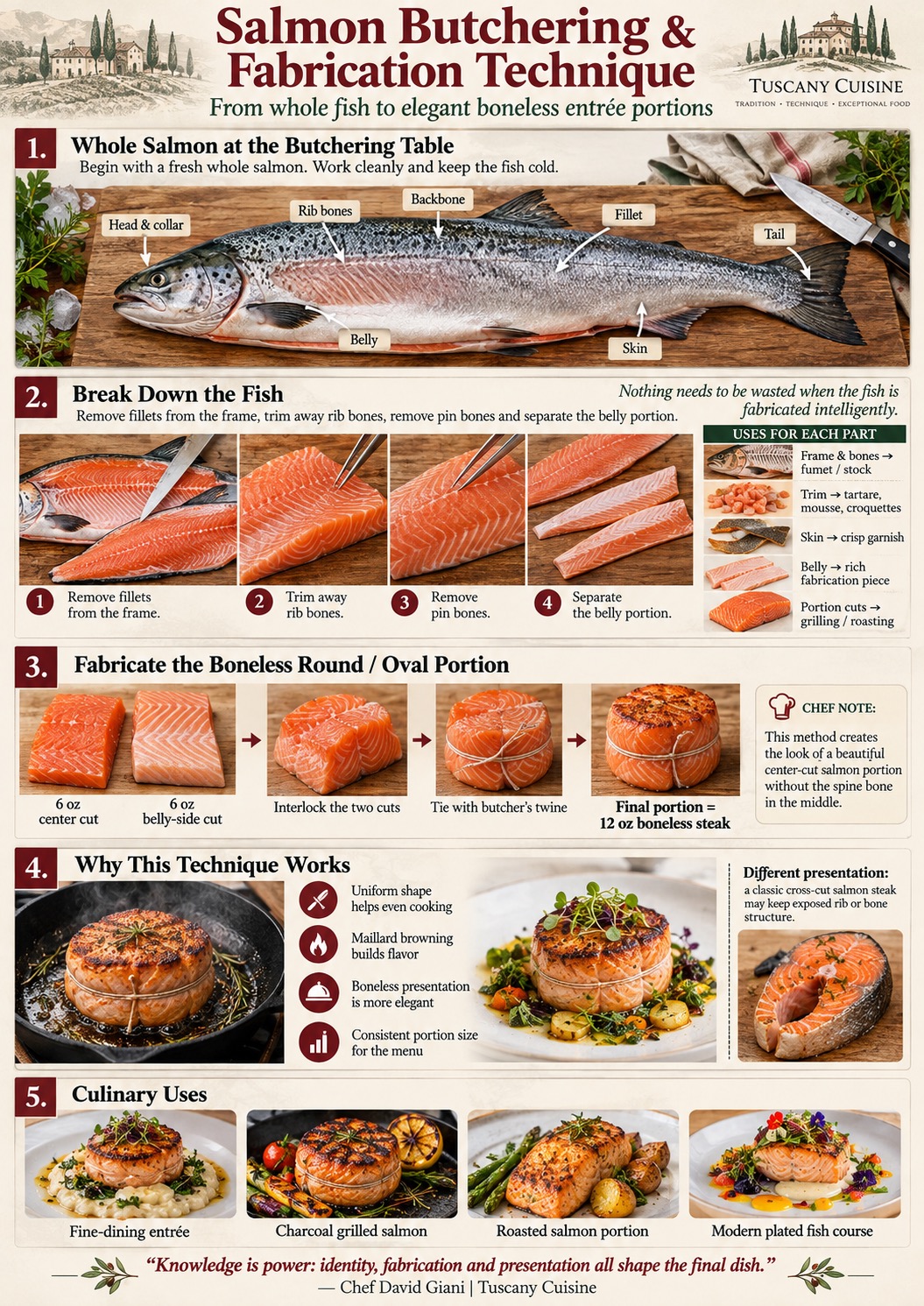
Visual fabrication guide: from whole salmon anatomy and breakdown to a tied 12 oz boneless round/oval entrée portion, including no-waste culinary uses for frame, trim, skin and belly.
1. Read the Whole Fish
Before cutting, identify the head and collar, backbone, rib cage, fillets, belly, skin and tail. Understanding the anatomy first helps the chef cut accurately, preserve yield and decide which parts will become premium portions and which will be redirected to other preparations.
2. Break Down with Purpose
Remove each fillet cleanly from the frame, trim away the rib bones, remove the pin bones and separate the belly section. Work cold, keep the knife sharp and avoid cutting away good flesh simply to make the fillet look uniform.
Frame and bones → fumet or fish stock
Trim → tartare, mousse, croquettes or fillings
Skin → crisp garnish when appropriate
Belly → rich fabrication piece or separate preparation
Prime portions → grilling, roasting, searing or curing
3. Build the Boneless Round / Oval Portion
For the Charcoal Grilled Salmon presentation, cut one approximately 6 oz center-cut piece and one approximately 6 oz belly-side piece. Interlock the thinner belly-side cut against the thicker center cut so the two pieces form one compact, even round or oval.
4. Tie and Shape
Wrap butcher’s twine around the circumference and tighten only enough to hold the construction together. The final result is one 12 oz boneless salmon steak with the visual presence of a generous center cut but without the central spine bone.
5. Cook as One Portion
The uniform tied shape helps the two interlocked pieces cook more evenly. During charcoal grilling, Maillard browning develops on the exterior and builds flavor. If the exterior reaches the desired color first, finish gently in the oven rather than over-darkening the surface.
6. Plate and Use the Whole Fish
Remove the twine before service and present the salmon as one clean boneless portion. The technique supports elegant fine-dining presentation, consistent portion control and better utilization of the whole fish rather than treating belly, trim, skin and frame as waste.
Butchering note: a classic cross-cut salmon steak may intentionally retain the central bone and exposed rib structure. That is a different traditional cut. The tied round/oval technique is designed for a refined boneless presentation where the guest receives the visual weight of a center-cut steak without having to remove the spinal bone at the table.
Recipe Application · Charcoal Grilled Salmon
This recipe demonstrates the fabrication technique in service: two skinless, boneless 6 oz salmon cuts are interlocked, tied into one 12 oz round/oval portion, charcoal grilled, and plated with roasted Yukon Gold potatoes, garlic spinach and lemon-parsley emulsion.
Both have legitimate uses, but their nutrition, cost structure, consistency and environmental profile differ.
Wild Salmon
Usually leaner, more seasonal and more variable by species and run.
Flavor is often more pronounced. Flesh color in species such as sockeye
can be exceptionally vivid. Premium wild king is highly prized.
Farmed Salmon
Usually offers more uniform sizing, year-round availability and higher fat content.
Atlantic salmon dominates this market. Good farmed fish can be excellent for portion control,
raw preparations, smoking and menu consistency.
Chef Decision
Choose wild when you want stronger identity, seasonality and provenance storytelling.
Choose farmed when you need consistent cost, predictable yield and rich texture across service.
Characteristic
Typical Wild Salmon
Typical Farmed Atlantic Salmon
Calories
Lower to moderate
Usually higher
Fat
Lower overall fat
Higher overall fat
Omega-3
High
Also high, often high due to total fat
Protein density
High
High
Texture
Firmer, sometimes leaner flakes
Richer, softer, more buttery
Availability
Seasonal
Year-round
Uniformity
More variable
More standardized
Price stability
More variable
Often more predictable
Nutrition perspective:
both wild and farmed salmon are strong sources of high-quality protein and omega-3 fatty acids.
Farmed salmon generally contains more total fat and calories, while many wild salmon types are leaner and more mineral-dense per calorie.
Approximate Nutrition Value
Values vary by species, farming method and cut; the table below is a practical chef-level guide per 100 g raw salmon.
Nutrient
Wild Salmon (approx.)
Farmed Atlantic Salmon (approx.)
Calories
140–180 kcal
190–230 kcal
Protein
20–25 g
19–23 g
Total fat
5–10 g
12–15 g
Omega-3 fatty acids
High
High
Vitamin D
Good source
Good source
Vitamin B12
Excellent source
Excellent source
Selenium
Good source
Good source
Potassium
Moderate
Moderate
Seasonality & Best Market Periods
Seasonality depends heavily on whether the fish is wild or farmed and on the producing region.
Winter
Farmed Atlantic salmon remains widely available. Wild selections are limited depending on origin and frozen inventories.
Spring
Farmed product stays steady; early seasonal interest begins for some Pacific sources.
Summer
Peak interest for many wild Alaskan salmon runs, especially sockeye and king depending on fishery timing.
Autumn
Strong market presence can continue for selected wild runs and preserved frozen stock; premium farmed product remains stable.
Premium Farmed Reference
Scottish Atlantic salmon is often considered one of the best-known premium farmed salmon choices
for restaurants because of consistency, flavor and reliable availability.
Premium Wild Reference
Wild Alaskan king and wild Alaskan sockeye are frequently celebrated for provenance, texture and flavor,
though availability and cost vary seasonally.
Quality Selection & Professional Handling
High-value oily fish requires disciplined cold-chain control.
Quality point
Professional standard
Smell
Clean, marine and fresh; avoid stale, sour or strongly fishy aroma.
Flesh
Firm with resilience; avoid mushy texture or gaping that suggests mishandling.
Color
Should match species expectations; color alone does not equal quality, but it should look fresh and even.
Fat lines
Well-defined marbling suggests richness and careful handling.
Skin
Bright and moist, not dry or excessively damaged.
Storage
Keep well iced or under strict refrigeration, protected from cross-contamination and odor transfer.
Fabrication
Remove pin bones carefully and maintain clean trim to minimize waste.
Professional Culinary Uses
Different species and cuts support different applications.
Raw & Cured
Ideal for gravlax, grappa-cured salmon, tartare, crudo and smoked preparations when quality and safety standards are fully controlled.
Roasted & Pan-Seared
Center-cut fillets and portions perform well when skin crispness and temperature control are priorities.
Trim Utilization
Belly trim, tail trim and shaped offcuts can be used for mousse, tartare, croquettes, staff meal or pasta fillings depending on quality.
Tuscany Cuisine Platform Record
The Salmon page functions both as an educational foundation page and as a platform ingredient identity.
It can support recipes, inventory, menu engineering and future fish-butchery education across the Tuscany Cuisine system.
Butchering lesson
Boneless 6 oz + 6 oz tied round / oval portion
Current Platform Usage
Grappa-Cured Salmon uses 4 lb skin-on salmon sides for approximately 24 appetizer portions.
Cured Salmon Salad uses 60 g thinly sliced cured salmon for the 2-serving plated appetizer.
Charcoal Grilled Salmon connects the salmon identity to the butchering lesson above: two 6 oz skinless, boneless cuts are interlocked and tied into one 12 oz fine-dining portion.