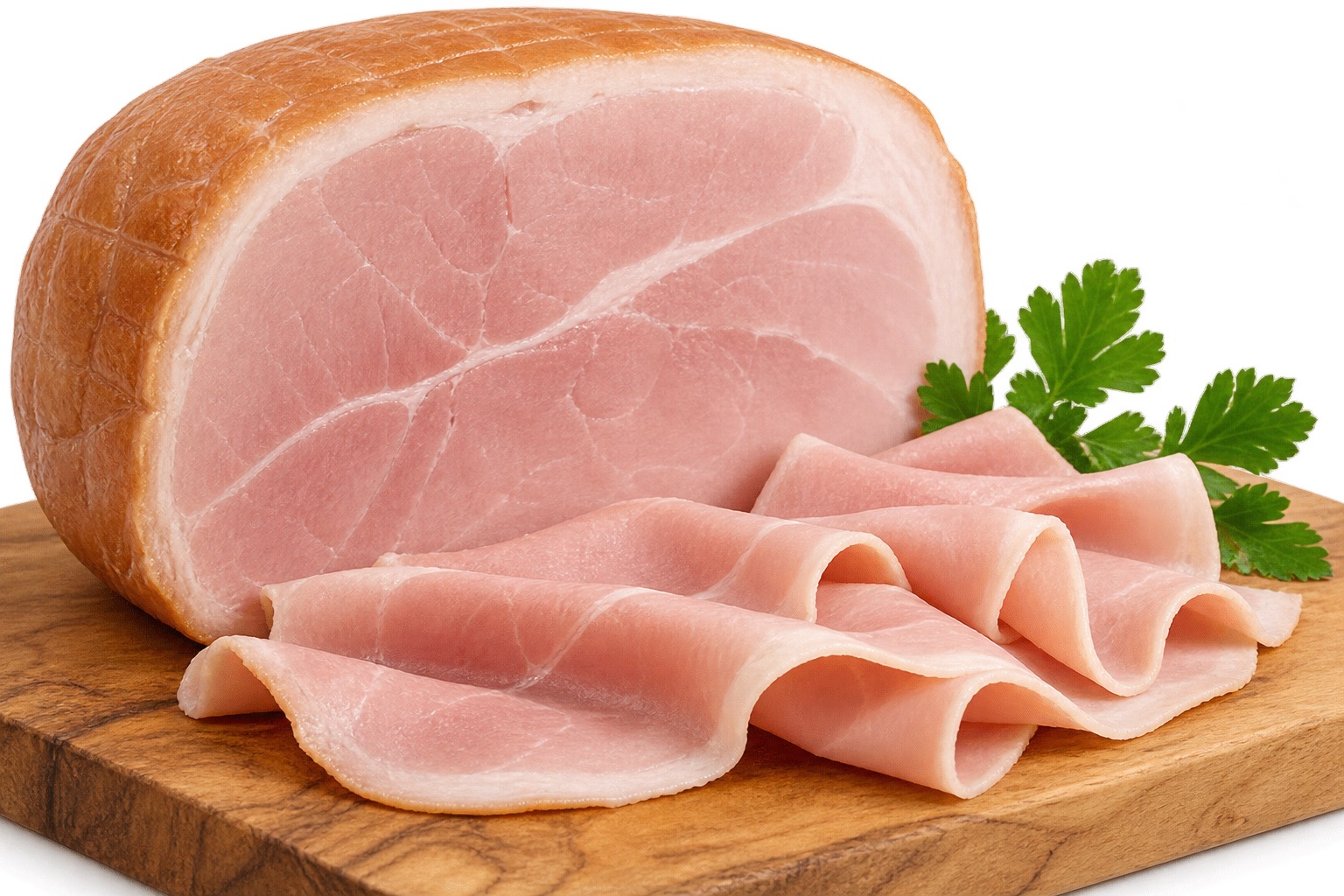
Italian cooked ham made primarily from the pork hind leg. Mild, delicate and versatile, prosciutto cotto belongs to the cooked-ham branch of Italian salumeria and should not be confused with dry-cured prosciutto crudo.
Italian CharcuteriePork Hind LegCooked & RefrigeratedProfessional Ingredient
What Is Prosciutto Cotto?
Prosciutto cotto is an Italian-style cooked ham traditionally produced from the fresh hind leg of the pig. The leg is selected, deboned and trimmed, seasoned or brined, shaped and cooked until the muscle structure becomes tender, cohesive and sliceable.
Unlike dry-cured ham, the preservation of prosciutto cotto relies principally on controlled brining, thermal processing, refrigeration and protective packaging rather than long air-drying and maturation. Its flavor is mild, gently savory and often subtly aromatic, while the texture should remain moist and supple.
Culinary distinction: Prosciutto cotto is not simply “prosciutto that has been heated.” It is a separate style of ham with its own production method, texture, moisture level, storage requirements and culinary applications.
History and Evolution
The word prosciutto historically refers to preserved pork leg. Italian culinary tradition became especially famous for long-aged prosciutto crudo, including the celebrated regional hams of Parma and San Daniele. Prosciutto cotto developed as a different preservation and service style: the leg is prepared, seasoned and cooked rather than slowly dehydrated through extended curing.
Modern Italian cooked-ham production became increasingly standardized with refrigeration, controlled brining, molding, vacuum packaging and pasteurization. This allowed a consistent, moist product suited to delicatessen slicing, sandwiches, prepared foods and restaurant applications.
Pork Cut and Anatomy
The classic raw material is the hind leg of the pig, the same general anatomical region used for many traditional cured hams. The fabrication objective, however, is different.
Primary muscles: large muscles of the fresh ham are retained to produce recognizable whole-muscle texture.
Bone: commonly removed before processing to permit even brining, forming and cooking.
Fat: exterior fat may be selectively trimmed, while some fat is retained for moisture, flavor and visual quality.
Skin: may be retained or removed depending on style and manufacturer.
Shoulder versions: cooked products made from the shoulder exist, but technically they are not the same anatomical cut as classic hind-leg prosciutto cotto.
Fabrication Process
Selection: Fresh pork legs are inspected for quality, muscle structure, fat balance and processing suitability.
Deboning & trimming: Bone, connective tissue and excess fat are removed according to product specification.
Brining / seasoning: Salted aromatic brine is introduced and distributed through the muscles.
Massaging / tumbling: Controlled mechanical action helps distribute seasoning and develop protein binding.
Forming: The ham is placed into molds or forms to create a uniform slicing shape.
Cooking: Slow controlled thermal processing cooks the interior while preserving moisture.
Cooling: Rapid controlled chilling stabilizes the product and firms its texture.
Packaging: The ham is commonly vacuum packed; industrial products may also receive a final pasteurization step.
Prosciutto Cotto vs. Prosciutto Crudo
Characteristic
Prosciutto Cotto
Prosciutto Crudo
Primary treatment
Brined, formed and cooked
Salted and dry-cured / aged
Main preservation
Heat processing + refrigeration
Salt + moisture reduction + maturation
Texture
Moist, tender, soft
Dense, silky, firmer and more concentrated
Flavor
Mild, delicate, gently savory
More concentrated, complex and matured
Color
Soft rose-pink
Deep pink to red
Typical slicing
Thin deli slices or culinary dice
Very thin slices, often served uncooked
Storage
Requires refrigeration
Whole cured hams are more shelf-stable before cutting; sliced product is refrigerated
Mild cooked ham with balanced salt, delicate pork flavor and a moist whole-muscle texture. Used throughout Italian delicatessens and professional kitchens.
Roasted Ham
A related cooked-ham style that may receive surface roasting or browning after or during thermal processing, producing deeper roasted aromas and a more pronounced exterior flavor.
Smoked Ham
Cooked ham may also be exposed to smoke or smoke flavor, creating a more assertive aromatic profile. This should be distinguished from traditional Italian prosciutto cotto unless specifically identified as smoked.
Other Commercial and Culinary Variations
Alta qualità: premium Italian classification associated with stricter quality parameters and recognizable muscle structure.
Scelto: selected-quality cooked ham classification used in the Italian market.
Defatted / trimmed: exterior fat reduced for leaner slicing applications.
Herb-crusted: exterior seasoned with herbs, pepper, rosemary or spices.
Honey or glazed ham: sweeter international-style cooked ham; not a traditional standard prosciutto cotto profile.
Shoulder ham: produced from pork shoulder rather than the hind leg and normally identified separately.
Professional Culinary Uses
Panini, focaccia, schiacciata and tramezzini
Pizza and pinsa toppings
Crespelle and savory crêpe fillings
Stuffed chicken, veal and pork preparations
Pasta fillings, tortellini-style preparations and baked pasta
Ham mousseline and forcemeat preparations
Frittata, omelets and egg dishes
Salads and composed antipasti
Fine dice for peas, cream sauces and vegetable preparations
Breakfast and brunch applications
Handling and Service
Keep refrigerated and protect cut surfaces from drying.
Slice across the muscle grain for tenderness.
For panini and antipasti, thin slicing emphasizes tenderness.
For fillings and mousselines, use controlled dice or finely chopped ham.
Add late to pizza when a softer texture is desired; bake longer when light browning is preferred.
Because sodium varies substantially by producer, taste the ham before seasoning the finished recipe.
Nutrition Profile
Prosciutto cotto is primarily a source of high-quality protein and also contributes fat, sodium, B vitamins and minerals. Exact values vary significantly by producer, fat trimming, added brine and formulation, so the package nutrition panel should be used for precise recipe costing and nutritional analysis.
Nutrient / Characteristic
Culinary Interpretation
Protein
High-protein meat ingredient suitable for entrées, sandwiches and fillings.
Fat
Varies with trimming and product grade; visible fat contributes flavor and moisture.
Carbohydrates
Usually low, though some commercial formulations may include small amounts from processing ingredients.
Sodium
Can be significant because brining is central to production.
Vitamins
Provides several B vitamins typical of pork products.
Minerals
Contributes iron, zinc, phosphorus and other minerals in varying amounts.
Nutrition values are intentionally presented as a profile rather than fixed numbers because composition differs by brand and classification. Tuscany Cuisine recipe pages should use the nutrition data for the exact product purchased when available.
Flavor Pairing Guide
Cheese
Fontina, mozzarella, Parmigiano Reggiano, Taleggio, stracchino and mild pecorino.
Vegetables
Peas, artichokes, mushrooms, asparagus, spinach, potatoes and roasted peppers.
Seasonings
Nutmeg, black pepper, sage, rosemary, parsley, garlic, mustard and light cream sauces.
Tuscany Cuisine Platform Connection
This ingredient record can be used by Tuscany Cuisine recipes, Menu Builder, Live Inventory, station dashboards, purchasing and ingredient-icon synchronization through the standardized inventory ID italian_cooked_ham and ingredient code PROSCIUTTO-COTTO-001.
Italian reference sources describe prosciutto as pork leg preserved either through salting and aging or through cooking. Technical descriptions of prosciutto cotto commonly include deboning, brine injection or seasoning, mechanical massaging, molding, cooking, cooling, vacuum packaging and pasteurization. Italian food-composition research also identifies multiple commercial categories of prosciutto cotto, including standard, selected and high-quality versions.