Common juniper
Juniperus communis L., family Cupressaceae. Its ripe cone berries are the internationally recognized culinary juniper and the only species registered under this icon.
Pine forest, citrus peel, black pepper and cool resin in one tiny blue-black cone. This chef's guide follows common juniper from its two-season ripening cycle to the spice jar, then into Tuscan wild-boar marinades, braises, sauces, teas, punches and botanical beverages.
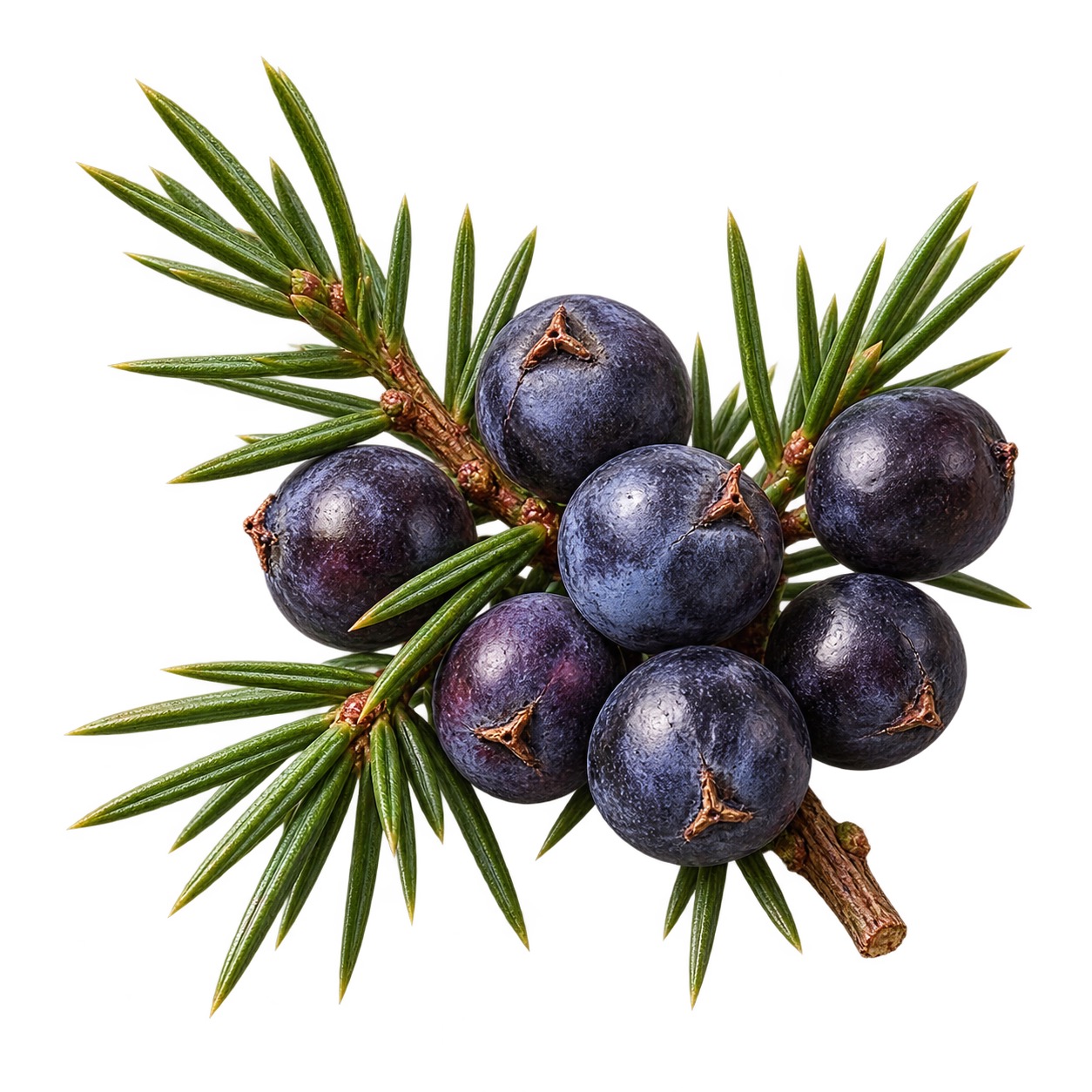 Active culinary icon
The culinary “berry” is a fleshy seed cone. For a dependable spice record, the botanical species matters as much as the form, origin and lot quality.
Juniperus communis L., family Cupressaceae. Its ripe cone berries are the internationally recognized culinary juniper and the only species registered under this icon.
Three fleshy cone scales fuse around hard seeds. The ripe cone is violet-brown to blue-black, usually with a pale waxy bloom and a three-rayed mark at the crown.
The operational record is for ripe, food-grade, whole dried berries. Fresh cones, ground spice, extracts and essential oil require separate controls.
Never cook with an unidentified ornamental or foraged juniper. Some related species—notably savin juniper, Juniperus sabina—are unacceptable substitutes. Purchase verified food-grade Juniperus communis from a traceable supplier.
Juniper's story crosses northern forests, mountain pastures, apothecaries, distilleries and the game kitchens of Europe.
Juniper cones and wood were valued for their strong evergreen aroma. Historical traditions placed the plant in food, smoke, household and herbal preparations.
Its clean resinous profile became a natural companion to venison, boar, hare, duck, pork, sauerkraut, pickles and slow winter cookery.
Juniper moved from herbal preparation into distilled grain spirits. It remains the aroma that gives gin its unmistakable botanical identity.
In Maremma-style game cookery, juniper joins wine, bay and soffritto aromatics to perfume long marinades and slow braises without hiding the meat.
Juniper should suggest a walk through the forest—not taste like furniture polish. Crush it at the last moment, build it into the cooking liquid and keep the dosage restrained enough that wine, meat and mushroom remain recognizable.
Kew recognizes common juniper across the temperate and subarctic Northern Hemisphere and currently accepts several infraspecific varieties. Botanical variety describes the plant; it does not automatically guarantee culinary quality.
| Accepted common-juniper form | Native range summarized from Kew | Culinary purchasing interpretation |
|---|---|---|
| J. communis var. communis | Mediterranean and Europe through Siberia and northwestern Iran | The principal broad Eurasian form behind much European spice trade. Ask for country, harvest year, berry maturity and sensory profile. |
| var. depressa | Subarctic North America to the subalpine United States | A North American botanical variety. Use only when the lot is sold and documented as food-grade culinary juniper. |
| var. hemisphaerica | Sicily, especially the Mt. Etna range in Kew's current treatment | A Mediterranean form of special Italian interest. Botanical provenance is not a flavor grade; verify harvest and food specification. |
| var. nipponica | Kamchatka through Japan, Korea, the Kurils and Sakhalin | An East Asian common-juniper variety. Do not assume that an ornamental or wild-harvest lot is suitable for culinary use. |
| var. saxatilis | Circumpolar, subarctic and subalpine North America and Eurasia | A low mountain and northern form. Cold habitat can shape growth, but only lot tasting can establish pine, citrus, resin and bitterness balance. |
Alpine, Balkan, Scandinavian, Central European, Italian or North American origin can suggest a story and terroir, but professional quality is established by verified species, ripeness, cleanliness, essential-oil freshness, traceability and the way the actual lot performs in a controlled tasting.
Common juniper often carries young green cones and mature dark cones at the same time. The ripe culinary cones mature in their second year and are generally collected in autumn.
Female plants form pale green, firm cones. These unripe cones are sharper, more aggressively resinous and not the standard dried spice grade.
The cone becomes dark blue to violet-brown, gains its waxy bloom and develops the rounder pine-citrus-spice aroma expected in the kitchen.
This calendar is a Northern Hemisphere culinary guide, not a fixed harvest rule. Altitude, latitude, climate, subspecies and local regulations shift timing. Sustainable collection leaves cones for wildlife and plant regeneration and follows landowner and conservation requirements.
A beautiful berry can still be exhausted. The decisive test is the clean aroma released when a whole berry is freshly cracked.
Blue-black, violet-brown or deep brown berries with a natural pale bloom; mostly whole, plump and recognizable, not a bag of powder and fragments.
Clean pine needle, citrus peel, resin, pepper and warm wood. A flat, dusty, rancid, turpentine-heavy or musty note fails the lot.
Minimal stems, leaves, green cones, discolored berries, insects or grit. The bag should be dry and free flowing, never damp or clumped.
| Receiving check | Accept | Reject or investigate |
|---|---|---|
| Species and label | Food-grade Juniperus communis, traceable lot and origin | Unidentified “juniper,” ornamental harvest or mixed botanical species |
| Color and maturity | Predominantly ripe dark cones with natural bloom | High percentage of green, bleached, blackened or severely broken cones |
| Crack test | Fast, clean pine-citrus-resin release | Weak, dusty, moldy, rancid or chemical odor |
| Physical condition | Dry, whole, pest-free and free flowing | Moisture, webbing, insects, clumps, visible mold or foreign debris |
| Packaging | Sealed, light-protective pack with lot and date | Open, torn, sun-faded or untraceable pack |
The European Pharmacopoeia standard cited by the EMA describes ripe dried J. communis cone berries, limits unripe or discolored berries and foreign matter, and specifies a minimum essential-oil level. It is a medicinal-raw-material benchmark—not a substitute for local food law—but it illustrates the maturity, purity and aromatic strength a premium culinary buyer should value.
Juniper's essential-oil composition varies by geography, plant, ripeness and storage. Its major volatile families explain why one lot reads bright and citrusy while another is darker and more resinous.
A practical profile for a fresh premium dried lot, scored as a culinary guide rather than a laboratory analysis.
Fresh and dried common-juniper cones share an identity but not a dependable weight-for-weight intensity. Treat a switch of form as a tested recipe change.
| Characteristic | Fresh ripe cone berries | Whole dried berries |
|---|---|---|
| Flavor direction | Green, juicy, vivid pine, bright citrus and sharper resin | Rounder pine, warm wood, dry spice and more integrated resin |
| Best expression | Short infusions, fresh sauces, brines, vinegar, syrup, garnish experiments and seasonal beverage work | Long marinades, salmì, ragù, braises, stocks, game jus, pickles, sauerkraut, teas and stable beverage formulas |
| Preparation | Rinse, inspect, lightly bruise; account for moisture and seed hardness | Keep whole in storage; lightly crush immediately before use |
| Heat behavior | Fragile green and citrus notes fade with prolonged heat | More predictable in a long cook, though stale berries contribute only bitterness and wood |
| Storage | Highly perishable seasonal product; refrigerate under an approved fresh-produce plan and use promptly | Airtight, cool, dark and dry; date after opening and replace by sensory failure |
| Inventory rule | Separate fresh item, lot yield and tested conversion | Active juniper_berries record, deducted by dry net weight |
Do not rely on “one teaspoon fresh equals one teaspoon dried.” Make a small infusion in the dish's actual liquid, taste at the intended cooking time and document the approved berry count or gram weight. Fresh cones vary dramatically in size, moisture, maturity and resin.
Juniper is most elegant when it is infused into a liquid or fat and then strained, leaving a clean forest perfume instead of hard seeds on the plate.
Lightly crush into red wine with bay, pepper, garlic and mirepoix. Keep refrigerated, drain and dry the meat before searing, then fully cook any marinade used in the sauce.
Chef start: 5–8 dried berries per 1 kg meatInfuse in stock, wine reduction, game jus, mushroom sauce, gastrique or cream; strain before service. Apple, orange and black currant can soften the resin.
Chef start: 2–4 berries per 1 L sauceAdd in a sachet or infuser so the berries can be removed. Long cooking integrates the spice, but excess quantity can turn medicinal and bitter.
Chef start: 3–6 berries per 1 kg meatGently crack verified food-grade berries and steep briefly with apple peel, citrus, rosemary or black tea. This is a flavor beverage, not a medical treatment.
Chef start: 2–3 berries per 250 mlCombine with apple, pear, cranberry, citrus peel, honey or wine. Cold infusion stays greener; warm infusion becomes rounder and more resinous. Strain before service.
Chef start: 6–10 berries per 1 L baseJuniper must lead a gin profile, but professional distillation requires a controlled formula, legal compliance and safe equipment. For culinary service, use a purchased spirit or a tested non-distilled infusion.
No universal extraction ratioThese are conservative chef-development ranges for whole dried berries, not regulatory or medical doses. Berry size and aromatic power vary. Start low, taste the finished extraction and record the exact approved weight for production.
Juniper perfumes the game and bridges meat, red wine and forest flavors. It does not tenderize by itself and it never replaces temperature control, clean handling or complete cooking.
Lightly crush the dried berries just before use. Fine powder extracts too quickly, muddies the sauce and can become bitter.
Combine dry red wine, juniper, bay, black pepper, garlic, onion, carrot and celery. Add the inspected game and marinate under the operation's approved cold-holding plan, commonly overnight.
Lift the meat from the marinade, drain well and pat dry. A dry surface browns; a wet surface steams. Strain the marinade and keep it cold until cooking.
Brown the meat deeply. Cook the soffritto, reduce the strained marinade through a full cooking step, add stock or tomato as the recipe requires and braise until the cut is tender.
Strain or remove the spice sachet. Balance forest bitterness with wine reduction, fruit, mushroom, cocoa, tomato or a small touch of sweetness—according to the Tuscan concept.
Use the marinade as the aromatic backbone of the braise. Juniper should remain behind the meat, wine and mushroom rather than dominate them.
Cool the cooked boar safely, shred or finely cut it, reduce the braising liquid to a glossy ragù and finish with fresh pappardelle. Remove whole juniper before portioning.
Build depth with dried berries during cooking, then add a separately tested fresh-juniper vinegar, oil or apple gel at plating for a greener aromatic top note.
Use inspected, legally sourced meat. Keep the raw marinade refrigerated, prevent cross-contamination and never serve it without a complete cooking step. Follow the current local food code and the kitchen's HACCP plan.
A responsible culinary page separates laboratory findings and traditional herbal use from demonstrated health benefits in people.
Juniper cones contain volatile terpenes as well as reported tannins and flavonoids. These compounds create flavor and show antioxidant or antimicrobial activity in laboratory studies.
The EMA recognizes long-standing herbal use for mild digestive complaints and urinary flushing, but classifies it as traditional use rather than well-established clinical efficacy.
The EMA assessment found no published clinical studies of juniper cone-berry preparations. Culinary seasoning should therefore never be presented as a treatment or cure.
Culinary use and concentrated herbal use are not the same. The EMA does not recommend medicinal juniper preparations during pregnancy or lactation because adequate safety data are lacking, and it notes special considerations around urinary or fluid-restriction conditions. Anyone using juniper medicinally, taking medication or managing kidney or urinary disease should consult a qualified clinician. Do not ingest essential oil as if it were whole spice.
Educational culinary information only. This page does not diagnose, prevent or treat disease and does not replace medical advice.
Published recipes are counted separately from development ideas. The counter reads the machine-readable recipe record embedded in this page.
Tuscan wild boar is marinated overnight in red wine with juniper and bay, then slowly braised and served with polenta, porcini mushrooms and spinach.
Connection confirmed · deduction pendingThe recipe currently records 8 g juniper berries & bay leaves as one combined quantity. The ingredient connection is valid, but the system must not deduct 8 g of juniper alone.
Open Cinghiale in SalmìThe icon is not decoration. It carries the ingredient from the Academy and recipe pages into menu planning, production, station picks, inventory, purchasing and receiving.
juniperberries.png · active icon
Before live inventory deduction is enabled for Cinghiale in Salmì, divide the combined 8 g “juniper berries & bay leaves” entry into two independent weights and map the juniper line to SPICE-JUNIPER-BERRY-DRIED. Until then, the connection remains visible but non-deductible.
Botanical distribution, quality, chemistry, seasonality, safety and platform usage were checked against primary scientific, regulatory and Tuscany Cuisine records.
Taxonomy and food regulations evolve. Always confirm the supplier specification, local food rules and your operation's current safety plan before purchasing, foraging, processing or serving a botanical ingredient.