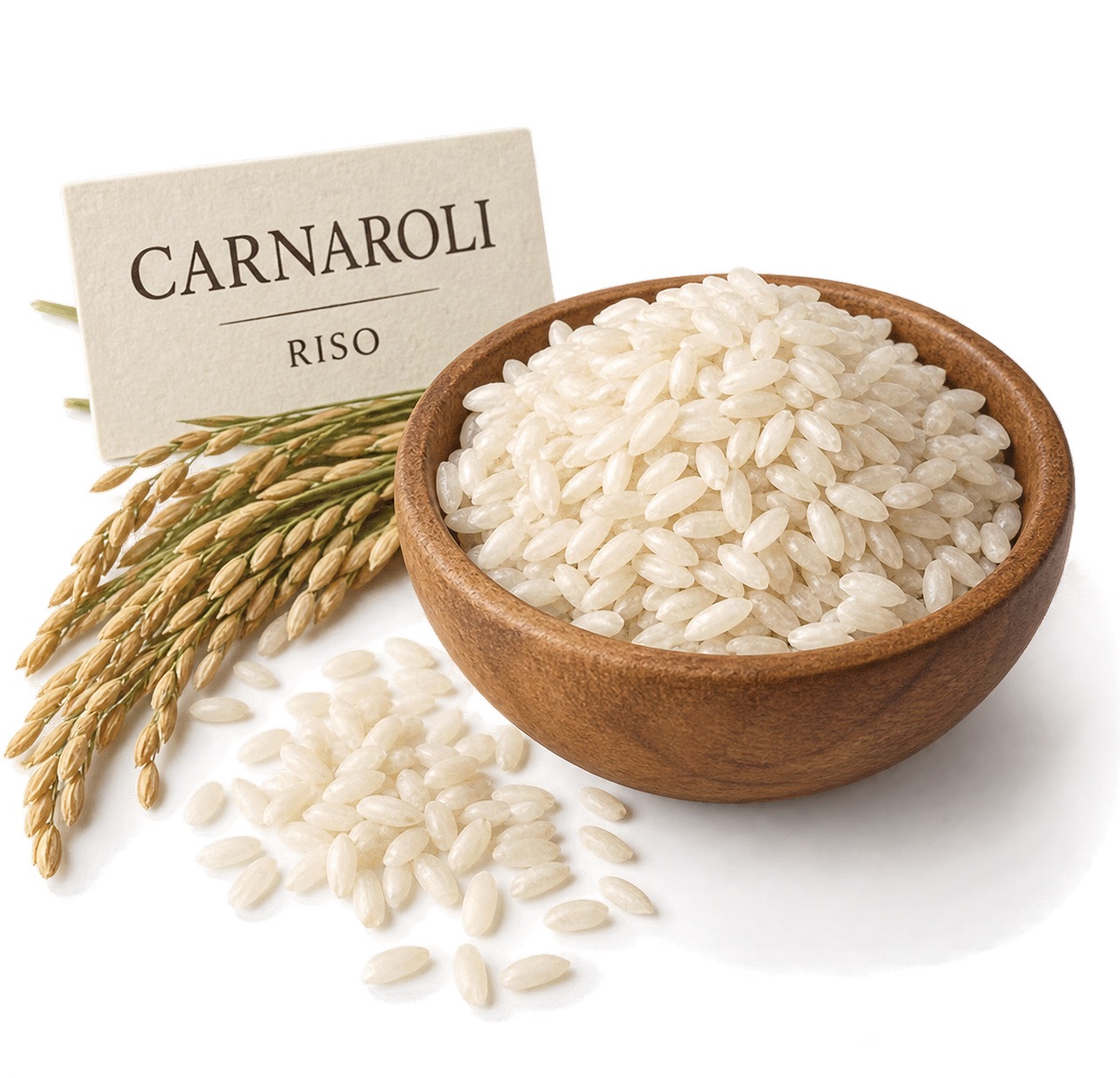
A professional guide to one of the world's essential grains: its long history, cultivation,
culinary families, Italian risotto varieties, aromatic Asian rices, California Calrose,
sushi rice, nutrition, harvest seasons, producing regions, and the practical ratios chefs
use to turn dry grain into a finished dish.
Most cultivated rice belongs to Oryza sativa, while Oryza glaberrima is an African
domesticated rice still cultivated on a smaller scale in West Africa. Rice may be long, medium or short
grain; aromatic or neutral; white, brown, parboiled or specialty milled. The correct choice is not simply
a matter of preference: starch behavior, grain shape, aroma and processing determine whether a rice stays
separate, becomes creamy, or develops the gentle cling needed for dishes such as sushi.
Botanical familyPoaceae · grass family. Principal cultivated species: Oryza sativa.
Major culinary formsLong grain, medium grain, short grain, aromatic, glutinous, brown, white and parboiled.
A grain shaped by water, migration and culinary culture
From ancient cultivation to a global staple
Rice has been cultivated for thousands of years and today supports food traditions across Asia,
Africa, Europe and the Americas. Its domestication and dispersal are complex, but Asian rice
(Oryza sativa) became the dominant cultivated species, while African rice
(Oryza glaberrima) developed as a separate West African domesticate.
Rice can grow in very different systems — irrigated paddies, rain-fed lowlands, upland fields and
flood-prone landscapes. The familiar flooded paddy is therefore one important cultivation system,
not the only way rice is grown.
In Italy, rice became deeply associated with the irrigated northern plains. Over centuries, water
management, milling, plant selection and regional cooking created the rice culture that eventually
gave the world risotto and celebrated varieties such as Carnaroli, Arborio and Vialone Nano.
Cultivation
How rice moves from field to grain
Exact practices depend on climate, variety and water system. This simplified professional overview
shows the common production sequence without implying that every rice-growing region uses permanent flooding.
Field preparationSoil is leveled or prepared so water, drainage and seed establishment can be controlled efficiently.
Seeding or transplantingRice may be direct-seeded or started as seedlings and transplanted, depending on local practice.
Water managementIrrigation or rainfall is managed through vegetative growth. Some systems use shallow flooding; others remain rain-fed or upland.
Flowering & grain fillPanicles emerge, flowers develop and the kernels fill with starch while farmers manage water and crop health.
Drain & harvestFields are commonly dried or drained before harvest so mature grain can be collected efficiently.
Drying & millingPaddy rice is dried, hulled and, for white rice, milled to remove bran layers before grading and packaging.
Variety Profiles
Eight rice identities chefs should understand
These profiles focus on practical kitchen behavior: grain structure, starch release, aroma, country or
region of production, cooking style and typical timing. Times are starting ranges and should be adjusted
for the producer, crop age, soaking, pot, heat source and desired texture.
Italy · Lombardy / Piedmont rice belt
Carnaroli
A prized Italian risotto rice with a long, firm grain and excellent cooking tolerance.
It absorbs flavor while holding structure, making it especially useful for restaurant service.
Family
Japonica · Italian long-A risotto type
Best use
Risotto, refined plated rice dishes
Texture
Creamy exterior, firm center
Timing
About 17–19 min for risotto
Liquid
Prepare about 3.5× rice weight in hot stock
Italy · Piedmont / Po Valley tradition
Arborio
Large, plump risotto rice known for generous starch release and an easily recognizable pearly center.
It creates a creamy result quickly but can move from al dente to soft faster than Carnaroli.
Family
Japonica · Italian long-A risotto type
Best use
Risotto, rice pudding, creamy preparations
Texture
Rich, creamy, tender
Timing
About 16–18 min
Liquid
Prepare about 3.5× rice weight in hot stock
Italy · Historical classification
Semifino
Semifino is a historical grain class, not an Arborio subtype.
Traditional Italian classifications placed Arborio and Carnaroli under superfino, while
Vialone Nano appeared in the semifino group. Modern legal commercial groupings are different.
Meaning
Historic Italian size/shape class
Example
Vialone Nano was historically classified semifino
Best use
Depends on the specific cultivar
Timing
Typically 14–17 min for risotto-style varieties
Liquid
About 3.0–3.3× rice weight as working stock
Italy · Verona, Veneto
Vialone Nano
A smaller, highly absorbent Japonica rice strongly associated with Verona. Riso Nano Vialone
Veronese has PGI protection and is celebrated for risotto because it takes on seasoning while
maintaining a distinct grain.
Family
Japonica · Vialone × Nano
Best use
Venetian-style risotto, seafood and vegetable risotti
Texture
Creamy, absorbent, compact grain
Timing
About 15–18 min
Liquid
Prepare about 3.2× rice weight in hot stock
India & Pakistan · Himalayan foothill regions
Basmati
Aromatic long-grain rice prized for slender kernels that elongate dramatically during cooking.
Properly cooked Basmati should remain light, fragrant and separate rather than creamy.
Family
Aromatic long grain
Best use
Biryani, pulao, pilaf, steamed rice
Texture
Fluffy, separate, elongated
Timing
12–15 min + resting
Water
Start around 1.5× rice weight after rinsing
Thailand · Hom Mali tradition
Jasmine / Hom Mali
Fragrant long-grain rice with a soft, gently clinging texture. Thai Hom Mali rice is known for
its characteristic aroma and is especially important in Thailand's food culture.
Family
Aromatic long grain
Best use
Thai curries, stir-fries, rice plates
Texture
Soft, fragrant, slightly clingy
Timing
12–15 min + resting
Water
Start around 1.35× rice weight after rinsing
United States · California
Calrose
A California-grown medium-grain Japonica type with a moist, tender and slightly sticky cooked
texture. It works very well for sushi, poke bowls, rice bowls and other dishes that benefit from
grains that cling without becoming a paste.
Family
Medium-grain Japonica
Best use
Sushi, poke, bowls, sides, some paella styles
Texture
Soft, moist, slightly sticky
Timing
About 18–20 min + resting
Water
Start around 1.25× rice weight after rinsing
Japan + global Japonica production
Sushi Rice
Sushi rice is a culinary category rather than one single cultivar. Short- or medium-grain
Japonica varieties such as Koshihikari and related types are cooked for a glossy, cohesive texture,
then seasoned with sushi vinegar while warm.
Family
Usually short- or medium-grain Japonica
Best use
Nigiri, maki, chirashi, onigiri
Texture
Glossy, cohesive, tender with spring
Timing
12–15 min + 10–15 min rest
Water
Start around 1.15× rice weight after rinsing/soaking
Italian classification note: the older terms comune/originario, semifino, fino and
superfino remain useful culinary vocabulary, but they should not be confused with a specific cultivar.
Arborio is not “semifino Arborio.” In the historic classification, Arborio and Carnaroli were listed as
superfino; Vialone Nano was listed as semifino.
Professional Tool
Rice Weight → Water / Stock Calculator
Enter the dry rice weight and choose the variety. The calculator returns a practical starting quantity
of water or stock plus timing and handling notes.
Carnaroli — Risotto
875 ml
Hot stock to have available
Ratio3.50 × rice weight
Cook time17–19 min
RestMantecatura off heat
Estimated portionsRecipe mode
Risotto ratio means stock to prepare and keep hot, not a command to add all liquid at once.
Add gradually and stop when the grain reaches the desired al dente texture.
Kitchen Reference
Quick cooking matrix
Rice
Method
Starting liquid by rice weight
Typical time
Rinse?
Primary goal
Carnaroli
Risotto
3.5× stock available
17–19 min
No
Creamy exterior, defined al dente core
Arborio
Risotto
3.5× stock available
16–18 min
No
Rich starch release and creamy body
Semifino-style
Risotto / absorption varies
3.0× stock available
14–17 min
Usually no for risotto
Match the exact cultivar
Vialone Nano
Risotto
3.2× stock available
15–18 min
No
High absorption, compact creamy grain
Basmati
Absorption
1.5× water
12–15 min + rest
Yes
Separate, elongated aromatic grains
Jasmine / Hom Mali
Absorption
1.35× water
12–15 min + rest
Yes
Soft fragrant grains with light cling
Calrose
Absorption
1.25× water
18–20 min + rest
Yes
Moist, tender, slightly sticky
Sushi rice
Absorption
1.15× water
12–15 min + rest
Yes, very well
Glossy cohesive grain for seasoning
Important: liquid ratios are operational starting points, not universal laws. Brand, crop age,
rinsing, soaking, elevation, pot diameter, lid seal, burner strength and desired final texture all change water
demand. For packaged rice, the producer's tested directions remain the best first calibration.
Nutrition
Cooked white rice: a useful reference point
Per 100 g cooked medium-grain white rice
130kcal
28.59 gcarbohydrate
2.38 gprotein
0.21 gfat
0.3 gfiber
68.61 gwater
How to read rice nutrition
Nutrition changes with variety, milling and enrichment. Brown rice retains the bran and germ,
generally providing more fiber and micronutrients than polished white rice. White rice is lower in fat,
easy to portion precisely, and its final calorie density changes according to how much water the grain absorbs.
The figures shown here are a reference for cooked medium-grain white rice. Use the nutrition label or
laboratory data for the exact product when calculating a restaurant recipe or nutrition panel.
Rice is naturally gluten-free as a grain, but kitchens must still control cross-contact when preparing
food for guests with medically required gluten avoidance.
Seasonality & Producing Regions
Rice is stored year-round, but harvest still has a season
Dried rice is available throughout the year because it stores well after proper drying and milling.
Agricultural seasonality, however, varies strongly by latitude, rainfall pattern, irrigation and cultivar.
🇮🇹 Northern ItalySpring field preparation and sowing; grain develops through summer; harvest commonly arrives in late summer into autumn. Key rice zones include Lombardy and Piedmont, with Vialone Nano strongly tied to Verona in Veneto.
🇺🇸 CaliforniaFields are prepared in late winter/early spring; seeding commonly occurs April–May; water is reduced as grain matures; harvest follows in the fall. Calrose is a major California rice identity.
🇮🇳 India / 🇵🇰 PakistanBasmati production is closely tied to the Himalayan foothill region and monsoon-season agriculture. Harvest timing varies by variety and local climate.
🇹🇭 ThailandTraditional Hom Mali production includes important rain-fed areas. In the Thung Kula Rong-Hai GI zone, light-sensitive aromatic rice is grown once yearly and harvested in the cool, rain-free season.
🇯🇵 Japan & Japonica regionsMany temperate Japonica systems follow spring establishment and autumn harvest, though production schedules differ by latitude and cultivar.
World Culinary Traditions
One grain, many culinary languages
🇮🇹
Italy
Risotto, supplì, arancini, timballi and rice salads. Northern Italian technique celebrates controlled starch release and al dente structure.
🇯🇵
Japan
Steamed gohan, sushi, onigiri and donburi rely on carefully washed Japonica rice with cohesion, sheen and clean flavor.
🇮🇳 🇵🇰
India & Pakistan
Basmati is central to biryani and pulao traditions, where fragrance, grain separation, spice layering and steam finishing are essential.
🇹🇭
Thailand
Jasmine rice accompanies curries, stir-fries and grilled foods, with aroma and soft texture forming part of the complete eating experience.
🇪🇸
Spain
Paella and other arroces rely on varieties chosen for absorption and the ability to carry saffron, stock and sofrito while preserving grain definition.
🇮🇷
Persian Cuisine
Polo, chelow and tahdig highlight long-grain rice, careful par-cooking, steaming and the prized crisp crust formed at the bottom of the pot.
🌍
West Africa
Rice traditions include jollof and many regional preparations in which tomato, pepper, stock, aromatics and local rice cultures create distinct identities.
🌎
Americas
Arroz con pollo, rice and beans, jambalaya, poke bowls and California sushi show how rice adapts to regional ingredients and migration histories.
Chef Guide
Selection, preparation and storage
Choosing the rice
Choose the grain for the finished texture, not simply by country.
For risotto, prioritize starch release plus enough internal structure to remain al dente.
For pilaf and biryani, prioritize separation and aroma.
For sushi, prioritize cohesive Japonica rice with a clean, slightly springy bite.
Rinsing & soaking
Rinse Basmati, Jasmine, Calrose and sushi-style rice until the water becomes much clearer.
Soaking can improve hydration consistency, especially for Basmati and sushi rice.
Traditional risotto rice is normally cooked without rinsing so the surface starch remains available.
Storage
Store dry white rice airtight, cool and dry, away from humidity, insects and strong odors.
Brown rice has a shorter practical storage window because the bran contains oils that can oxidize.
Rotate restaurant stock using clear receiving dates and FIFO discipline.
Which is better for risotto: Carnaroli or Arborio?
Both work. Carnaroli usually gives the cook a wider margin because the grain holds structure well, while Arborio releases starch readily and can become creamy quickly. The best choice depends on the dish, service style and chef preference.
Is Calrose basically sushi rice?
Calrose is a California-grown medium-grain Japonica rice and is widely used for sushi in the United States. But “sushi rice” is not one cultivar; it is a culinary category that includes several short- and medium-grain Japonica varieties.
Why should risotto rice usually not be rinsed?
Rinsing removes surface starch. In risotto that starch contributes to the creamy liquid that binds the dish. For that reason, chefs usually toast the dry rice directly rather than washing it first.
Why does the calculator show more stock for risotto than water for steamed rice?
Risotto stock is a working quantity kept hot beside the pan. It is added gradually and the exact absorbed amount changes with evaporation, pan width, heat and final texture. The calculator therefore estimates how much stock to have ready, not how much to pour in all at once.
Does rice have one global harvest season?
No. Rice is cultivated across tropical, subtropical and temperate regions, and some areas can grow more than one crop per year. The harvest window depends on climate, water system and cultivar.