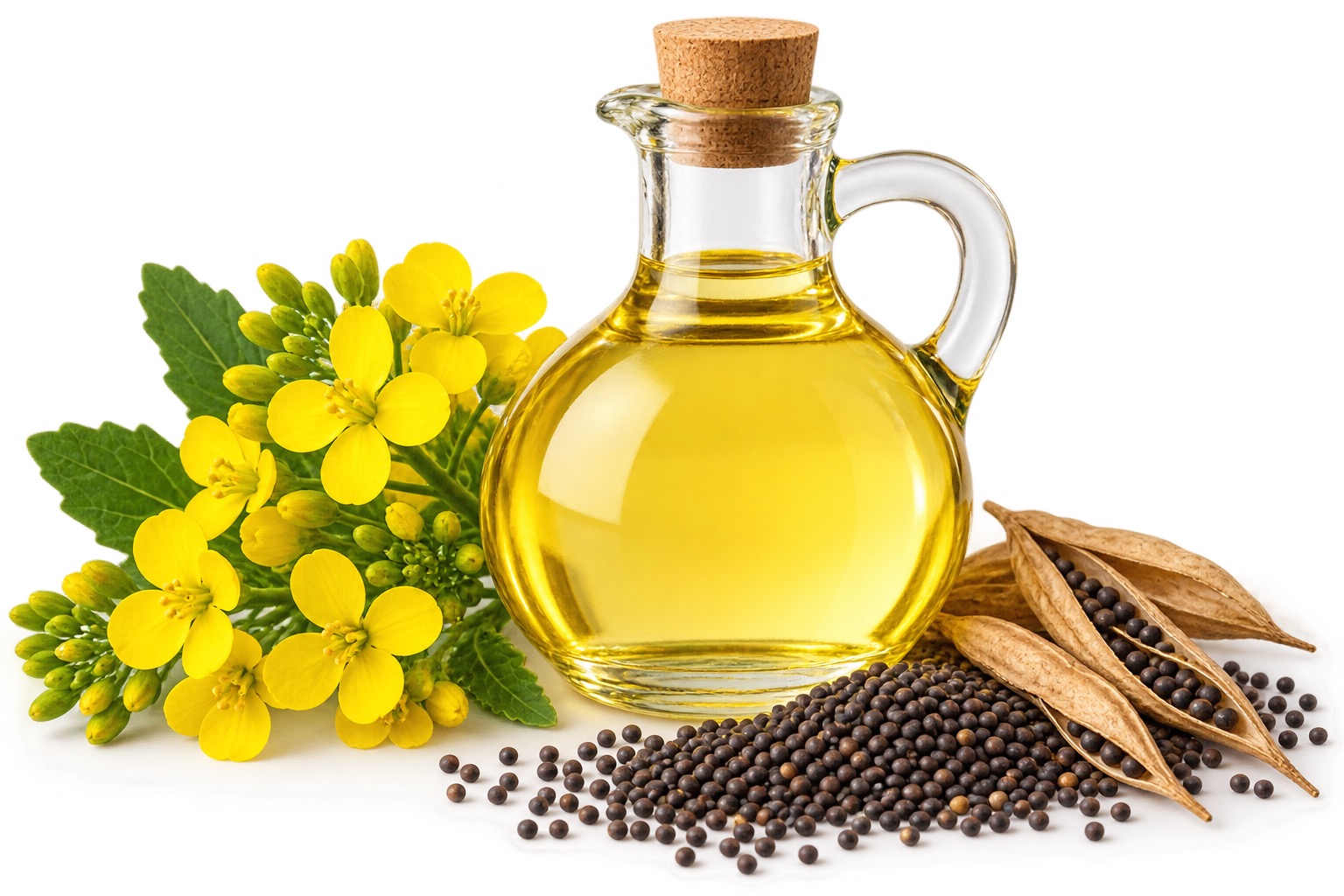
Ingredient Identity
Canola oil is a light, neutral-tasting edible oil pressed or extracted from canola-quality cultivars of rapeseed, primarily Brassica napus and Brassica rapa. The crop belongs to the Brassicaceae family, alongside mustard, cabbage, broccoli and Brussels sprouts.
History: From Rapeseed to Canola
Rapeseed has been cultivated for centuries in Europe and Asia. Commercial production expanded in Canada during the twentieth century, including wartime demand for industrial lubricants. Canadian plant breeders later selected varieties with much lower erucic acid in the oil and lower glucosinolate levels in the meal. By the 1970s, these “double-low” types formed the crop now recognized as canola, and the name canola was officially adopted in 1977.
What makes canola different?
Canola is not simply a marketing name for any rapeseed oil. Canola-quality material is distinguished by low erucic acid and low glucosinolate levels. The Canola Council describes the modern crop as the result of conventional selective breeding conducted before modern biotechnology became available.
Cultivation & Agronomy
Plant
Canola is a cool-season broadleaf oilseed. Plants develop yellow cruciform flowers followed by slender pods containing small dark seeds.
Climate
It performs especially well in temperate growing regions. Large commercial production is associated with the Canadian Prairies, Europe, China, India, Australia and other cool-to-moderate agricultural zones.
Harvest
Seeds are harvested when pods and seed moisture reach suitable maturity. Depending on production system, crops may be swathed before combining or harvested directly.
Seed Composition
Canola seed contains roughly 45% oil according to the Canola Council, making it an efficient commercial oilseed.
Rotation Value
As a broadleaf crop, canola can diversify cereal-heavy rotations, although disease, weeds, insects and volunteer canola still require careful agronomic management.
Modern Varieties
Both GM and non-GM canola varieties are grown. Traits may include herbicide tolerance, higher oleic acid profiles, disease resistance and improved yield stability.
Major Producing Regions
International agricultural databases commonly report rapeseed rather than separating every crop into “canola” and non-canola categories. The table below therefore uses USDA rapeseed production shares as a practical global market proxy.
| Producer / Region | Approx. share of world rapeseed production, 2025 | Context |
|---|---|---|
| Canada | 22.0% | Major canola producer and the world's largest rapeseed exporter in the USDA 2025 profile. |
| European Union | 21.6% | Large rapeseed-growing bloc; France, Germany and Poland are important producers. |
| China | 17.5% | Large domestic rapeseed producer and crusher. |
| India | 13.2% | Major rapeseed-mustard producer and edible-oil market. |
| Australia | 7.0% | Important export-oriented canola/rapeseed producer. |
| Russia | 6.0% | Growing rapeseed producer and regional supplier. |
Production shares are a 2025 USDA rapeseed dataset and should not be interpreted as a strict botanical or legal breakdown of “canola” alone.
How Canola Oil Is Made
After cleaning, seeds are conditioned, flaked and crushed. Commercial plants may heat the flakes and use mechanical pressing followed by solvent-assisted extraction to recover more oil. The crude oil is then refined to remove impurities, pigments, odors and unstable compounds. Cold-pressed canola oils are also produced, but they have a different flavor profile and may behave differently under heat.
Processing sequence
- Seed cleaning
- Conditioning and flaking
- Mechanical pressing / crushing
- Optional solvent-assisted extraction
- Degumming and refining
- Filtration / pigment removal
- Deodorization
- Bottling and storage
Nutrition Profile
Canola oil is particularly low in saturated fat compared with many commonly used culinary oils.
Oleic acid is a major fatty acid in standard canola oil and is even higher in high-oleic cultivars.
Canola oil contains alpha-linolenic acid, the essential plant-based omega-3 fatty acid.
Like all pure culinary oils, canola oil is essentially fat and is energy-dense. It naturally contains no carbohydrate or protein. The Canola Council also identifies canola oil as a source of vitamins E and K and plant sterols. Nutrition values vary slightly by product and serving size, so packaged-label data should be used for precise menu nutrition calculations.
Professional Culinary Uses
Deep Frying
Its neutral flavor and high smoke point make refined canola oil useful for fryers, breaded foods, potatoes, seafood and offal preparations.
Sautéing & Searing
Useful when the chef wants heat tolerance without a strong oil flavor competing with delicate ingredients.
Roasting
Works well on vegetables, proteins and sheet-pan preparations where an even coating and neutral profile are desired.
Dressings
Because refined canola remains fluid when chilled, it is practical for vinaigrettes, marinades and emulsified sauces.
Baking
Provides moisture in cakes, muffins and quick breads without introducing a strong flavor. It can replace some solid fats in formulas where creaming is not structurally required.
Mayonnaise & Emulsions
Its pale color and mild flavor make it a versatile base for mayonnaise, aioli-style sauces and herb oils.
Heat Performance
The Canola Council lists a smoke point of approximately 468°F / 242°C for regular refined canola oil and about 475°F / 246°C for high-oleic canola oil. In practice, oil quality, age, repeated fryer cycles, contamination, free-fatty-acid buildup and equipment condition all affect real kitchen performance.
Chef practice
- Filter fryer oil routinely.
- Avoid prolonged exposure to excess heat.
- Do not mix fresh oil with badly degraded oil.
- Discard oil with rancid odor, excessive foaming, darkening or abnormal smoke.
- Follow the operation's validated fryer-oil replacement program.
Storage & Quality
Keep canola oil tightly sealed in a cool, dark place away from ovens, direct sunlight and moisture. The Canola Council gives an approximate room-temperature shelf life of about one year for refined canola oil. High-volume kitchens should date containers and rotate stock by FIFO.
Signs of deterioration
- Paint-like or stale odor
- Unusually bitter or rancid flavor
- Darkened fryer oil
- Excessive foaming
- Smoking at abnormally low temperature
Allergy & Dietary Considerations
Canola is not one of the nine major food allergens recognized under U.S. federal law. However, any food can potentially trigger an individual hypersensitivity, and specialty or flavored oils may contain other allergenic ingredients. Refined oils contain very little residual protein, but kitchens serving guests with diagnosed allergies should still review the actual manufacturer label, cross-contact controls and medical guidance rather than assuming every canola product is equivalent.
Canola vs. Other Kitchen Oils
| Oil | Flavor | Typical best use | Operational note |
|---|---|---|---|
| Canola | Neutral | Frying, sautéing, baking, dressings | Versatile general-purpose oil |
| Extra Virgin Olive Oil | Fruity / peppery | Finishing, dressings, moderate-heat cooking | Chosen for flavor as much as fat function |
| High-Oleic Canola | Very neutral | Commercial frying, high-heat cooking | Higher oxidative stability |
| Peanut Oil | Mild / nutty | High-heat frying | Peanut is a major allergen |
Frequently Asked Questions
Is canola oil the same thing as rapeseed oil?
Canola was bred from rapeseed, but the canola designation refers to low-erucic, low-glucosinolate material. International statistics often group canola under rapeseed, which is why production data should be interpreted carefully.
Can canola oil be used for deep frying?
Yes. Refined canola oil's neutral flavor and high smoke point make it widely used for deep frying, sautéing and other high-heat applications.
Is canola oil genetically modified?
Canola itself was developed using conventional plant breeding. Today both genetically modified and non-GM canola varieties are commercially grown.
Does canola oil contain trans fat?
Standard retail canola oil is marketed as trans-fat-free. Its predominant fatty acids are unsaturated.
How long does canola oil keep?
Refined canola oil is commonly stored at room temperature for about one year when protected from heat and light, although the manufacturer's best-by guidance should always take precedence.
Reference Sources
Research notes for this educational ingredient page were checked against current industry and U.S. government references.
Canola Council of Canada — Canola history Canola Council of Canada — Canola oil facts, processing and culinary qualities USDA Foreign Agricultural Service — 2025 rapeseed production and export profile U.S. FDA — Major food allergens