Brown algae
Alginate occurs naturally in brown seaweed cell walls, where alginic acid is present as calcium, magnesium, sodium and other alginate salts.
Functional pantry · Hydrocolloids · Molecular gastronomy
A water-soluble hydrocolloid obtained from alginic acid found naturally in the cell walls of brown seaweeds. In professional kitchens it is valued for thickening and stabilization, and especially for creating calcium-cross-linked gels in modern spherification techniques.

/academy/ibrary/pantry/hydrocolloids/sodiumalginate.png
What it is
Sodium alginate is the sodium salt of alginic acid, a natural polysaccharide present in the cell walls of brown algae. FDA regulations identify it as a natural polyuronide constituent of certain brown algae, while JECFA lists it internationally as INS 401. The material is a long-chain carbohydrate polymer rather than a simple salt or starch.
/academy/ibrary/pantry/hydrocolloids/Sodium.html is therefore the right permanent library home.
Alginate occurs naturally in brown seaweed cell walls, where alginic acid is present as calcium, magnesium, sodium and other alginate salts.
Alginate is built from mannuronic-acid and guluronic-acid residues arranged in blocks. Their ratio and sequence influence viscosity, flexibility and the character of calcium-set gels.
JECFA identifies sodium alginate as INS 401; European food-additive terminology commonly identifies the same ingredient as E401.
Origin and history
Brown seaweeds have been used for centuries, but the alginate industry began with nineteenth-century chemical study. E. C. C. Stanford discovered algin in 1881 while extracting brown seaweed with alkali. Commercial alginate production later developed in the United States and United Kingdom during the early twentieth century.
Coastal cultures used brown seaweeds long before alginate was isolated as a distinct functional polysaccharide.
E. C. C. Stanford obtained a viscous material by alkaline extraction of brown seaweed and named the material “algin.”
Commercial alginate industries developed in the United States and United Kingdom and later expanded to other seaweed-producing regions.
Chefs now use food-grade alginate for controlled viscosity, stabilization, films, gels and molecular-gastronomy spherification.
How sodium alginate is obtained
The aim of industrial processing is to convert the alginate naturally bound in brown seaweed into a purified, water-soluble sodium alginate. FAO processing references describe two principal recovery routes: an alginic-acid route and a calcium-alginate route.
Brown seaweed is cleaned to remove sand, salts, shells and other marine material, then rehydrated or prepared for extraction.
Many processes use dilute acid to convert insoluble mineral alginates and reduce compounds that can darken or degrade the extract.
Sodium carbonate is commonly used to convert alginate into soluble sodium alginate so it can be extracted into water.
The viscous extract is diluted, clarified and filtered to remove insoluble seaweed material.
The purified solution is precipitated either as alginic acid or calcium alginate; the recovered material is then converted back to sodium alginate.
The purified sodium alginate is dried, milled and standardized to the required particle size and viscosity specification.
Culinary science
Sodium alginate dissolves in water to form a viscous hydrocolloid solution. When calcium ions reach the alginate chains, they replace sodium at binding sites and cross-link the polymer. The result is a water-insoluble calcium-alginate network that can form a membrane, gel or structured matrix.
Alginate is blended into the flavored liquid. Portions are dropped into a calcium bath. Calcium diffuses inward, so gelation continues over time and the center can eventually become more set.
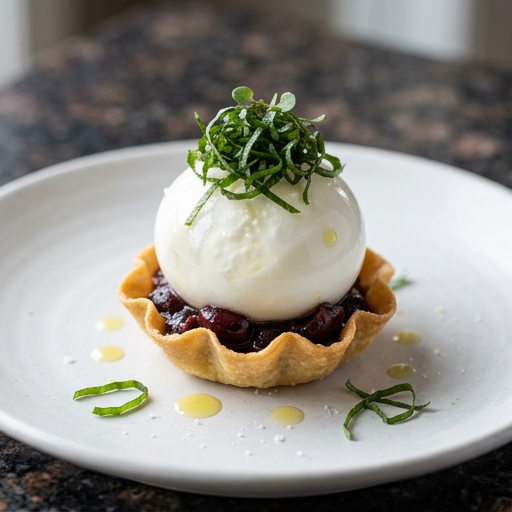
Calcium lactate is placed in the burrata base while sodium alginate is used in the bath. A membrane forms around the calcium-containing center, an excellent method for dairy and other calcium-rich preparations.
Alginate needs thorough dispersion and hydration. Resting the bath allows trapped air to escape, producing cleaner surfaces and more consistent sphere formation.
Professional culinary uses
FDA regulations recognize sodium alginate for technical functions that include thickening, stabilization, texturizing, firming, emulsifying and formulation assistance in specified food categories. In chef applications, its behavior is especially useful when water management and calcium-triggered gelation are required.
Use alginate with a controlled calcium source to create thin membranes around juices, sauces, purées, dairy preparations and other flavored liquids.
Hydrated alginate increases viscosity in water-based systems. Performance depends on concentration, grade, shear, temperature, mineral content and formulation.
Alginate can help keep dispersed particles suspended and support more consistent texture in sauces, fillings, dressings and selected processed foods.
Because calcium cross-links alginate, chefs and food manufacturers can produce films, gels and restructured foods without relying on gelatin.
Once alginate is properly dispersed and hydrated, calcium-triggered gelation can occur at cool kitchen temperatures—useful for flavor-sensitive modernist preparations.
Sodium alginate is plant/algae derived rather than animal gelatin. Finished recipe dietary status still depends on every other ingredient in the formulation.
Hydrocolloid comparison
They may all influence texture, but they should never be treated as interchangeable ingredients in a professional recipe system.
| Ingredient | Typical source | Primary culinary behavior | Gel trigger | Tuscany Cuisine use |
|---|---|---|---|---|
| Sodium Alginate | Brown seaweed | Thickening, stabilization and calcium-reactive gelling. | Calcium ions | Reverse spherification bath for Molecular Burrata. |
| Agar | Red algae | Forms firm, brittle, heat-reversible gels. | Heat to dissolve, cooling to set | Separate future hydrocolloid identity. |
| Carrageenan | Red seaweed | Thickening and gelling; behavior varies by kappa, iota and lambda type. | Type-dependent; influenced by ions and cooling | Separate future hydrocolloid identity. |
| Potato Starch | Potato tuber | Starch gelatinization, thickening and crisp-coating functions. | Heat and water | STARCH-POTATO-0001 |
Purchasing, receiving and storage
Consistent modernist cooking depends on using the same food-grade material, measuring accurately and controlling hydration.
Specify food-grade sodium alginate and retain the supplier specification, viscosity grade, lot number and package identity.
Confirm product name, food-grade status, intact seal, lot information and the absence of moisture damage before accepting stock.
Store tightly sealed in a clean, cool, dry pantry. Protect from humidity because hydrocolloid powders can clump and hydrate prematurely.
Use an accurate gram scale. Small changes in hydrocolloid percentage can noticeably alter viscosity, membrane strength and mouthfeel.
Add gradually under good shear to reduce clumping. Follow the recipe and supplier guidance for hydration time and concentration.
High calcium in water or ingredients can start cross-linking prematurely. Reverse spherification keeps the alginate bath separate from the calcium-rich flavored center until shaping.
Tuscany Cuisine platform record
The current Tuscany Cuisine inventory identity is sodium_alginate. This page activates the dedicated hydrocolloid icon and learning record without inventing a conflicting permanent Master Ingredient Registry code.
Hydrocolloid · Inventory · Recipe · Purchasing · Receiving
/academy/ibrary/pantry/hydrocolloids/sodiumalginate.png
Inventory: sodium_alginate
Registry code: formal assignment pending
Recipe 169 can display this icon and link to this hydrocolloid record while preserving its 4 g base quantity and serving scaling.
Sodium alginate remains part of the Antipasti Station molecular-preparation pick list whenever the Molecular Burrata recipe is scheduled.
The stable inventory key sodium_alginate can connect stock, purchasing, receiving and future vendor records to one ingredient identity.
Technical references
The culinary interpretation above is grounded in authoritative food-regulation and alginate-production references.
Defines sodium alginate as the sodium salt of alginic acid from certain brown algae and identifies permitted food functions.
International identity, chemical formula, CAS number and food-additive specification.
Explains extraction from brown seaweed, alginic-acid and calcium-alginate recovery routes, conversion to sodium alginate, drying and milling.
Detailed discussion of acid pretreatment, sodium-carbonate extraction, precipitation and viscosity control.
Records Stanford’s 1881 discovery of algin and describes the development of commercial alginate production.
Provides chemical identity, CAS information and the polymer formula (C6H7NaO6)n.