Refined granulated sugar
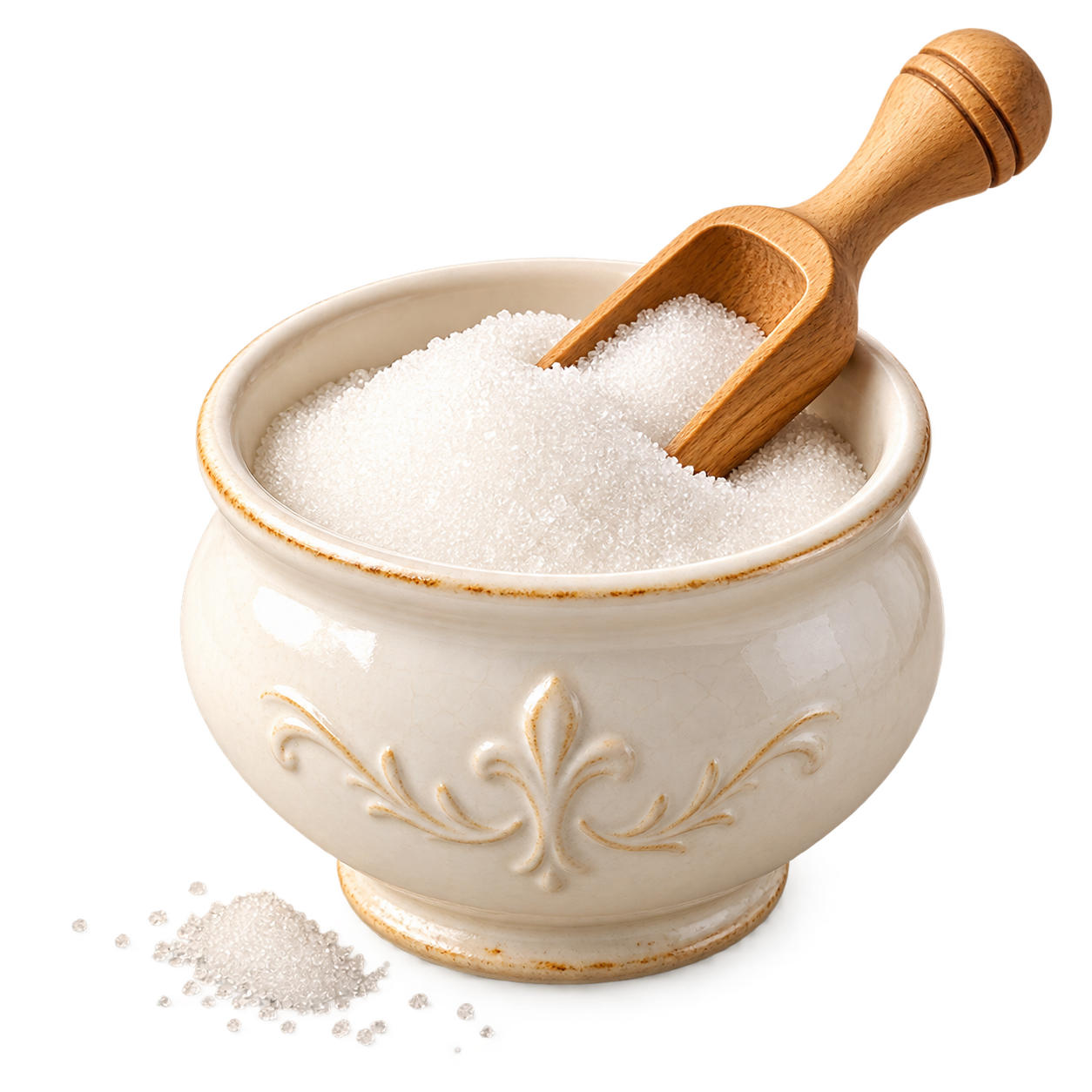
Dry, free-flowing crystalline sucrose used for baking, pastry, syrups, caramel, frozen desserts and curing. This is the only form represented by sugar.png.
From cane stalk or beet root to a refined crystal: study extraction, clarification, crystallization, refining, sugar quality, culinary types and the functions that control pastry, caramel, frozen desserts, preserving and savory cures.
 Active ingredient icon
The active Tuscany Cuisine record is refined granulated sugar measured by dry net weight. Related sugars are explained here, but different particle size, moisture, molasses or syrup content can require a separate recipe and inventory identity.
Dry, free-flowing crystalline sucrose used for baking, pastry, syrups, caramel, frozen desserts and curing. This is the only form represented by sugar.png.
Powdered, pearl, sanding, nib and rock sugars behave differently because particle size, surface area and additives change dissolution, texture and presentation.
Do not deduct as granulated sugarRepresented by canna.jpeg, this separate card identifies brown sugar extracted from sugarcane. The graphic shows the brown crystal together with sugarcane so readers can immediately distinguish it from refined white sugar and from beet-derived sugar. Its molasses character gives more color, aroma and moisture while preserving the historical cane-sugar lineage that shaped early sugar civilization.
Invert sugar, glucose syrup, corn syrup and other liquid sweeteners have different solids, water, sweetness, crystallization control and freezing behavior.
Own yield and concentration requiredSugar is not only sweetness. In a professional formula it controls structure, tenderness, moisture, color, aroma, aeration, freezing, boiling concentration and preservation. Removing sugar without rebuilding those functions creates a different recipe.
Travel through sugar's ancient origins, global trade, human cost, industrial transformation, health impact and purposeful use in the professional kitchen.
Created and narrated by Chef David Giani for the Tuscany Cuisine Culinary Academy and Ingredient Library.
Sugar moved from a cultivated grass and regional luxury to a global commodity. That journey includes agricultural invention and culinary exchange, but also conquest, plantation economies, enslavement, forced labor and industrial transformation.
Sugarcane was domesticated in the New Guinea region and spread through island Southeast Asia toward India. Early users chewed the cane; South Asian processors developed methods for extracting juice and producing concentrated and crystalline sugars.
Processing knowledge passed through Persia and the Islamic world. Cane cultivation and sugar making reached Egypt, North Africa, Iberia, Cyprus, Crete and Sicily, where irrigation, milling and boiling supported Mediterranean production.
For centuries in Europe sugar was costly and used in medicine, confectionery, preserves and elite kitchens. Trade, refining and expanding production gradually changed it from a rare seasoning into a more familiar food ingredient.
European demand drove cane plantations from Atlantic islands into Brazil, the Caribbean and the Americas. Their wealth depended heavily on the brutal exploitation of enslaved Africans, Indigenous people and later indentured laborers.
European chemists identified sucrose in beets, and commercial beet processing expanded during the Napoleonic era when maritime conflict restricted cane supplies. Breeding and industrial improvements made the beet a major temperate sugar crop.
Modern mills and refineries use controlled clarification, evaporation, vacuum crystallization, centrifugation, drying and quality testing. Cane and beet now supply most of the world's commercial sucrose.
The plants and first extraction steps differ, but both production systems isolate, concentrate and crystallize sucrose. Once highly refined, source may have little effect in ordinary cooking; less-refined products preserve more source character.
Fresh cane is cleaned, prepared, shredded or crushed and passed through roller mills. Water or recycled juice can improve extraction. The fibrous residue, bagasse, is commonly used as boiler fuel or for other products.
Washed beets are sliced into thin cossettes. Hot water draws sucrose from the plant tissue in a diffuser. Pressed pulp remains as a co-product, while the raw juice moves to purification.
Clarification removes suspended and dissolved impurities; evaporation concentrates the juice; controlled supersaturation forms crystals; centrifuges separate crystal from mother liquor; drying stabilizes the finished sugar.
| Comparison | Sugarcane | Sugar beet | Chef's meaning |
|---|---|---|---|
| Plant part | Fibrous grass stalk | Fleshy storage root | The first extraction equipment is different. |
| Harvest handling | Process quickly because cut cane loses quality | Can be stored for a limited campaign under controlled conditions | Freshness and factory timing affect raw material quality. |
| Extraction | Crushing and multiple roller mills, sometimes diffusion | Slicing and counter-current hot-water diffusion | Both aim to move sucrose into juice with minimal loss. |
| Primary residue | Bagasse fiber | Pressed beet pulp | Co-products affect the environmental and economic system. |
| Less-refined flavor | Cane molasses can contribute caramel, mineral and vegetal notes | Beet molasses has a distinct profile and is normally separated from consumer white sugar | Do not assume raw or brown products are interchangeable. |
| Refined white sugar | Predominantly purified crystalline sucrose | Buy by specification: purity, color, crystal size, moisture and performance. | |
canna.jpeg card represents sugar extracted from cane. It is intentionally not a beet icon. The visual identity follows the historical cane tradition that predates modern beet-sugar industrial production.Industrial details vary by mill and region. This simplified flow shows the central purpose of each stage without turning different technologies into one rigid formula.
Heat, lime and controlled chemistry help neutralize acids and form solids that can settle, float or filter away. Beet purification commonly uses liming and carbonation with carbon dioxide.
A series of evaporators reuses steam energy while water is removed. Concentrated juice becomes thick enough for final vacuum-pan boiling.
Under vacuum, syrup can boil at lower temperature. Once the concentration reaches the controlled supersaturation zone, seed crystals guide uniform crystal growth.
The mixture of crystals and mother liquor, called massecuite, spins in a basket. Liquor passes outward while crystals remain, are washed as specified and move to drying.
Remaining liquor can be reboiled to recover additional crystals. Each recovery leaves a darker, less pure molasses stream with different value and uses.
Warm air removes surface moisture, cooling prevents caking and screens classify crystal size. The finished grade moves to conditioning, storage and packaging.
A cane refinery removes the molasses film and soluble color from raw sugar, then recrystallizes a high-purity liquor. Beet factories often produce white sugar directly through their own purification sequence.
| Refinery stage | What happens | Quality purpose | Kitchen connection |
|---|---|---|---|
| Affination | Raw crystals are mingled and washed with concentrated syrup, then centrifuged. | Loosens and removes the outer molasses film. | Reduces color and source flavor before remelting. |
| Melting | Washed crystals dissolve into hot high-purity liquor. | Creates a uniform liquid that can be clarified and filtered. | Particle identity is reset before new crystals form. |
| Clarification | Phosphatation, carbonation, filtration or other approved systems remove suspended impurities. | Improves purity, clarity and process control. | Clean flavor and consistent color begin with clean liquor. |
| Decolorization | Adsorbents or ion-exchange systems remove soluble color bodies. | Produces a lighter liquor for white sugar. | Color matters in white fondant, meringue, syrup and delicate pastry. |
| Evaporation & crystallization | Water is removed under vacuum and controlled seed crystals grow. | Sets purity, crystal size and recovery. | Crystal grade influences dissolving, creaming and finishing. |
| Washing, drying & grading | Centrifuged crystals are washed, dried, cooled and screened. | Controls moisture, color, flow and particle distribution. | Uniform dry crystals scale and perform predictably. |
Sucrose content alone does not make two sugars equivalent. Crystal size, moisture, molasses, invert sugar, starch, color and water content determine how each product dissolves, aerates, browns and feels.
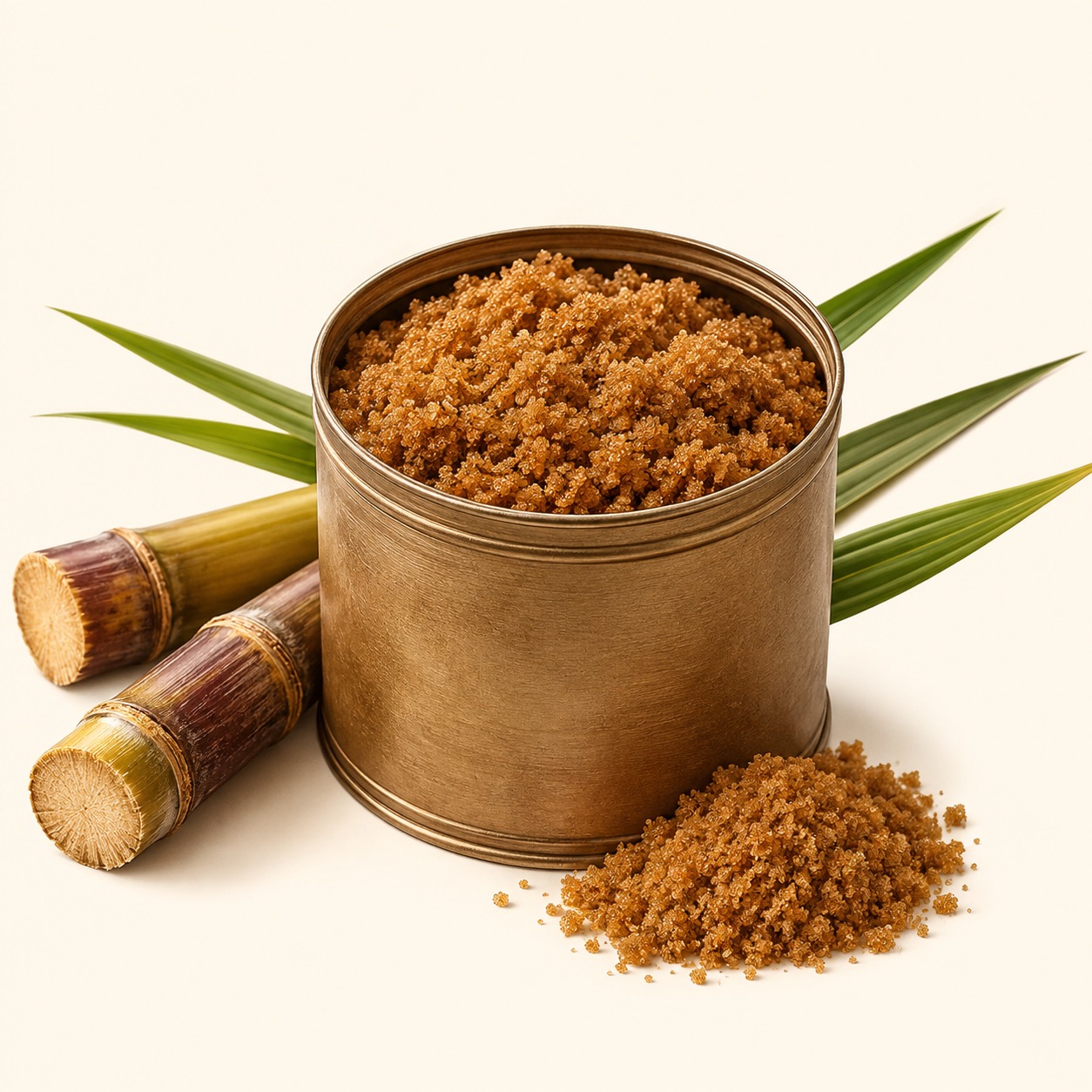
This card uses canna.jpeg and represents brown sugar extracted from cane.
The image is meant to help readers immediately distinguish brown cane sugar from the white
granulated sugar icon and from beet-based sugar references.
Brown cane sugar brings molasses flavor, amber-brown color and more moisture. White granulated sugar is drier, more neutral and is still the main active sugar record in the Tuscany Cuisine system.
Reader note: brown cane sugar is not dramatically healthier than white sugar. The main difference is flavor, moisture, color and small trace-mineral content, not a major change in calories.
| Sugar type | Defining character | Best culinary uses | Substitution caution |
|---|---|---|---|
| Granulated white Active icon | Dry, neutral, free-flowing medium crystals of refined sucrose | General baking, custards, syrups, caramel, preserves, beverages, frozen desserts and curing | Authoritative Tuscany Cuisine record; measure by weight. |
| Fine / caster | Smaller crystal than regular granulated; dissolves faster | Meringue, sponge cake, cocktails, delicate custard and cold mixing | May be approved by weight only when the recipe tolerates the faster dissolving rate and the vendor grade matches. |
| Superfine / baker's special | Very small controlled crystal for rapid dispersion | Commercial baking, fine-textured cakes, whipped foams and dry mixes | Can alter creaming aeration and dough spread; test the formula. |
| Powdered / icing | Pulverized white sugar; may contain starch or another anticaking agent | Icings, glazes, dusting, short doughs, buttercream and decorations | Never replace granulated sugar by equal volume; starch and surface area change structure. |
| Light brown cane sugar Brown cane icon | Soft, moist sugar derived from cane with a lighter molasses profile | Cookies, cakes, sauces, glazes, barbecue, chutney, vinaigrettes, savory cures and caramel notes | Additional moisture and invert sugar affect spread, softness and keeping quality; keep separate from white granulated sugar. |
| Dark brown cane sugar | More molasses flavor, color and moisture in a cane-based sugar | Gingerbread, fruitcake, baked beans, dark sauces, braises and robust desserts | Deeper color and flavor; stronger effect on acidity, moisture retention and hygroscopicity. |
| Muscovado | Moist, strongly aromatic less-refined cane sugar with pronounced molasses character | Chocolate, coffee, spice cakes, sauces, marinades, rum desserts and dark caramel profiles | Flavor and moisture are not equivalent to ordinary brown sugar. |
| Demerara | Large amber crystals with a light cane/molasses character | Hot beverages, crunchy toppings, brûléed fruit and finishing | Large crystals dissolve slowly and can remain textural. |
| Turbinado / raw-style cane | Partially refined, centrifuged golden crystal with surface molasses | Toppings, beverages, baking accents, barbecue rubs and some cures | Not the same as brown sugar or granulated white; confirm the recipe's intended flavor and weight. |
| Pearl / nib sugar | Large compressed or formed white pieces designed to resist melting | Brioche, waffles, choux, buns and visible bakery garnish | Structural garnish, not a general sweetening replacement. |
| Sanding sugar | Coarse decorative crystals, sometimes colored | Cookie, pastry and confectionery finish | Appearance and crunch are the purpose; colors and coatings require label review. |
| Panela, jaggery and whole-cane sugars | Concentrated cane juice products with mineral, caramel and vegetal notes; form and process vary | Regional sweets, beverages, sauces, spice pastes and savory glazes | Composition, water, flavor and color vary widely; purchase by exact tradition and specification. |
| Invert sugar | Sucrose split into glucose and fructose; usually supplied as syrup or paste | Ganache, fondant, confectionery, ice cream, sorbet and moisture retention | Sweeter, more hygroscopic and more crystallization-resistant than sucrose. |
| Glucose / dextrose | Different sugar chemistry and relative sweetness; dry or syrup forms | Confectionery control, frozen desserts, glazing and texture management | Solids and water must be calculated; do not exchange one-for-one without reformulation. |
Codex describes white sugar as purified, crystallized sucrose with polarization of at least 99.7 °Z. Professional purchasing goes further by defining color, moisture, ash, crystal distribution, flow, flavor, pack and the intended culinary process.
| Checkpoint | Accept | Reject or flag | Record |
|---|---|---|---|
| Identity | Approved granulated grade and source declaration when required | Powdered, brown, raw or specialty sugar substituted without approval | Ingredient code, vendor SKU, grade, source |
| Crystal | Reasonably uniform particle distribution for the specification | Excess fines, oversized crystals or inconsistent lots that change process time | Screen/particle grade and culinary application |
| Color & purity | White to the contracted ICUMSA or supplier color specification | Unexpected yellowing, gray cast, specks or foreign material | Certificate of analysis when required |
| Moisture & flow | Dry, free-flowing crystals with only light breakable compaction | Wetness, severe hard caking, condensation or leaking packaging | Condition, humidity exposure, damage |
| Aroma & taste | Clean neutral sweetness without foreign odor | Musty, chemical, smoky, perfumed, fermented or pest-related notes | Sensory check and affected lot |
| Packaging | Intact food-grade bag or container, correct net weight, lot and label | Torn, damp, contaminated, infested or untraceable package | Lot, date, quantity, temperature/condition |
| Certification claims | Organic, fair-trade, geographic or sustainability claim verified on current documentation | Unverified marketing language or claim transferred from another SKU | Certificate, scope, expiry and vendor |
A formula works because sugar interacts with water, proteins, starches, fats, air and heat. Understanding those interactions allows controlled reduction, substitution and scaling.
Sucrose moderates bitterness, acidity, salt and roast flavors. The correct amount depends on temperature, serving context and other sweeteners.
Sugar competes for water and can delay gluten development and starch gelatinization, creating a more tender crumb when the formula is balanced.
Hygroscopic sugars bind water and influence softness, staling and shelf life. Brown and invert sugars retain moisture differently from dry sucrose.
Granulated crystals cut into plastic fat during creaming, helping create air cells. Crystal size, fat temperature and mixing time control the result.
Added gradually, dissolved sugar thickens the liquid phase around egg-white bubbles and slows drainage, supporting meringue structure while also slowing whipping.
Caramelization is thermal decomposition of sugars. Maillard browning is a separate reaction between reducing sugars and amino compounds; both create color and aroma through different chemistry.
Supersaturation, agitation, seed crystals, interfering ingredients and cooling rate determine whether a syrup becomes smooth fondant, clear caramel or grainy candy.
Dissolved sugars lower the freezing point and control the amount of unfrozen water. Ice cream and sorbet require a calculated balance of sweetness and texture.
At sufficiently high concentration, sugar reduces water activity and supports preservation in jam, candied fruit and syrups. A casual addition of sugar is not a validated safety process.
When decreasing sugar, check sweetness, total solids, water availability, batter viscosity, spread, browning, set temperature, frozen texture and shelf life. A successful lower-sugar formula often needs several coordinated adjustments.
The following matrix focuses on why sugar is present. It is a planning guide, not permission to substitute forms without recipe testing.
| Application | Useful sugar form | Main function | Control point |
|---|---|---|---|
| Cakes & muffins | Granulated, fine/caster, brown or powdered according to formula | Sweetness, tenderness, aeration, moisture and color | Weigh accurately; crystal size and mixing method affect crumb. |
| Cookies | Granulated for crispness/spread; brown for moisture and chew; powdered for short delicate texture | Spread, snap, chew, color and shelf texture | Changing the granulated-to-brown ratio changes water and invert sugar. |
| Meringue & foam | Fine/caster or controlled granulated; syrup for Italian meringue | Foam stability, gloss and structure | Add at the right rate; dissolve crystals; control syrup temperature. |
| Custard & pastry cream | Granulated or fine/caster | Sweetness, protein coagulation control and mouthfeel | Whisk without incorporating unnecessary air; account for added water from syrups. |
| Caramel & spun sugar | Clean granulated sugar; glucose/invert sugar when formula requires crystallization control | Color, flavor and glass structure | Use clean equipment; manage seed crystals, heat and humidity. |
| Confectionery | Sucrose combined with glucose, invert sugar or other controlled solids | Crystal size, chew, glass transition and shelf stability | Temperature, solids and agitation must match the target candy. |
| Ice cream & sorbet | Sucrose blended with dextrose, invert sugar or glucose as calculated | Sweetness, freezing point, scoopability and body | Balance total sugar solids instead of judging sweetness alone. |
| Jam & preserves | Granulated or preserving sugar, sometimes glucose/invert sugar | Gel support, solids, flavor, water activity and color | Use a validated ratio, pH and process; sugar is only one preservation control. |
| Fermented dough | Granulated, honey or other formula-specific sweetener | Flavor, color, tenderness and fermentation substrate | High sugar also creates osmotic stress for yeast; enriched dough needs control. |
| Savory sauces & glazes | Granulated, brown, raw-style sugar or syrup | Balance acidity, bitterness and heat; build sheen and caramel notes | Season gradually and account for reduction concentration. |
| Salt-and-sugar cures | Granulated plus separately specified raw/cane sugar when required | Flavor balance, osmotic action and surface conditioning | Follow a validated cure formula, refrigeration and product-specific food-safety controls. |
| Finishing & decoration | Powdered, sanding, demerara, pearl or caramel | Appearance, crunch, melt resistance and contrast | Choose for humidity resistance, particle size and service timing. |
Low-moisture sugar is pantry-stable, but it can absorb humidity and odors, harden, become infested or carry contamination from damaged packaging and poor handling.
Confirm approved product, net weight, intact dry packaging, clean lot code and the contracted crystal grade. Reject wet, torn, infested, odorous or untraceable bags.
Transfer opened sugar to a sealed, labeled food-safe container. Store off the floor in a cool, dry, pest-controlled zone away from steam, drains, chemicals and strong aromas.
Use a clean dry scoop. Weigh into a clean container; protect the master bin from wet utensils, flour dust, allergen cross-contact and returned mise en place.
Clumping signals moisture exposure. Light dry clumps may be screened when the operation permits; investigate hard caking, condensation or package damage before use.
Rotate by receiving date and supplier quality date. Traceability still matters even when dry sugar remains usable for a long period under correct storage.
Once water, flavorings, fruit, dairy or other ingredients are added, the preparation has a new food-safety and shelf-life profile. Label, chill or hold according to the validated recipe.
Both are primarily sucrose-based added sugars. Brown sugar carries molasses, moisture and small amounts of minerals, while refined white granulated sugar is nearly pure crystalline sucrose. The difference matters more to flavor and culinary performance than to overall nutritional value.
| Nutrient · per 100 g | Brown sugar | White granulated sugar | Chef interpretation |
|---|---|---|---|
| Calories | ~380 kcal | ~387 kcal | Very similar energy density. |
| Carbohydrate | ~98.1 g | ~100 g | Both are overwhelmingly carbohydrate. |
| Total sugars | ~97 g | ~100 g | Brown sugar is still primarily sugar. |
| Protein | ~0.1 g | 0 g | Nutritionally insignificant. |
| Fat | 0 g | 0 g | Neither is a fat source. |
| Calcium | ~83 mg | ~1 mg | Molasses contributes more minerals to brown sugar. |
| Potassium | ~133 mg | ~2 mg | Higher in brown sugar, but small at normal culinary portions. |
| Iron | ~0.7 mg | ~0.05 mg | Brown sugar contains more trace iron from molasses. |
| Magnesium | ~9 mg | ~0 mg | Present only in small amounts. |
| Sodium | ~28 mg | ~1 mg | Brown sugar can contain slightly more naturally associated minerals. |
Use actual grams and the exact sugar identity. Brown cane sugar and white granulated sugar have very similar calories but different moisture and molasses content, so recipe calculations should follow the ingredient actually used.
Total sugars include sugars naturally present in foods as well as added sugars. Granulated sugar added during preparation belongs in the added-sugars calculation.
Honey, maple syrup, cane syrup and less-refined sugars have distinctive flavor and composition, but they still contribute sugars and energy. Use precise menu language.
Nutrition data note: approximate values are based on standard USDA FoodData Central reference entries for brown sugar and granulated sugar. Commercial products vary by moisture, molasses level and formulation. Always use the actual supplier Nutrition Facts label for menu analysis.
Educational notice: this page provides culinary and general nutrition education, not medical advice. Use current regulations, the actual supplier label and a qualified nutrition professional for required analysis or dietary guidance.
The counter reads the embedded recipe record and includes only confirmed pages that explicitly use the active granulated-sugar identity. Powdered, brown, raw, turbinado and liquid sugars stay outside this count until separately mapped.
This is a controlled record, not a search-engine estimate. Adding another verified recipe object to tc-recipe-connections automatically updates the visible count.
Granulated sugar sweetens and controls the body of the vanilla-lemon custard and its pistachio and strawberry variations.
Open RecipeSugar balances mascarpone richness and affects the gentle setting of the egg-and-cream custard.
Open RecipeGranulated sugar supports the whipped egg whites and sweetens the coconut cocoa custard.
Open RecipeGranulated sugar provides restrained sweetness, color and tenderness to the Marsala-and-lemon enriched dough.
Open RecipeSugar builds the meringue finish and the rum-and-star-anise soaking syrup for the sponge.
Open RecipeGranulated sugar contributes gentle sweetness, dough tenderness and baked color in the laminated pastry formula.
Open RecipeGranulated sugar seasons the puff pastry and becomes a crisp caramelized finish around fig and Chantilly layers.
Open RecipeGranulated sugar balances the sea-salt cure around salmon, citrus, fennel, bay, peppercorn and grappa.
Open Recipesugar.png granulated-sugar count.The active record supplies the same code, icon and inventory identity to recipes, Menu Builder calculations, production, station pick lists, Live Inventory, vendor requirements, purchasing and receiving.
 TC-ICON-SUGAR-GRANULATED
Match only granulated sugar aliases to this code and preserve the exact quantity, culinary function and preparation destination.
Aggregate gram requirements by menu and route dry sugar to Pastry, Bakery, Antipasti or another confirmed production station.
Deduct issued dry weight. Convert bag, pound and kilogram purchases to grams while retaining the vendor package and lot.
Specify crystal grade, source when required, pack size, certifications, lot documentation, target price and delivery condition.
Confirm code, icon, correct sugar form, dry package, net weight, lot, grade, odor and evidence of moisture or pests.
When sugar becomes syrup, caramel or cure, record the dry input and create a preparation batch with its own measured yield and handling rule.
granulated_sugar. The recipe ingredient code and approved product form control the deduction. The canna.jpeg card exists specifically to keep cane-derived brown sugar distinct from white granulated sugar and beet-based visual references.Processing, quality, history and nutrition information was cross-checked against government, intergovernmental, research and educational references. Recipe quantities were verified against the connected Tuscany Cuisine recipe pages listed above.
Professional notice: source crop, refinery method, purity, color, crystal size, moisture, additives, certification, shelf quality and culinary performance vary by product and lot. Follow the approved supplier specification, local regulations and the operation's food-safety plan. Curing, preserving and reduced-water-activity foods require validated procedures.