Apium graveolens var. rapaceum · Apiaceae · Sedano Rapa
A professional ingredient page for celeriac—the dense, aromatic, knobby celery relative prized for raw julienne salads, remoulade, soups, purees, gratins, roasting and refined vegetable cookery.
🌱 Root Vegetable❄️ Cool-Season Crop🇮🇹 Sedano Rapa🥗 Garde Manger🔗 Live Ingredient Record
Celery root, also called celeriac, knob celery or sedano rapa, is a cultivated form of celery selected for the enlarged edible base rather than long crisp stalks.
The edible knob is formed largely from a swollen hypocotyl and upper root area. Beneath its rough, irregular exterior is firm ivory flesh with a clean celery aroma, mild earthiness and subtle sweetness. It should not be confused with ordinary stalk celery, even though both belong to the same species.
History and culinary origin
Celery has ancient Mediterranean roots, but the specialized swollen-root form known as celeriac developed through European selection. By the early modern period, cooks and growers in central and northern Europe valued it as a winter vegetable that could be stored, cooked, mashed or eaten raw.
Its use became especially established in France, Germany, the Netherlands, Belgium, central Europe and northern Italy. In Italy, sedano rapa is used in salads, vegetable preparations, soups and modern restaurant garnishes.
How celeriac differs from stalk celery
Stalk celery is selected for long, tender petioles. Celeriac is selected for the enlarged basal structure. This difference is important for Tuscany Cuisine ingredient identity: the two products have different purchasing units, trim loss, texture, storage behavior and recipe applications.
For that reason, this page establishes celery root as its own ingredient record rather than borrowing the stalk-celery icon.
Cultivation
Celeriac is a long-season, cool-weather crop. Seed is commonly started early because young plants develop slowly. The crop performs best in fertile, moisture-retentive soil with steady irrigation and consistent nutrition. Irregular moisture can contribute to poor shape, cracking and coarse texture.
Stage
Professional growing note
Seedling
Slow early growth; transplants are often started well ahead of field planting.
Field establishment
Cool conditions, fertile soil and even moisture support steady enlargement.
Bulking
The knob develops gradually over a long growing season; stress can reduce uniformity.
Harvest
Harvest when roots reach marketable size and before severe freeze injury.
Storage
Cold, humid storage extends availability well beyond field harvest.
Important celeriac varieties
Giant Prague
A classic old European type known for large knobs and strong traditional celeriac character.
Monarch
A widely recognized market type valued for rounded roots, good internal color and dependable culinary quality.
Brilliant
A smooth, relatively uniform type that can reduce trimming loss and improve commercial presentation.
Prinz
A modern European cultivar selected for uniformity, quality and reliable production.
Diamant
A commercial cultivar valued for root shape and consistency in professional production.
Specialty / local selections
Regional seed lines can vary in knob size, foliage, smoothness, flavor intensity and storage behavior.
Seasonality
Celeriac is at its best in cool weather. Fall and winter are the principal market seasons, with good storage extending availability into spring. In many professional kitchens, its strongest menu season overlaps with braises, roasted meats, game, winter salads and root-vegetable purees.
Best quality standards
Choose roots that are firm, heavy for their size and free of deep soft spots, extensive decay or severe cracking. A somewhat rough and knobby skin is normal. Smaller to medium specimens may be easier to peel and can have a favorable flesh-to-trim ratio.
After peeling, the flesh should be dense, pale and fresh-smelling rather than hollow, spongy or excessively fibrous.
Storage and handling
Store whole celeriac under refrigeration with high humidity. Remove excessive soil before use but avoid unnecessary washing before long storage. Once cut, protect from dehydration and enzymatic browning.
Acidulated water or lemon-based dressing is useful for raw preparations. In the Carrot & Celery Root Salad, the lemon-Dijon vinaigrette helps preserve the pale color of the fine julienne.
Preparation yield
Celeriac typically has more trim loss than smoother root vegetables because the exterior is uneven and may hold soil between rootlets. Professional costing should therefore track usable yield after peeling, trimming and rootlet removal.
A sharp chef’s knife is usually faster than a vegetable peeler for removing the thick irregular exterior. Once squared and peeled, the flesh can be sliced, diced, julienned or cut for roasting.
Nutrition overview
Raw celeriac is a relatively low-calorie vegetable that contributes carbohydrate, fiber, vitamin K, vitamin C, phosphorus and potassium. Its dense texture makes it satisfying while remaining much lighter in starch than potatoes.
~42 kcalEnergy / 100 g raw
~1.5 gProtein
~9 gCarbohydrates
~1.8 gFiber
Nutrient
Approximate amount
Culinary nutrition note
Fat
~0.3 g
Naturally very low in fat.
Potassium
~300 mg
Contributes useful mineral content to vegetable-forward menus.
Phosphorus
~115 mg
Notable mineral for a root vegetable.
Vitamin C
~8 mg
Fresh raw preparations preserve more heat-sensitive vitamin C.
Vitamin K
Meaningful source
One of celeriac’s more notable micronutrients.
Nutrition values are approximate and can vary by cultivar, maturity and preparation.
Raw culinary uses
Fine julienne is one of the classic preparations. Celeriac works beautifully with lemon, Dijon mustard, parsley, mayonnaise, crème fraîche, yogurt and apples. French-style céleri rémoulade remains one of the best-known examples.
In lighter modern preparations, vinaigrette rather than mayonnaise keeps the texture crisp and the celery aroma very clear.
Cooked culinary uses
Roast celeriac in wedges or cubes, braise it in stock, simmer it into soups, bake it in gratins or puree it alone or with potato. It also accepts browning well and can become nutty and sweet at high oven temperatures.
Its savory aroma makes it especially useful with poultry, pork, beef, game, mushrooms, truffles and winter herbs.
Ingredient record in the Tuscany Cuisine platform
Celery root is now established as its own Ingredient Library identity so it can synchronize correctly with recipes, Live Inventory, station prep, search and future purchasing and deduction logic.
Ingredient Code: TC-VEG-CELERIAC-001Inventory ID: celery_rootIcon ID: TC-ICON-VEG-CELERIAC-001Icon: celeryroot.webpCategory: ProduceSubcategory: Root Vegetables / CeleriacStation: Produce / Salad Station
This identity is intentionally separate from stalk celery so ingredient icons, inventory usage, trim yield, recipe quantities and search results remain accurate across the platform.
Connected Recipe 350
Carrot & Celery Root Salad uses 500 g celery root for the base 4-serving production, peeled and fine-julienned with carrots, lemon-Dijon vinaigrette, parsley and frisée.
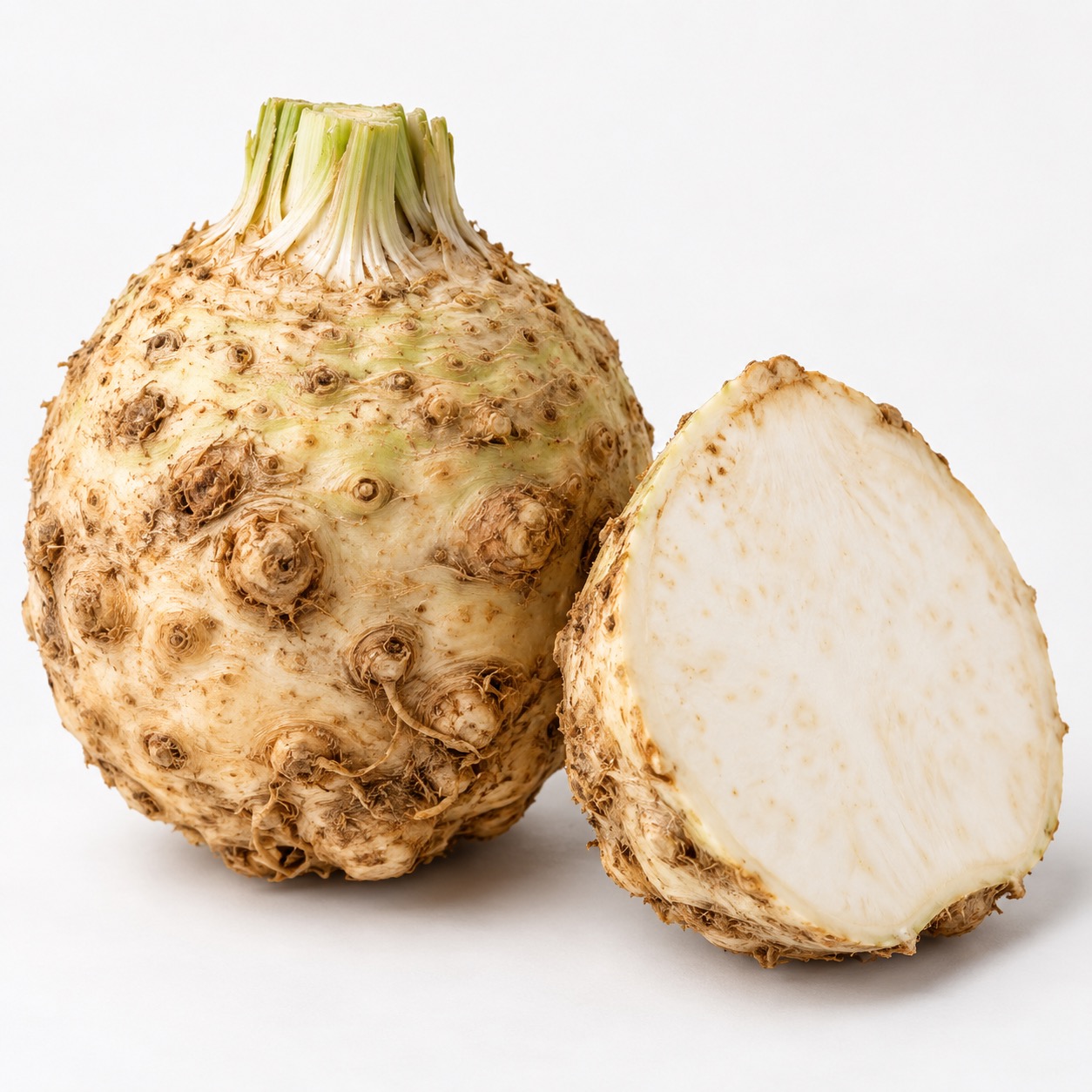 Celery Root / Celeriac Ingredient Icon