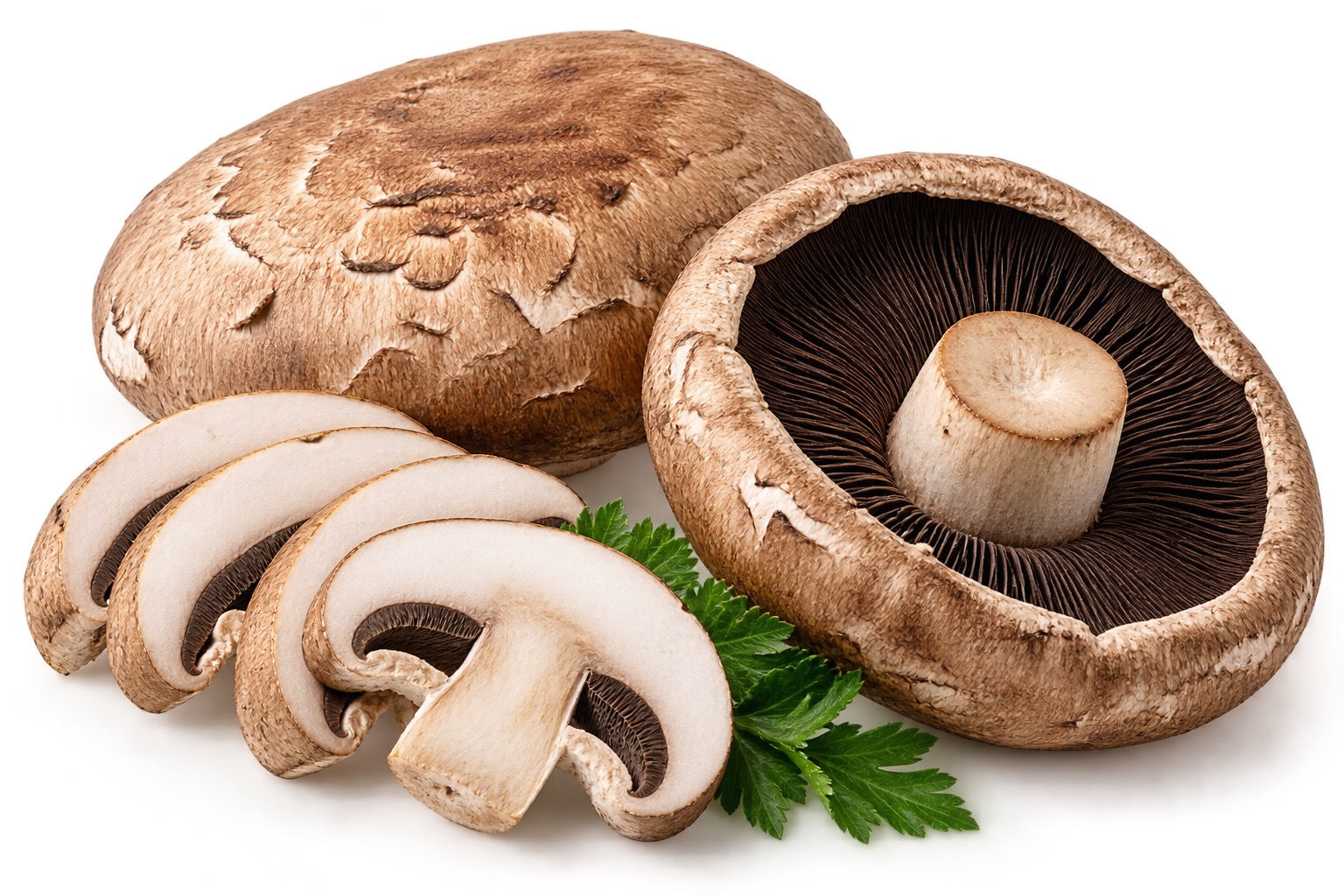
Large, mature brown mushrooms of Agaricus bisporus, prized for their firm texture, pronounced umami character and versatility across grilling, roasting, steaming, sous-vide, marinating and raw preparations.
A Portobello is the fully mature brown form of Agaricus bisporus, the same cultivated species that is sold at younger stages as white button mushrooms and brown cremini mushrooms. As the mushroom matures, its cap expands, the veil opens and the dark gills become exposed.
Maturity creates a broader surface area, firmer structure and more pronounced savory flavor, making Portobellos particularly valuable when a recipe needs a mushroom that can withstand grilling, roasting, stuffing or substantial marination.
Culinary identity: Portobello, cremini and common button mushrooms are different market stages or strains within the same species rather than unrelated mushrooms.
History
Agaricus bisporus has a long history of commercial cultivation in Europe and later North America. Modern mushroom farming transformed what had once been a limited seasonal product into a year-round cultivated ingredient.
Portobello mushrooms became especially popular as mature brown mushrooms entered restaurant and retail markets as a distinct culinary product. Their large cap, substantial texture and natural umami made them well suited to grilling and entrée-style preparations.
Seasonality
Because Portobellos are commercially cultivated under controlled environmental conditions, they are generally available year-round. Their practical kitchen seasonality is therefore driven more by market supply, quality and menu style than by a short natural harvest window.
For purchasing, choose firm caps with a dry surface, intact edges and a fresh earthy aroma. Avoid mushrooms that are slimy, strongly discolored or excessively shriveled.
Commercial Cultivation
Commercial Agaricus bisporus production is highly controlled. Penn State Extension describes a production cycle involving compost preparation, spawning, casing, pinning and cropping. Portobello growers manage pin density and environmental conditions so fewer mushrooms can develop into larger mature caps suitable for the Portobello market.
Stage
Purpose
Composting
Creates a selective nutrient-rich substrate, commonly based on straw or other agricultural materials with added nitrogen sources and gypsum.
Spawning
Introduces cultivated mushroom mycelium into the prepared substrate.
Colonization
Mycelium develops through the substrate.
Casing
A moist surface layer supports water management and helps stimulate fruiting.
Pinning
Primordia form and begin developing into mushrooms.
Cropping
Mushrooms enlarge and are hand harvested in successive flushes.
Portobello maturity
Selected brown mushrooms are allowed to grow larger and more mature, developing broad open caps and exposed gills.
Flavor Profile
Umami High
Earthiness High
Sweetness Low
Bitterness Low–Medium
Richness Medium
Portobellos develop a concentrated savory character when browned. Their aroma is earthy and gently nutty, while their substantial texture can become almost meat-like when grilled or roasted. The dark gills contribute color and deeper flavor but may darken pale sauces or fillings.
Professional Cooking Methods
Grilling
Brush lightly with oil, season, and grill cap-side and gill-side until tender with visible caramelization. Excellent for sandwiches, plated vegetables and meatless entrées.
Roasting
High heat concentrates flavor and drives off excess moisture. Whole caps, quarters or thick slices work well with garlic, rosemary, thyme and olive oil.
Sautéing
Cook over medium-high heat in a wide pan so released moisture evaporates rather than steams the mushroom. Finish with herbs, butter or wine.
Steaming
Steam gently when a soft, moist texture is preferred without browning. This technique works for controlled prep, fillings and lighter dishes.
Sous-Vide
Vacuum-seal with a small amount of fat, aromatics and seasoning. Sous-vide provides even seasoning and controlled tenderness; finish quickly in a hot pan or on the grill when browning is desired.
Stuffing
Large caps provide a natural vessel for breadcrumbs, herbs, cheeses, vegetables, meat forcemeats or mousselines.
Marinated Portobello
Portobellos absorb marinades readily. Use olive oil with acid such as wine vinegar or lemon, then add garlic, herbs, pepper and restrained salt. For hot preparations, marinate briefly before grilling or roasting so the mushroom remains firm rather than waterlogged.
Cooked mushrooms can also be marinated after roasting or grilling for antipasti. Their porous structure makes them especially effective at carrying vinaigrette and aromatic herbs.
Thin-Shaved Raw Applications
Very fresh, firm Portobellos can be sliced paper-thin for delicate composed salads. Remove surface soil carefully, trim the stem and shave across the cap with a mandoline or very sharp knife.
Dress lightly just before service with lemon, extra virgin olive oil, salt and black pepper. Parmigiano Reggiano, arugula, parsley, celery leaves or shaved fennel can complement the earthy mushroom without overwhelming it.
Nutrition
Portobello mushrooms are naturally low in calories and fat while providing protein, fiber, potassium, copper and several B vitamins. USDA research on mushrooms has also examined grilled Portobellos and found that most nutrients remain well retained during cooking.
Nutritional Characteristic
Culinary Relevance
Calories
Low-energy ingredient suitable for vegetable-forward preparations.
Protein
Moderate for a vegetable ingredient, but not nutritionally equivalent to meat.
Fat
Naturally very low; cooking fats strongly influence finished calorie content.
Fiber
Contributes dietary fiber and structure.
Potassium
A notable mineral contribution; USDA research has highlighted potassium in grilled Portobellos.
Copper
Mushrooms can contribute meaningful dietary copper.
B vitamins
Contribute several B vitamins typical of cultivated mushrooms.
Exact nutrition varies with serving size, cooking method and added fats or seasonings. Use the current supplier or USDA data when a recipe requires precise nutritional calculation.
Shelf Life & Storage
Fresh Portobellos are highly perishable and should remain refrigerated. For best culinary quality, keep them dry, cold and able to breathe rather than sealed in a moisture-trapping environment.
Store refrigerated in original ventilated packaging or a paper bag.
Do not wash before storage; clean immediately before use.
Use while caps remain firm and surfaces are dry.
Discard mushrooms with persistent slime, sour odor or advanced decay.
For professional kitchens, rotate by receiving date and inspect daily.
Practical quality window: commonly several days under good refrigeration, though exact shelf life depends on harvest age, handling and packaging.
Preparation Notes
Brush away dirt or wipe with a damp towel rather than soaking.
Stems are edible but may be fibrous; trim or mince them for stuffing.
Gills are edible. Remove them only when a cleaner appearance or lighter-colored sauce is desired.
Salt near cooking time because mushrooms quickly release moisture.
Allow adequate pan or grill space to encourage browning.
Pair with garlic, thyme, rosemary, parsley, balsamic vinegar, red wine, butter, olive oil and aged cheeses.
Culinary Applications
Italian Kitchen
Risotto, pasta sauces, crostini, polenta accompaniments, stuffed mushrooms, frittate and vegetable contorni.
Grill & Entrée
Whole grilled caps, vegetable steaks, sandwiches, burgers, composed plates and side dishes.
Fine Dining
Purées, mushroom duxelles, layered garnishes, shaved raw salads, consommé garnishes and stuffed preparations.
Tuscany Cuisine Platform Connection
This page defines the ingredient identity PORTOBELLO-MUSHROOM-001 with Live Inventory ID portobello_mushroom. Recipes can use the same record for icon synchronization, Menu Builder, costing, purchasing, station production and Ingredients Library linking.
Commercial Agaricus bisporus cultivation uses controlled composting, spawning, casing, pinning and cropping. Penn State Extension specifically notes that Portobello growers manage pin sets to produce the larger mature mushrooms desired for the Portobello market. USDA nutrition research has also included grilled Portobellos and reports strong nutrient retention after cooking.