Home β€Ί Sauces & Stocks β€Ί Vegetable Stock
Culinary Foundation Β· Stock & Broth

Vegetable Stock

A professional kitchen foundation built from vegetables, aromatic herbs and water. Tuscany Cuisine develops the stock with roasted or deeply toasted vegetables for color and complexity, then simmers it for two hours without salt so it remains versatile for risotto, soups, sauces, braises and reductions.

πŸ₯• Roasted Vegetables πŸ’§ 3:1 Water Ratio 🌿 Bouquet Garni ⏱️ 2-Hour Simmer πŸ§‚ No Salt ❄️ 3-Day House Standard
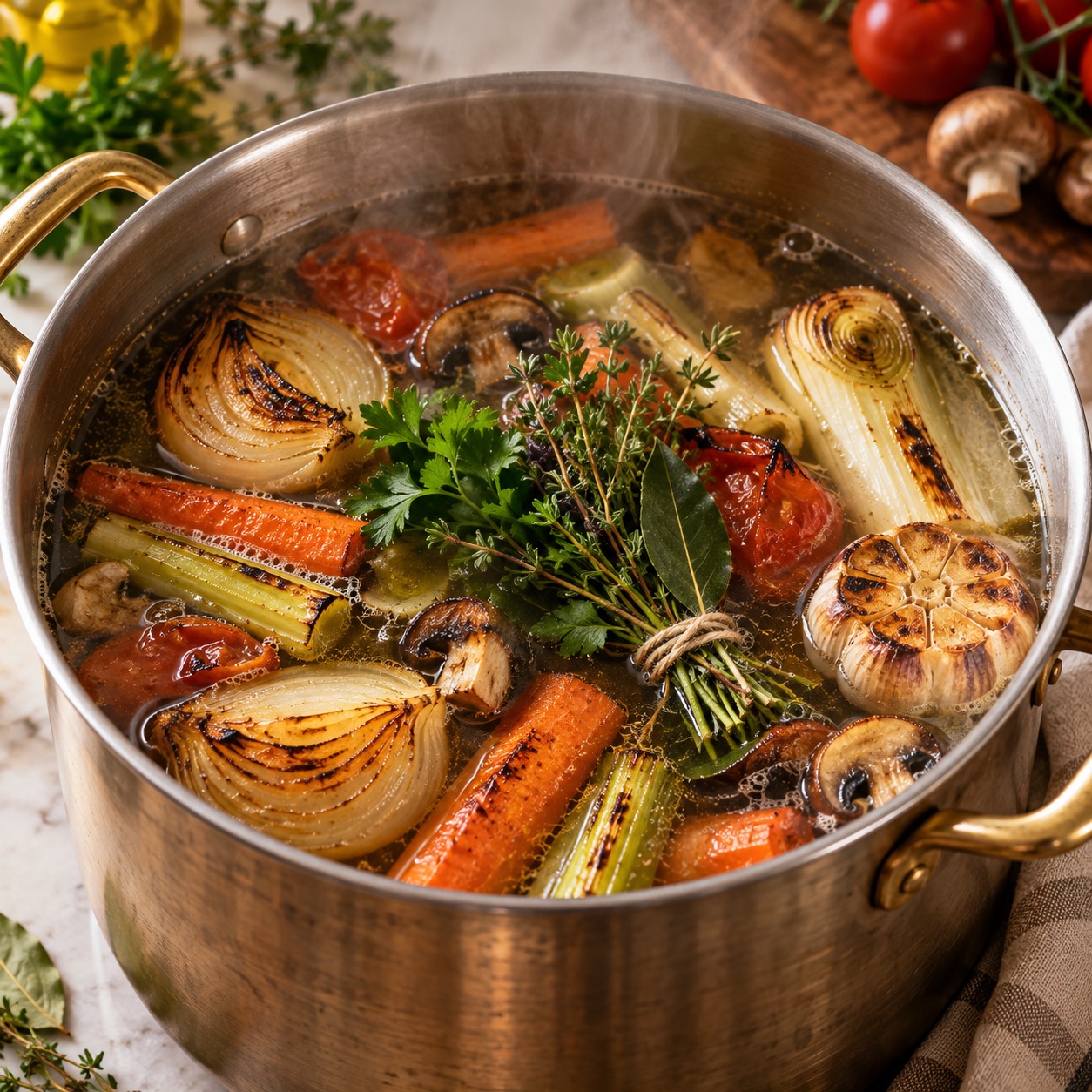
Roasted vegetables simmering in a stockpot with a fresh herb bouquet garni
Stock.webp Β· Roasted Vegetable Stock
Stock Calculator Stock vs Broth Stock Formula Vegetable Broth Storage Culinary Uses FAQ
Professional Definition

Vegetable Stock vs. Vegetable Broth

The words stock and broth are sometimes used interchangeably, especially with vegetables. For Tuscany Cuisine production, the distinction is based on technique, concentration and intended use. Stock is the deeper culinary building block; broth is the lighter preparation.

Vegetable Stock

The vegetables are first roasted in the oven with a light coating of olive oil, or deeply toasted in a large stockpot. Browning creates more color, aroma and savory complexity before water is added.

  • Roasted or pan-toasted vegetables
  • Water = 3Γ— total vegetable weight
  • Rosemary, sage, thyme and bay leaves
  • Whole black peppercorns
  • No salt
  • Controlled simmer: 2 hours
  • Designed as a foundation for other recipes

Vegetable Broth

The vegetables are not roasted. They are combined directly with water, brought to cooking temperature and simmered to produce a lighter, cleaner vegetable flavor and paler color.

  • Raw vegetables directly into the pot
  • No roasting or deep toasting stage
  • Fresh herbs can include 4 g parsley
  • No salt
  • Lighter color and flavor
  • Useful when roasted flavor is not desired
1 : 3
Tuscany Cuisine Vegetable Stock Production Ratio

Weigh the prepared vegetables, then use water equal to three times that weight. The core onion-carrot-celery formula weighs 1,200 g, which starts with 3,600 g / approximately 3.6 L water. If garlic and mushroom scraps are included in the measured vegetable weight, calculate the water from the final total.

Base Production Formula

Roasted Vegetable Stock

This stock is intentionally unsalted. It is designed to become part of another recipe where concentration, reduction and final seasoning can be controlled by the chef.

Ingredients

  • Onions500 g Β· rough cut Β· clean skins left on
  • Carrots300 g Β· rough cut
  • Celery400 g Β· rough cut
  • Garlic2 whole heads
  • Mushroom scrapsusable clean trim Β· quantity as available
  • Extra-virgin olive oilas needed Β· lightly coat for roasting
  • Fresh rosemary3 g
  • Fresh sage3 g
  • Fresh thyme3 g
  • Bay leaves3 g
  • Whole black peppercorns5 g
  • Water3 Γ— total vegetable weight
  • Saltnone

Method

Prepare the vegetablesRough-cut the onions, carrots and celery. Keep clean onion skins for additional stock color. Add the whole garlic and clean mushroom scraps.
Develop colorLightly dress the vegetables with extra-virgin olive oil and roast until deeply golden, or toast directly in a large stockpot. Build color without burning the vegetables.
Calculate the waterWeigh the final vegetable mass and add water equal to three times that weight.
Add the aromaticsAdd rosemary, sage, thyme, bay leaves and whole black peppercorns. Keep the preparation completely unsalted.
Simmer gentlyBring the liquid toward a simmer, then maintain a controlled simmer for 2 hours. Avoid a violent boil that clouds and aggressively reduces the stock.
Strain and coolStrain thoroughly, cool according to your kitchen HACCP program and refrigerate promptly.
Production Tool

Vegetable Weight β†’ Stock Water Calculator

Enter the actual total weight of all vegetables going into the stock. The calculator applies the Tuscany Cuisine 3 parts water : 1 part vegetables production formula.

Base reference: 500 g onion + 300 g carrots + 400 g celery = 1,200 g. If you weigh the two garlic heads and mushroom scraps into the batch, add that weight before calculating.
3600 ml
Starting water quantity
Liters3.60 L
Ratio3.00 Γ— vegetable weight
Simmer2 hours
SaltNone
Lighter Preparation

Vegetable Broth Method

Vegetable broth uses the same general vegetable family but skips the browning stage. The result is cleaner, lighter and more directly vegetable-forward. Tuscany Cuisine also leaves the broth unsalted so the chef retains full control in the finished dish.

1. Raw vegetablesPlace the prepared onion, carrots, celery, garlic and clean vegetable trim into the stockpot without roasting.
2. Add waterCover with the required water for the desired broth strength and bring the pot up to cooking temperature.
3. Add herbsUse the aromatic herbs as desired and add approximately 4 g fresh parsley for the broth profile.
4. Simmer & strainOnce the liquid reaches a boil, reduce to a controlled simmer. Keep unsalted, then strain when the desired vegetable flavor is extracted.
Culinary Applications

Where vegetable stock works in the Tuscany Cuisine system

🍚 RisottoUse as the hot liquid for Carnaroli, Arborio and Vialone Nano when a clean vegetable foundation is appropriate.
πŸ₯£ SoupsBuild minestrone, purΓ©es, vegetable soups and grain soups without adding unnecessary meat flavor.
πŸ₯„ SaucesUse for reductions, vegetable sauces, emulsions and pan sauces where a neutral savory base is needed.
🌱 Plant-Based CookingProvides body and savory depth for vegetarian and vegan preparations when all selected ingredients meet the intended diet.
🍝 PastaLoosen sauces, finish grains, hydrate fillings or reinforce vegetable-based pasta preparations.
πŸ₯• BraisingUse as a gentle braising liquid for vegetables, legumes and grains.
🧊 Batch ProductionProduce as a controlled foundation, then portion for station use rather than seasoning every recipe separately at the stock stage.
πŸ‘¨β€πŸ³ Menu DevelopmentA no-salt stock gives the chef greater control when the same foundation feeds multiple recipes with different seasoning requirements.
Storage & HACCP

Strain, cool, identify and rotate

Cool correctly

After straining, cool the stock promptly according to the established Tuscany Cuisine HACCP cooling procedure. Do not leave a deep hot stockpot at room temperature to cool slowly.

Refrigerated shelf life

Tuscany Cuisine house standard: 3 days refrigerated after proper cooling and storage. Label the container with production and discard/use-by dates.

Protect the flavor

Store covered in clean food-safe containers and keep away from products that can transfer strong aromas. Apply FIFO rotation in station and production inventory.

Chef David Giani production note: The absence of salt is intentional. Stock is a building block. If it is reduced into a sauce, used to cook risotto, or concentrated inside another preparation, salt added too early can become excessive. Season the final dish where the chef can evaluate the complete concentration and balance.
Platform Connections

Continue through Tuscany Cuisine

FAQ

Vegetable stock questions

Why roast the vegetables for stock?

Roasting or deep pan-toasting develops browning, color and a more complex savory profile. It creates a stronger culinary foundation than simply simmering raw vegetables in water.

Can the vegetables be toasted directly in the stockpot?

Yes. The Tuscany Cuisine method allows either oven roasting with a light olive-oil coating or direct toasting in a large stockpot. In both methods, develop good color without burning the vegetables.

Should onion skins stay on?

Clean onion skins can remain on during stock production. They contribute additional color to the finished stock. Discard dirty, damaged or unsuitable outer material.

Why use mushroom scraps?

Clean usable mushroom trim adds savory depth and makes productive use of kitchen trim. Because the amount varies by production, the calculator works from the actual total vegetable weight.

Why is there no salt?

Because the stock may later be reduced or used as an ingredient in multiple recipes. Keeping it unsalted protects the chef's ability to season the finished dish accurately.

How long does the stock simmer?

Tuscany Cuisine uses a controlled two-hour simmer for this roasted vegetable stock before straining.