Chef's foundation
Understanding monkfish as an ingredient
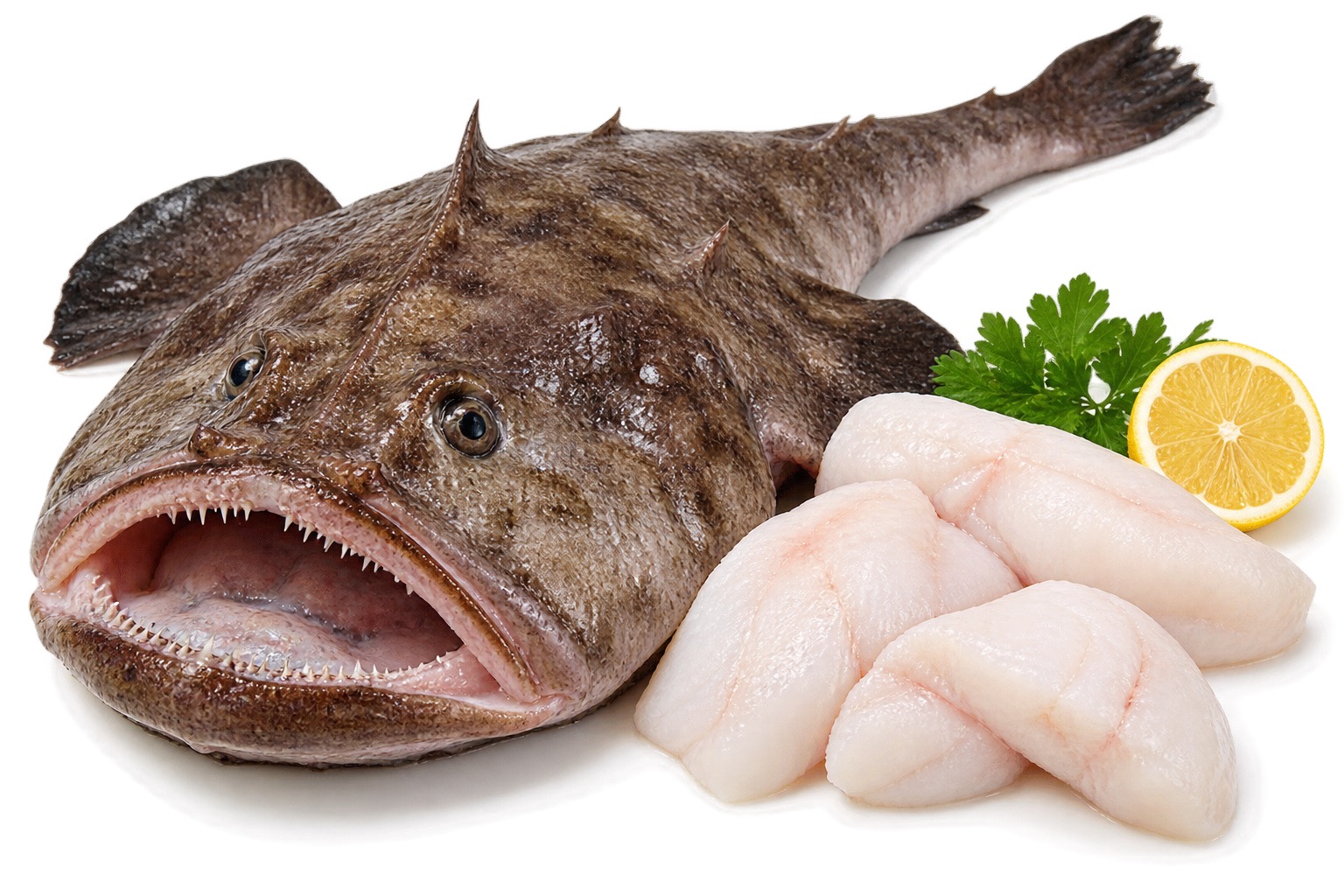
Monkfish is a culinary market name used for several anglerfish in the genus Lophius. These fish have enormous flattened heads, wide mouths and tapered bodies, but the prized kitchen portion is usually the muscular tail. In Italy, the tail is widely recognized as coda di rospo, while the whole fish may be called rana pescatrice or pescatrice.
The chef should never treat “monkfish” as a complete purchasing specification. A professional order should identify the scientific species when possible, catch area, wild-harvest origin, product form, fresh or frozen condition, trim level and net edible weight. This matters because European, Mediterranean and North American monkfish come from different species and fisheries.
Species identity
The principal monkfish species
Lophius piscatorius
Linnaeus, 1758
European angler · White angler
A major European species distributed through the eastern Atlantic from northern waters toward the Strait of Gibraltar and into the Mediterranean and Black Sea. FishBase reports a depth range of roughly 20–1,000 m and classifies it in the family Lophiidae.
Lophius budegassa
Spinola, 1807
Black-bellied angler
An important Mediterranean and eastern Atlantic species extending from the British Isles toward West Africa. FAO Mediterranean references describe it as a coastal, continental-shelf and upper-slope benthic fish found throughout the Mediterranean.
Lophius americanus
American monkfish · Goosefish
The principal North American monkfish. NOAA places its range in the northwest Atlantic from the Grand Banks and Gulf of St. Lawrence south to Cape Hatteras. It lives on the bottom over sand, mud and shell habitats and can occur from coastal waters to depths approaching 3,000 ft.
Origin & geography
Monkfish has a range—not one country of origin
Italy sits inside a wider native range
Lophius piscatorius and Lophius budegassa both occur in the Mediterranean. Their culinary importance in Italy belongs to a larger European and Mediterranean seafood tradition, rather than to a single national biological origin.
American monkfish
Lophius americanus supports a separate North American fishery from the Canadian Atlantic region south through the U.S. Northeast and Mid-Atlantic.
European chefs will also encounter French market language such as lotte or queue de lotte. The names change with language and product form, but the purchasing discipline remains the same: identify species and harvest origin whenever traceability allows.
Seasonality
A regional seafood calendar—not one global month
Monkfish availability depends on species, migration, fishing area, fleet activity, quotas, closures, weather and whether the product is sold fresh or frozen. A single global “monkfish season” would be misleading.
Year-round, with seasonal peaks
NOAA lists U.S. wild-caught monkfish as available year-round, with peaks in late fall and spring. NOAA also notes that monkfish migrate seasonally for feeding and spawning.
Check the fishery, not just the calendar
For Italy and the Mediterranean, verify the current landing area, species, fishery rules, gear, freshness and supplier traceability. Local availability can differ substantially between ports and seasons.
Flavor profile
Why chefs value the tail
NOAA describes monkfish tail meat as firm, dense and relatively boneless, with a texture similar to lobster. Maine Sea Grant likewise notes the dense white tail meat and the North American nickname “poor man's lobster.”
Selection & purchasing
Professional quality standards
Look for resilience and clean aroma
Flesh should feel firm and resilient, with a clean marine aroma and no sour, ammonia-like or stale odor. Excess liquid, softening, discoloration or drying can signal poor handling.
Define the trim
Record whole fish, tail-on-bone, skinned tail, membrane-trimmed loin or portion-cut product separately. These forms have different labor, waste and edible-yield economics.
- Confirm scientific species when available.
- Record country or catch area rather than assuming “monkfish” identifies origin.
- Distinguish fresh from previously frozen product.
- Check skin and connective membrane removal in the purchasing specification.
- For frozen tails, monitor glaze, packaging integrity, dehydration and thaw loss.
- Use receiving and storage controls appropriate to highly perishable seafood.
Fabrication
Tail, loins, cheeks and liver
The tail is the primary commercial cut because it contains dense paired loins around the central bone. The outer skin is removed and the thin connective membrane should be trimmed carefully; leaving too much membrane can make the cooked surface contract and become chewy.
Main culinary cut
Portion into medallions, thick steaks or long loins for roasting, grilling, pan roasting, skewers, stews and braises.
A separate delicacy
Monkfish liver is valued in Japanese cuisine as ankimo. Treat liver as a distinct product with its own supplier, freshness and food-safety specifications.
Cooking science
Dense flesh rewards controlled heat
Monkfish holds its shape under methods that would break more delicate white fish. Its firm structure makes it especially useful for roasting, pan roasting, grilling, skewering, poaching, baking and seafood stews. The same density also means aggressive overcooking can make the meat tight and dry.
FishBase records Lophius piscatorius as a commercial fish eaten through steamed, sautéed, broiled, boiled, fried and baked preparations. In a professional kitchen, technique should be chosen around portion thickness, trim, sauce structure and service timing.
Culinary usage
Italy, the Mediterranean and beyond
Coda di rospo in the savory kitchen
Its firm meat works naturally with tomato, white wine, garlic, parsley, saffron, shellfish broths, citrus and olive oil. It can be roasted as a loin, cut into medallions, threaded onto skewers or incorporated into seafood pasta fillings and stews.
From French lotte to Japanese ankimo
European markets commonly sell the tail as the premium portion. In Japan the liver is prepared as ankimo, demonstrating how different culinary cultures value different parts of the same fish.
Nutrition
Lean fish with protein and selenium
Monkfish is generally a low-fat, low-calorie seafood. Maine Sea Grant describes it as a low-fat, low-calorie source of selenium. The reference table below uses the New York Sea Grant educational monkfish nutrition card, which attributes its data to USDA FoodData Central. Exact values vary by species, sample and preparation.
| Nutrient | Approx. per 100 g |
|---|---|
| Energy | 64.6 kcal |
| Protein | 12.3 g |
| Total fat | 1.3 g |
| Saturated fat | 0.29 g |
| Vitamin B12 | 0.77 µg |
| Selenium | 31 µg |
| Iron | 0.27 mg |
| Cholesterol | 21.2 mg |
| Sodium | 15.3 mg |
Tuscany Cuisine recipe connection
Seafood Lasagna with Pesto Carlofortino
Monkfish is one of the seafood components in Chef David Giani's Seafood Lasagna, where its firm texture is combined with crab, shrimp, clams, mussels and sea bass, layered with fresh pasta, béchamel and basil-lemon pesto Carlofortino.
Open Seafood Lasagna →FAQ
Monkfish questions chefs ask
Is coda di rospo the same as monkfish?
In Italian culinary use, coda di rospo refers to the prized tail of anglerfish/monkfish, especially species of Lophius. Rana pescatrice and pescatrice are also common Italian names.
Why is monkfish compared with lobster?
The comparison comes mainly from its dense, firm, relatively boneless tail meat and mild sweetness. It is a texture analogy rather than a biological relationship.
Can monkfish be grilled?
Yes. The dense tail meat tolerates direct heat well when properly trimmed and not overcooked. Thick portions, skewers and loins are particularly well suited to grilling.
Is monkfish always sustainable?
No seafood species should receive a permanent global sustainability label. Evaluate the current fishery, species, stock, catch area, gear, regulations and traceability.
Research & references
Sources behind this culinary foundation
- NOAA Fisheries — Monkfish (Lophius americanus): range, habitat, availability, flavor, texture and U.S. fishery management. NOAA Fisheries ↗
- FishBase — Lophius piscatorius: taxonomy, eastern Atlantic and Mediterranean distribution, depth, biology and culinary market use. FishBase ↗
- FishBase — Lophius budegassa: black-bellied angler distribution, depth and Mediterranean occurrence. FishBase ↗
- FAO AGRIS / MEDITS research — Mediterranean distribution of Lophius piscatorius and Lophius budegassa. FAO AGRIS ↗
- Maine Sea Grant — monkfish season, nutrition overview, tail meat, liver and culinary uses. Maine Sea Grant ↗
- New York Sea Grant — monkfish nutrition educational material using USDA FoodData Central data. New York Sea Grant ↗