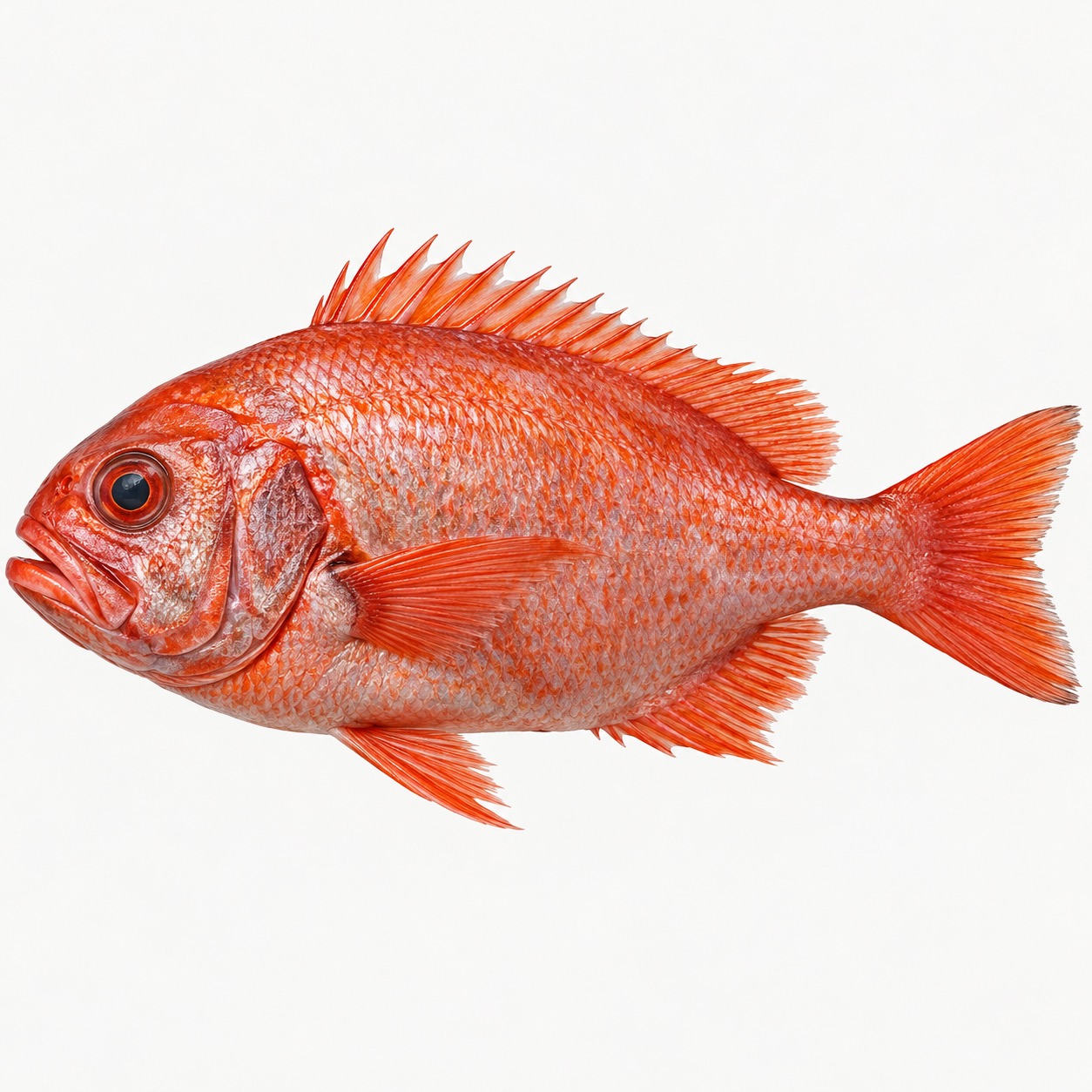
Identity & Culinary Classification
Italian Name — Scorfano
For the Tuscany Cuisine culinary library, Scorfano is retained as the requested Italian culinary/common reference. However, Orange Roughy is scientifically Hoplostethus atlanticus and belongs to the Trachichthyidae family; Mediterranean fishes commonly called scorfano belong to different taxonomic groups. This distinction is important for professional purchasing, labeling, and species identification.
Origin & Geographic Distribution
Orange roughy has a broad deep-water distribution across temperate parts of the Atlantic, Indian and South Pacific Oceans. Major historic and commercial fisheries have included waters around New Zealand, southern Australia, Namibia, the southwest Indian Ocean, parts of the North Atlantic, and Chile.
It is associated with continental slopes, canyon edges and seamount systems. Adults often occur near the seafloor and can form dense aggregations, especially during spawning.
Seasonality
Orange roughy should not be treated like a conventional coastal “seasonal fish” whose market quality is tied mainly to a short fresh-harvest window. Commercial availability is heavily influenced by managed deep-water fisheries, quotas, fishing-area openings and frozen inventory.
For chefs and buyers, this means that market availability may be year-round through frozen supply, while truly fresh product depends on fishing region, landing schedule, transport time and local distributor access.
Fish Market Forms — Fresh, Frozen, Fillet or Whole
| Market form | Typical availability | Chef / buyer note |
|---|---|---|
| Frozen fillet | Common | The most practical and widely traded restaurant form. Easy to portion and suitable for sautéing, roasting, broiling and seafood stews. |
| Fresh fillet | Possible but less common | Availability depends on proximity to landings and distribution. Flesh should be firm, moist and clean-smelling. |
| Whole / headed-and-gutted | Specialty / wholesale | More likely in specialized seafood trade than in ordinary retail. Useful when whole-fish identity or fabrication is required. |
| Frozen whole / H&G | Wholesale / export channels | Deep-water fisheries often rely heavily on freezing for long-distance transport and stable quality. |
Fresh and frozen are both recognized market forms. In U.S. trade records, frozen Orange Roughy fillets are specifically documented as an imported product category.
Buying Quality
Fresh
- Flesh should be firm and spring back when gently pressed.
- Whole fish should have clear, bright eyes and red-to-pink gills.
- Avoid sour, ammonia-like or strongly “fishy” odors.
- Fillets should not show drying, brown/yellow edges or mushy texture.
Frozen
- Fillets should be solidly frozen with intact packaging.
- Avoid heavy frost, excessive ice crystals or obvious signs of thawing and refreezing.
- Watch for white freezer-burn spots, fading, dehydration or liquid accumulation.
Nutrition
Orange roughy is a lean, high-protein fish. USDA reference data for 3 oz / 85 g baked or broiled orange roughy lists approximately:
| Nutrient | Per 3 oz / 85 g cooked | Approx. per 100 g |
|---|---|---|
| Calories | 76 kcal | 89 kcal |
| Protein | 16 g | 18.8 g |
| Total fat | 1 g | 1.2 g |
| Water | about 69% | about 69% |
Values vary somewhat with raw material, trim and cooking method.
Flavor, Texture & Culinary Uses
The flesh is pale to white, mild and clean-tasting, with a firm texture that holds together well during cooking. Because its flavor is restrained, it works particularly well with olive oil, garlic, herbs, citrus, tomato, white wine and light fish broths.
- Pan sauté
Portion into fillets and cook quickly with olive oil and aromatics. - Roast / bake
Use moderate heat and protect the lean flesh from drying. - Broil
Well suited to seasoned fillets with a light oil coating. - Seafood stew
Its firm texture makes it appropriate for Cacciucco and other brothy preparations. - Poach
Use fish fumet, white wine or aromatic court bouillon. - Fry
Firm portions can be breaded or battered without excessive breakup.
Professional Kitchen Notes
- Because the flesh is lean, avoid prolonged dry cooking.
- For stews, add the fish late enough to preserve clean flakes and prevent overcooking.
- Frozen fillets should be thawed under refrigeration and dried before searing.
- Record the exact species in purchasing and inventory systems instead of using a generic “white fish” description.
- Use the scientific name when traceability or supplier documentation is important.
Sustainability & Purchasing Responsibility
Orange roughy is an exceptionally long-lived deep-water species and can live for well over a century. Because deep-water stocks grow and recover slowly, responsible sourcing is particularly important. Buyers should verify the fishery, country of origin, current management status, supplier traceability and applicable sustainability certification or guidance rather than treating all Orange Roughy as equivalent.