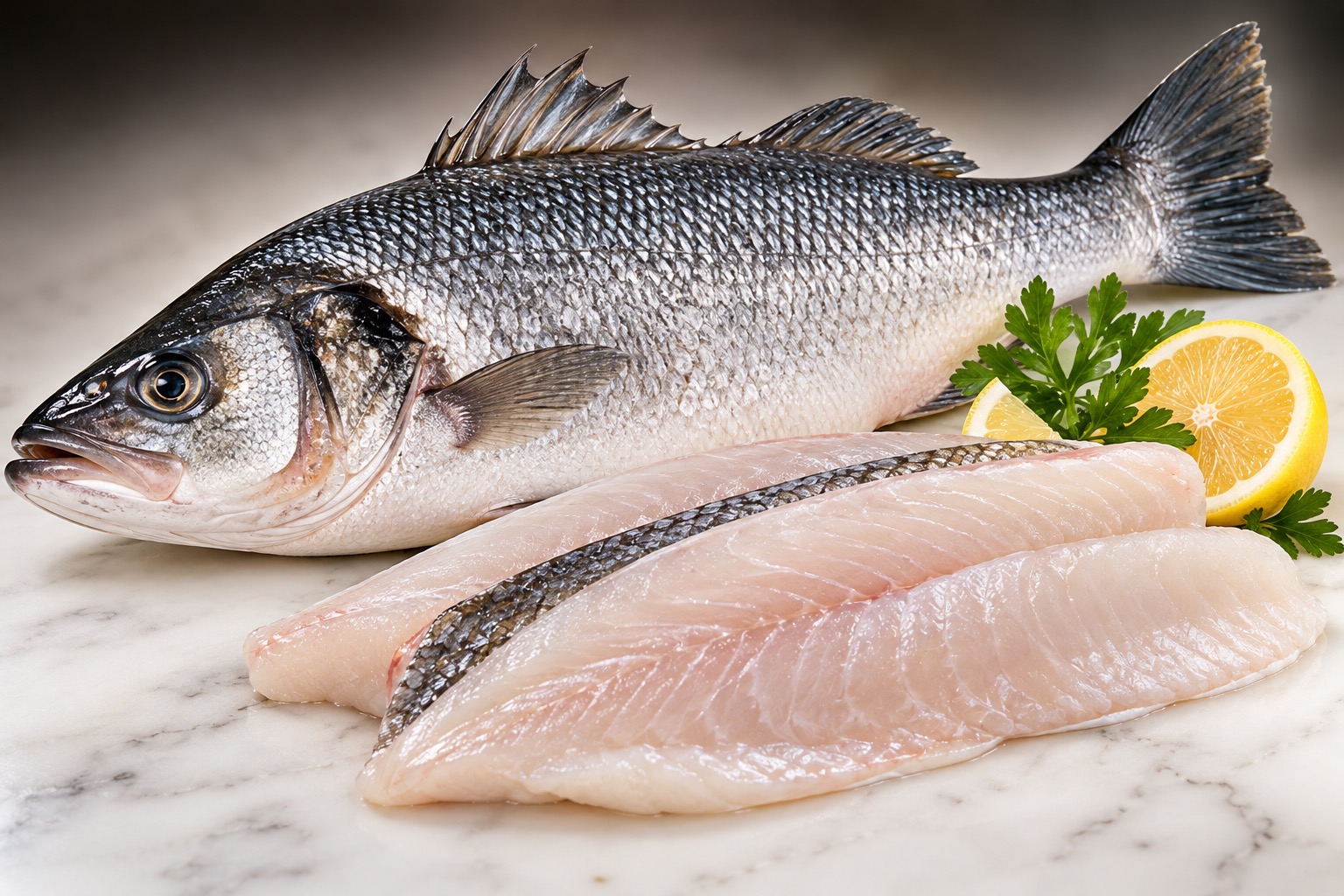
Market-name intelligence
“Sea bass” is a culinary market family, not one biological family
European branzino, Atlantic black sea bass, striped bass, Chilean sea bass,
white seabass, corvina, bluenose and barramundi may all appear beside the words
“bass” or “sea bass” in culinary commerce, but they do not represent one species,
one family, one origin, one fat level or one season.
For a chef, menu writer or purchasing system, the market name is only the first layer.
The complete ingredient specification should identify the scientific species whenever possible,
harvest origin, wild or farmed production, product form, size, fresh or frozen condition
and any sustainability or legal-trade documentation required for that fishery.
Tuscany Cuisine inventory rule:
FISH-SEABASS-001 can serve as the recipe-level Sea Bass identity,
but supplier and purchasing records should store a species field.
A 500 g farmed Greek Dicentrarchus labrax is not the same food-cost,
nutrition, yield or culinary product as a Chilean sea bass loin or a wild white seabass fillet.
Jump to a species
Sea Bass types around the world
01
TRUE / CORE SEA-BASS MARKET SPECIES
European Sea Bass · Branzino
Dicentrarchus labrax · Moronidae
Origin / RangeNortheast Atlantic, Mediterranean and Black Sea; central to Italian, Greek, Turkish, Spanish and French seafood markets.
Wild / FarmedWild-caught and extensively farmed. European aquaculture includes sea cages, lagoons, ponds and other grow-out systems; the bulk of modern production is from aquaculture.
SeasonalityFarmed supply supports year-round availability. Wild fish are migratory; spawning occurs mainly in winter to early spring in Mediterranean populations and can extend later in Atlantic populations.
Flavor & TextureClean, delicate and mildly sweet with fine-to-medium flakes; wild fish are generally leaner while farmed fish may carry more fat.
Culinary use
Whole roasting, salt crust, grilling, pan roasting, steaming, baking, acqua pazza, soups and refined fillet service.
Chef / purchasing note: In Italy, this is the fish most commonly meant by branzino or spigola. It is the best default species when a Mediterranean recipe simply says branzino.
Primary reference: FAO / EUMOFA
02
NORTHWEST ATLANTIC SEA BASS
Black Sea Bass
Centropristis striata · Serranidae
Origin / RangeU.S. Atlantic coast; NOAA lists U.S. wild-caught supply from Massachusetts to the west coast of Florida.
Wild / FarmedWild-caught. U.S. fisheries are managed with quotas, size limits, seasons and gear controls.
SeasonalityGenerally available year-round, but actual availability and legal harvest seasons vary by state and fishery.
Flavor & TextureMild, fresh and somewhat delicate; tender yet firm white flesh.
Culinary use
Whole roast, pan roast, broil, grill, bake, chowder, tacos and simple lemon-herb preparations.
Chef / purchasing note: A leaner Atlantic restaurant fish with good structure and a clean finish.
Primary reference: NOAA Fisheries
03
BASS · WILD AND FARMED
Atlantic Striped Bass
Morone saxatilis · Moronidae
Origin / RangeAtlantic coast of North America. Wild U.S. supply is associated with the Atlantic coast from Maine through the Mid-Atlantic and Carolinas.
Wild / FarmedWild-caught and farmed. Commercial aquaculture also includes farm-raised striped bass products.
SeasonalityFresh and frozen product can be available year-round depending on area; wild availability follows regional migration, spawning and management calendars.
Flavor & TextureSlightly sweet with firm texture and large flakes.
Culinary use
Grilling, roasting, pan searing, baking, broiling, steaming and composed seafood entrées.
Chef / purchasing note: Excellent when a chef wants a larger flake and firmer bite than delicate Mediterranean branzino.
Primary reference: NOAA Fisheries
04
NOT A TRUE SEA BASS · CROAKER FAMILY
White Seabass
Atractoscion nobilis · Sciaenidae
Origin / RangeEastern Pacific, centered off Baja California and extending north to the San Francisco area; also occurs in the northern Gulf of California.
Wild / FarmedPrimarily wild-caught. California has used hatchery enhancement to support populations, but this is not the same as routine food-fish farming.
SeasonalityCalifornia Sea Grant reports San Diego availability generally from June through March, subject to fishery conditions and management.
Flavor & TextureLow-fat, mild, firm and meaty with thick, large white flakes.
Culinary use
Grill, sear, bake, broil, sauté, steam or poach; the firm flesh works well in steak-size cuts.
Chef / purchasing note: Despite the market name, white seabass is a croaker and should be purchased under its correct species identity.
Primary reference: California Sea Grant
05
NOT A TRUE BASS · TOOTHFISH
Chilean Sea Bass · Patagonian Toothfish
Dissostichus eleginoides · Nototheniidae
Origin / RangeCold southern-ocean and sub-Antarctic waters; harvested around southern South America and other Southern Hemisphere fishing grounds.
Wild / FarmedWild-caught deep-water fish. International trade is controlled through toothfish catch-documentation requirements and national/CCAMLR systems.
SeasonalityCommercial restaurant supply is often frozen-at-sea and can be available through the year; harvest timing and legality depend on fishery area and management rules.
Flavor & TextureRich, buttery and moist with large, tender flakes and substantially higher fat than most fish sold as sea bass.
Culinary use
Roast, pan roast, grill, poach, steam, miso-style preparations and smoking; the rich flesh benefits from acid and restrained sauces.
Chef / purchasing note: The name is a market name. It is not a bass and should never be substituted into purchasing records as though it were branzino.
Primary reference: NOAA Fisheries / CCAMLR / SeafoodSource
06
MARKET-NAME GROUP · SPECIES MUST BE VERIFIED
Corvina · Croaker Group
Cynoscion spp. and other Sciaenidae · Sciaenidae
Origin / RangeCorvina is used for several croakers. For example, striped corvina (Cynoscion reticulatus) ranges from Mexico to Panama in the eastern central Pacific.
Wild / FarmedMostly wild-caught depending on the species and region. The word corvina alone is not a complete purchasing specification.
SeasonalityFishery-specific. Because several species can legally use Corvina as a market name, seasonality must follow the scientific species and catch area.
Flavor & TextureGenerally mild, clean and moderately firm; exact fat level, flake size and richness vary by species.
Culinary use
Ceviche where food-safety controls permit, grilling, sautéing, pan roasting, baking, soups and coastal Latin preparations.
Chef / purchasing note: FDA's Seafood List recognizes Corvina as an acceptable market name for multiple Cynoscion species. Record the scientific name on supplier specs whenever possible.
Primary reference: FDA Seafood List / FishBase
07
NOT A TRUE SEA BASS · DEEP-WATER WAREHOU
Bluenose · Bluenose Warehou
Hyperoglyphe antarctica · Centrolophidae
Origin / RangeSouthern Hemisphere deep waters, including New Zealand and Australia, South Africa and Argentina.
Wild / FarmedWild-caught deep-water fish, marketed fresh and frozen.
SeasonalityFishery- and quota-specific rather than a universal culinary season; availability depends on regional deep-water fisheries.
Flavor & TextureChef profile: clean, firm white flesh with enough structure for moist-heat or dry-heat cooking.
Culinary use
Steaming, broiling, baking and frying; FishBase also notes export to Japan for sashimi markets.
Chef / purchasing note: Bluenose is sometimes grouped commercially with 'bass-like' premium white fish, but taxonomically it is a warehou/medusafish-family species.
Primary reference: New Zealand MPI / FishBase
08
ASIAN SEA BASS · WILD AND FARMED
Barramundi · Asian Sea Bass
Lates calcarifer · Latidae
Origin / RangeIndo-West Pacific from the Arabian Gulf across South and Southeast Asia to Papua New Guinea and northern Australia.
Wild / FarmedWild and heavily farmed. Aquaculture uses coastal cages, ponds and recirculating systems; farming began commercially in Southeast Asia and spread widely.
SeasonalityFarmed barramundi supports year-round market supply. Wild spawning seasons vary strongly by latitude and monsoon/water-temperature regime.
Flavor & TextureMild, clean and moist with medium-firm flesh and broad culinary flexibility.
Culinary use
Whole roast, grill, steam, pan sear, curry, broth, fry and Southeast Asian herb-and-aromatic preparations.
Chef / purchasing note: A very useful global farmed alternative when consistent size, year-round availability and flexible cooking performance are priorities.
Primary reference: FAO
09
WESTERN PACIFIC SEA BASS
Japanese Sea Bass · Suzuki
Lateolabrax japonicus · Lateolabracidae
Origin / RangeWestern Pacific from Japan toward the South China Sea, including brackish and coastal habitats.
Wild / FarmedWild fisheries and aquaculture are both reported for the species.
SeasonalitySpawning occurs in winter; restaurant availability depends on local fishery and aquaculture supply.
Flavor & TextureClean white-fish profile with firm, versatile flesh.
Culinary use
Salt grilling, broiling, steaming, pan cooking, soups and refined Japanese fish preparations.
Chef / purchasing note: A distinct Asian sea-bass lineage and not interchangeable in inventory with European branzino without changing the supplier specification.
Primary reference: FishBase
Aquaculture
How sea-bass farming differs around the world
Mediterranean
European Sea Bass · Branzino
FAO describes European sea bass as one of the foundational marine aquaculture species of Europe.
Traditional systems include Italian valliculture and Mediterranean lagoons, while modern production
is dominated by hatchery juveniles grown in marine cages, with additional pond and land-based systems.
Indo-Pacific
Barramundi · Asian Sea Bass
Barramundi farming spread from Southeast Asia and now includes coastal cages, ponds and
recirculating aquaculture systems. Its hardiness, hatchery production and rapid growth make it
especially useful for consistent restaurant supply.
North America
Striped Bass
Striped bass reaches restaurants from both wild and farmed sources. Farmed product can support
more regular sizing and year-round purchasing, while wild product remains tied to regional
migration and management seasons.
Wild-only purchasing
Chilean Sea Bass, Black Sea Bass & Bluenose
Several premium bass-market species remain principally or entirely wild fisheries.
Their purchasing controls should emphasize catch area, legal documentation, management status,
traceability, product form and supplier reliability rather than farming method.
Seasonality
Wild season, farmed season and market season are different ideas
A chef's seafood calendar should distinguish biological seasonality from legal fishing seasons
and from commercial availability. Farmed European sea bass and barramundi may be marketed year-round,
while wild fish can move seasonally, spawn at particular times and be controlled by regional
quota or opening periods.
- European sea bass: farmed supply is broadly year-round; wild spawning is mainly winter/early spring in the Mediterranean and can extend later in Atlantic populations.
- Black sea bass: NOAA describes availability as generally year-round, varying by state.
- Atlantic striped bass: fresh and frozen product is available year-round depending on area, but wild fisheries follow regional migration and management.
- White seabass: California Sea Grant lists San Diego availability from June through March under its fishery conditions.
- Corvina: no single season can be assigned because several different species are sold under the market name.
- Chilean sea bass and Bluenose: restaurant availability is strongly affected by frozen supply, catch area, quotas and international/regional fishery management.
Nutrition
Sea bass nutrition changes dramatically by species
The label “sea bass” is too broad for one universal nutrition panel. The examples below show
how lean European, Black and Striped Bass differ from the much richer toothfish marketed
as Chilean sea bass. Values are raw edible fish per 100 g unless the cited source states otherwise.
| Species |
Calories |
Protein |
Fat |
Omega-3 |
| European sea bass · wild D. labrax |
96 kcal |
20.1 g |
1.6 g |
508 mg |
| Black sea bass · C. striata |
97 kcal |
18.43 g |
2.0 g |
— |
| Atlantic striped bass · M. saxatilis |
97 kcal |
17.73 g |
2.33 g |
— |
| Chilean sea bass · Patagonian toothfish |
184 kcal |
13.2 g |
14.2 g |
1.3 g |
Nutrition-engine rule: do not use the Chilean sea bass profile for Branzino,
or a Branzino profile for Corvina or White Seabass. Link nutrition to the actual species and
production source whenever the menu needs precise values.
Flavor matrix
How a chef chooses the right “sea bass”
Delicate / Mediterranean
European Branzino
Fine, clean, lightly sweet. Excellent whole, roasted, grilled, salt-baked or served with olive oil, herbs, citrus and vegetables.
Firm / Atlantic
Striped & White Seabass
More muscular and steak-like, with larger flakes. Useful for grilling, pan roasting, broiling and composed entrées.
Rich / Deep Water
Chilean Sea Bass
High-fat, buttery and succulent. Best when acidity, bitter greens, miso, citrus or restrained sauces balance its richness.
Versatile / Global
Corvina, Barramundi & Bluenose
Useful restaurant white-fish profiles, but purchasing must still respect exact species, catch origin and farm/wild status.
Whole Roast
Salt Crust
Grill
Pan Roast
Broil
Steam
Poach
Bake
Soup & Broth
Acqua Pazza
Tuscany Cuisine recipe connection
Seafood Lasagna with Pesto Carlofortino
The Seafood Lasagna uses Sea Bass Fillet as one of its mixed-seafood components.
With this page published, that ingredient can now use Seabass.webp,
link to Seabass.html, and carry the canonical platform identity
FISH-SEABASS-001 while preserving a species field for purchasing.
Open Seafood Lasagna →
FAQ
Sea Bass questions chefs and buyers ask
Is Branzino the same as Sea Bass?
Branzino and spigola are Italian names used for European sea bass,
Dicentrarchus labrax. “Sea bass” by itself is a broader market term.
Is Chilean Sea Bass really a bass?
No. Chilean sea bass is a restaurant-market name for toothfish, primarily
Patagonian toothfish Dissostichus eleginoides and, in some trade contexts,
Antarctic toothfish Dissostichus mawsoni.
Is White Seabass really a bass?
No. Atractoscion nobilis is a croaker in the Sciaenidae family.
What exactly is Corvina?
Corvina is not one species. FDA's Seafood List recognizes the market name for multiple
croakers, including several Cynoscion species. A professional purchase specification
should therefore include the scientific name.
Can Sea Bass be farmed?
Yes. European sea bass and barramundi are major farmed marine fish,
and striped bass also has aquaculture supply. Other sea-bass market species are principally wild.
Research & references
Primary sources for this global species guide
- FAO — European Sea Bass, Dicentrarchus labrax: distribution, reproduction, Mediterranean aquaculture and farming systems.
- EUMOFA — European Sea Bass: wild-fillet nutrition values and EU market context.
- NOAA Fisheries — Black Sea Bass: origin, year-round availability, flavor, texture and nutrition.
- NOAA Fisheries — Atlantic Striped Bass: wild/farmed supply, year-round availability, flavor, texture and nutrition.
- California Sea Grant — White Seabass: taxonomy, Baja/California range, seasonality, flavor and cooking.
- NOAA Fisheries — Toothfish Trade: Chilean sea bass/toothfish catch documentation and import controls.
- FDA Seafood List: acceptable U.S. market names and scientific identities, including Corvina species.
- FishBase — Bluenose Warehou: distribution, depth and culinary market uses.
- FAO — Barramundi / Asian Sea Bass: geographic range, seasonality and aquaculture systems.
- FishBase — Japanese Sea Bass: western Pacific range, aquaculture and winter spawning.