Body & appearance
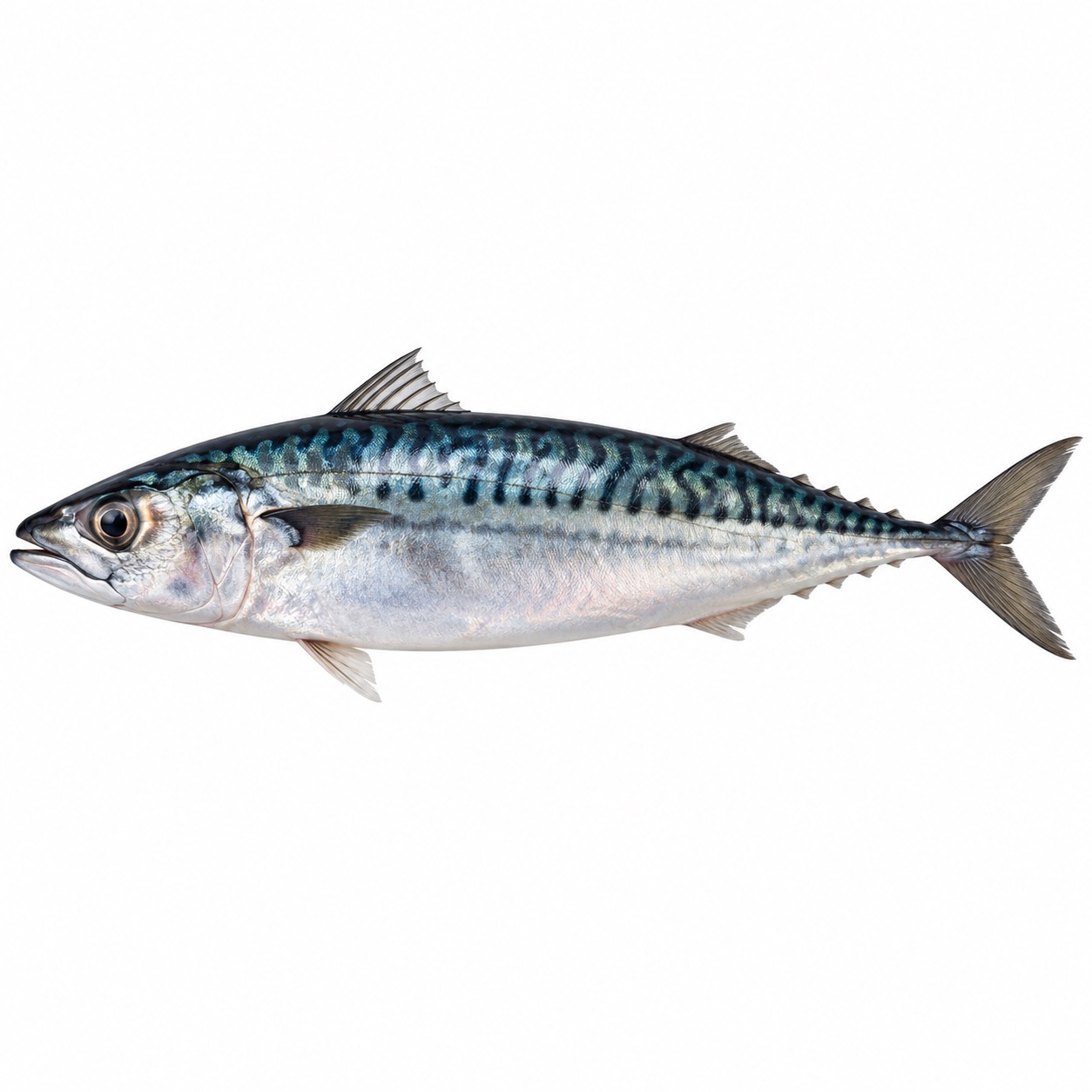
Atlantic mackerel has an elongated spindle-shaped body, a silvery underside and a blue-green back marked by numerous dark wavy bars.
Tuscany Cuisine · Culinary Foundations · Fish & Seafood
Sgombro · Atlantic Mackerel · Scomber scombrus
Mackerel is a fast-swimming pelagic fish recognized by its metallic blue-green back, dark wavy markings and silvery belly. Its naturally oily flesh gives it rich flavor, moist texture and strong culinary character, making it particularly suited to direct heat, smoking, salting, pickling and bold Mediterranean accompaniments.
Professional fish identity
Mackerel belongs to a broad family of streamlined pelagic fishes. For professional purchasing, the word “mackerel” is not enough: species, catch area, size, processing form and harvest method should be specified because multiple species enter the market under related common names.
Atlantic mackerel has an elongated spindle-shaped body, a silvery underside and a blue-green back marked by numerous dark wavy bars.
A schooling pelagic fish that spends much of its life in open water and migrates seasonally with temperature, food availability and spawning patterns.
Classified as an oily fish. Its fat content gives superior moisture and flavor but also means freshness and cold-chain control are especially important.
Species awareness
Commercial naming varies. Use the scientific name when sourcing for a precise menu or purchasing specification.
Scomber scombrus
North Atlantic species and the primary identity used for this Tuscany Cuisine foundation page.
Scomber colias
Warmer-water Atlantic species, also sold under mackerel and chub-mackerel names.
Scomber japonicus
Important eastern Pacific species common off California and Mexico; culinary handling is similar but market identity should remain distinct.
History & Mediterranean tradition
Mackerel has long been important because it is abundant, flavorful and well suited to preservation. Before modern refrigeration, salting, fermentation and other preservation methods allowed oily pelagic fish to travel far from the coast.
Archaeological and historical research shows that salted fish and fermented fish sauces were widespread in the Roman Mediterranean. Mackerel, together with sardines, anchovies and other pelagic fish, appears in this preservation tradition and in the broader history of garum and salsamenta.
Across Italy, Spain, Portugal, France, Britain and northern Europe, mackerel remains important fresh, grilled, baked, smoked, salted, pickled or canned. Its intensity makes it especially compatible with herbs, citrus, vinegar, tomato, mustard, onion and bitter greens.
Origins, range & habitat
Atlantic mackerel occurs on both sides of the North Atlantic and in adjacent seas. It is a cold-to-temperate pelagic species that moves in schools over the continental shelf, migrating between feeding, overwintering and spawning areas.
In North American waters, Atlantic mackerel ranges from Labrador south toward North Carolina and migrates through New England and Mid-Atlantic waters.
European stocks range through the northeast Atlantic, North Sea and neighboring waters, with seasonal migration between feeding and overwintering grounds.
Mackerel species are familiar throughout Mediterranean markets. Italian culinary language commonly uses sgombro for this family of oily, striped pelagic fish.
Seasonality & market form
| Factor | Chef meaning | Purchasing note |
|---|---|---|
| Seasonal migration | Mackerel moves with water temperature, spawning cycles and food availability. | Local fresh availability can change sharply through the year. |
| Fat content | Oil level can vary with season and feeding condition, changing richness and cooking behavior. | Ask suppliers about catch area, size and season. |
| Fresh market | Best handled very cold and used promptly because oily fish deteriorates quickly. | Check bright skin, clear eyes, firm flesh and clean sea aroma. |
| Frozen / preserved | Frozen, smoked, salted and canned mackerel extend year-round availability. | Use the processing form as a separate menu and inventory specification. |
Flavor profile
High relative to lean white fish; natural oils keep the flesh moist and give a full finish.
Pronounced savory character supports strong herbs, alliums, fermented condiments and roasted flavors.
Soft, flaky and moist when cooked correctly; overcooking can make the flesh dry and the dark meat taste stronger.
Lemon, vinegar, tomato, pickles, mustard and wine are natural partners because acidity cuts through the oil.
Nutrition
NOAA’s seafood reference for raw Atlantic mackerel lists approximately the following values per 100 g. Exact values vary with season, individual fish and laboratory method.
Mackerel is widely valued as an oily fish rich in long-chain omega-3 fatty acids, making it nutritionally distinct from many lean white fish.
Atlantic mackerel is also an excellent source of selenium and provides important B vitamins, including niacin, B6 and B12.
Purchasing, freshness & fabrication
Look for bright reflective skin, clear prominent eyes, red to pink gills, resilient flesh and a clean marine aroma. Dull skin, soft belly, strong oxidation or sour odor signal declining quality.
Because mackerel is oily and highly perishable, keep it very cold from receiving through fabrication and service. Store on drained ice or under an approved refrigerated seafood system.
Common restaurant forms include whole gutted fish, butterflied fish, skin-on fillets and pin-boned portions. Trim bloodline selectively when a milder flavor is desired.
Professional cooking methods
Mackerel responds best to methods that respect its oil content, create surface browning and pair the fish with acidity or aromatic freshness.
Culinary applications
Grilled sgombro, roasted fish, tomato-based preparations, agrodolce, herb sauces, citrus, capers, olives and seasonal vegetable plates.
Smoking, salting, pickling and canning emphasize mackerel’s rich character and make it useful for antipasti, salads, spreads and sandwiches.
Mackerel can support refined restaurant compositions when its richness is controlled with texture, acidity and precise accompaniments.
Lemon, orange, vinegar, tomato, onion, shallot, garlic, basil, parsley, rosemary, mustard, horseradish, capers, olives, fennel, bitter greens, pine nuts, currants and white wine.
Mineral, high-acid whites and dry rosato styles can balance mackerel’s oily texture. Match the wine to the sauce and garnish as much as to the fish itself.
Tuscany Cuisine recipe connection

Baked mackerel wrapped in caul fat, with pine nuts, currants, basil risotto and tomato coulis. The recipe is preserved in Tuscany Cuisine as a professional competition-dish memory connected to Chef David Giani’s participation as a selected finalist in the Gualtiero Marchesi Award in Milan in 2003.
Base mackerel quantity: 360 g for 2 servings.
Recipe ID: 448 · Station: Secondi / Fish Station.
Tuscany Cuisine ingredient system
This identity connects the new Sgombro icon with recipe ingredients, Menu Builder, Live Inventory, purchasing, receiving, production, Culinary Foundations and master search.
FISH-MACKEREL-FILLETmackerel_fillet/academy/culinary-foundations/fishes/Sgombro.webp/academy/culinary-foundations/fishes/Mackarel.htmlmackerel_fillet for compatibility with the integrated Secondi recipe.Professional FAQ
Sgombro is the Italian name commonly used for mackerel. This foundation page uses Atlantic mackerel, Scomber scombrus, as the primary scientific identity.
Mackerel contains more natural oil and has a pronounced dark-meat character. Its flavor is best balanced with acidity, aromatics, herbs and fresh vegetables rather than treated like a delicate lean fish.
Often yes. Skin protects the flesh and can become crisp during grilling or pan searing. Scale, trim and dry the skin carefully before cooking.
No. Multiple species are sold as mackerel. Professional purchasing should identify the species and origin whenever possible.
Professional references