Manzanillo
A major table-olive cultivar and one of the varieties commonly associated with California ripe-olive processing.
The familiar mild black olive found in cans, foodservice containers, pizzas, salads and sandwiches is usually a canned ripe black olive. Its color and flavor are created through controlled processing rather than simply leaving every olive on the tree until naturally black.
This is an important distinction for culinary education: regular canned black olives and naturally black fermented olives are not the same product style.
For Recipe 180, Tuscany Cuisine now identifies the ingredient specifically as pitted canned black olives instead of using a vague generic olive identity.
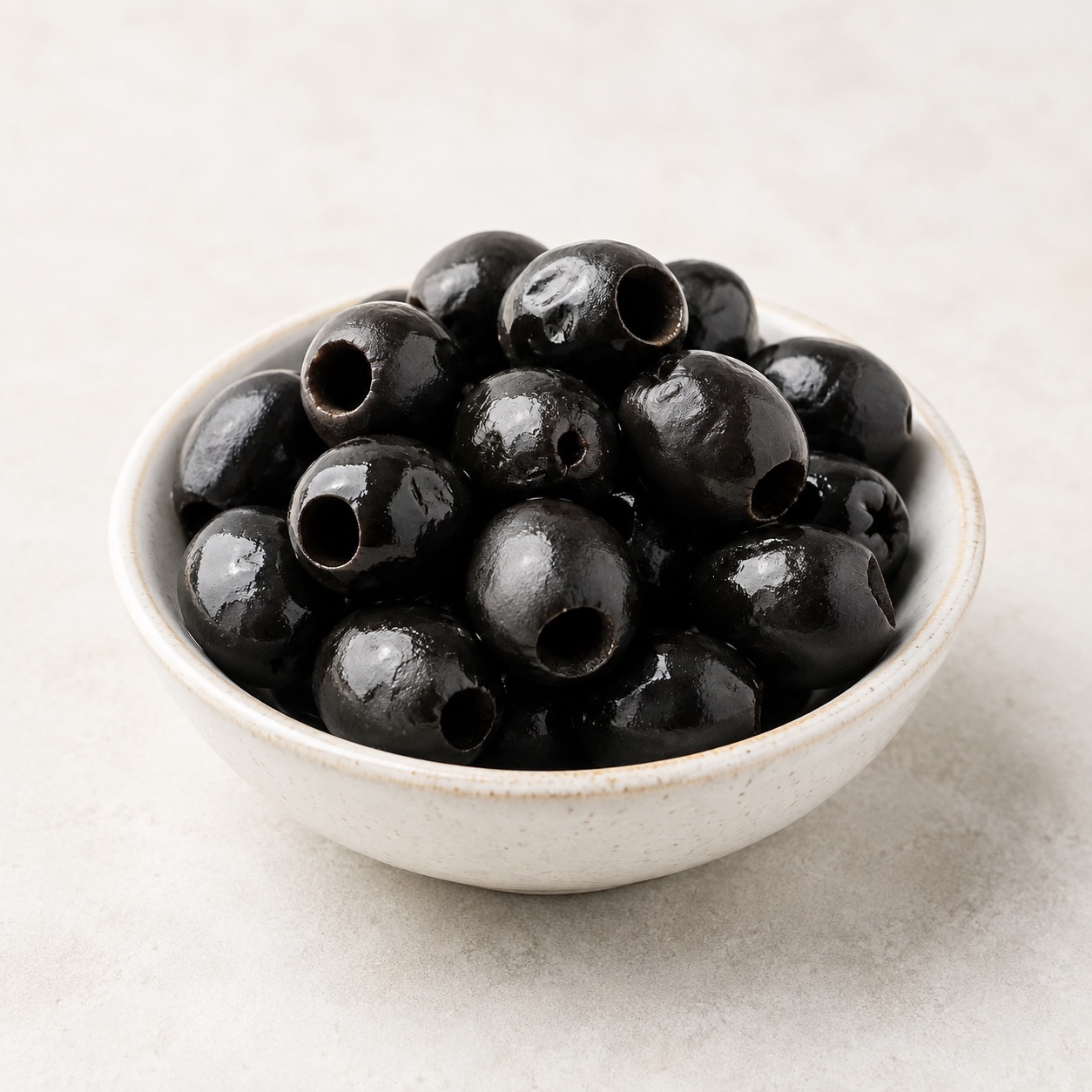
canned_black_olivesThe mild, uniform black olive used throughout American and international foodservice.
Olives naturally contain bitter compounds, especially oleuropein, so they normally require curing or processing before they are pleasant to eat. The common canned black olive belongs to a commercial style often associated with the California ripe-olive process.
These olives can be harvested while still green or beginning to change color. During processing they are debittered, exposed to air under controlled conditions so the flesh darkens through oxidation, packed in a salt solution and heat processed in sealed containers for preservation.
A simplified professional overview of the California-style ripe-black process.
Salted liquid is important, but the commercial preservation system is more than brine alone.
In the kitchen, the liquid surrounding canned black olives can taste like a relatively mild brine compared with strongly cured Mediterranean olives. Technically, however, the product is preserved through a combination of processing steps: debittering, controlled pH, salt solution, sealed packaging and heat sterilization.
Because manufacturers use different formulations, Tuscany Cuisine should not assign one exact salt percentage to every canned black olive. Always use the supplier specification or label when sodium, brine concentration or food-cost calculations need precision.
Two different product families that should remain separate in the ingredient registry.
Often harvested before full black maturity, debittered with alkaline treatment, darkened through oxidation, commonly color-stabilized, packed in a salt solution and heat sterilized. Usually mild, smooth and uniform.
Harvested at or near natural ripeness and traditionally placed directly into brine for fermentation or curing. Examples include many Greek-style black olives. They usually have stronger varietal flavor and a more distinctive cured character.
The final product style is shaped by both cultivar and processing method.
A major table-olive cultivar and one of the varieties commonly associated with California ripe-olive processing.
Historically important in California and suitable for both table-olive and oil uses. It also appears in canned ripe-olive standards.
Larger-fruited table varieties may be prepared whole or pitted when size and flesh-to-pit ratio suit commercial service.
Stone retained. Useful for antipasti, garnishes and service where the intact fruit is preferred.
The most useful format for sandwiches, salads, pizza and recipe production because there is no pit hazard during service.
Convenient foodservice formats for pizza, salads, baked dishes, sandwiches, fillings and garnish applications.
Harvest is seasonal; the canned ingredient is available throughout the year.
Fresh olive harvest depends on cultivar, climate and the processing style desired. Fruit for canned ripe olives may be harvested before complete natural black ripeness. Once processed and commercially canned, the ingredient becomes a stable year-round pantry item.
For purchasing, focus less on “fresh season” and more on supplier consistency, drained weight, size grade, pitted-versus-whole format, sodium level and the specific style needed by the recipe.
Approximate values for canned ripe olives; brand, size and brine can change the numbers.
| Energy | Approximately 116 kcal per 100 g for a USDA reference entry of canned ripe olives |
|---|---|
| Protein | About 0.8 g per 100 g |
| Total fat | About 10.9 g per 100 g |
| Carbohydrate | About 6.0 g per 100 g |
| Fiber | About 1.6 g per 100 g |
| Sodium | About 735 mg per 100 g in the referenced canned-ripe-olive dataset |
| Cholesterol | 0 mg |
A mild pantry olive with broad foodservice versatility.
Pitted black olives add mild saltiness and soft olive flavor without dominating delicate fillings such as whipped fish, poultry or vegetables.
Sliced black olives are widely used as a topping because they distribute evenly and hold their shape during baking.
Useful in mixed salads, pasta salads and composed antipasti when a mild olive is preferred over a stronger fermented variety.
Can be sliced or chopped into tomato sauces, pasta preparations, puttanesca-inspired dishes and Mediterranean garnishes.
Suitable for savory fillings, olive spreads and forcemeat-style preparations where a neutral black olive is useful.
Whole or halved pitted olives provide clean visual contrast on antipasti, buffet platters and baked dishes.
Follow the commercial package and protect the product after opening.
The exact identity needed for Recipe 180 and future pantry synchronization.
| Canonical name | Canned Black Ripe Olives |
|---|---|
| Recipe display name | Pitted Black Olives |
| Common kitchen name | Regular Black Olives |
| Inventory ID | canned_black_olives |
| Category | Pantry / Preserved Produce |
| Subcategory | Table Olives / Canned Black Ripe Olives |
| Base unit | g |
| Icon | /academy/ibrary/fruit/blackolive.jpeg |
| Knowledge page | /academy/ibrary/fruit/blackolive.html |
| Formal ingredient code | Pending Master Ingredient Registry assignment |
| Connected recipe | Recipe 180 — Grilled Sandwich with Whipped Stoccafisso |
| Recipe quantity | 20 g · pitted and sliced |
Official sources used to distinguish canned ripe black olives from naturally black table olives.