
About the Tuscany Cuisine Original Film
The Flour of the World — From Ancient Grain to Modern Culinary Science
The film above is now the primary content of this page. It introduces the long story of flour before the visitor continues into the technical library: wheat families, milling, 00 flour, durum semolina, semola rimacinata, W and P/L, hydration, dough temperature, pasta, bread, pizza, pastry and Panettone production.
Use the sections below as the film’s companion professional reference. The separate Italian Bread documentary remains available further down this page as a companion film focused specifically on breadmaking traditions, lievito madre, fermentation and regional Italian breads.
Tuscany Cuisine Original Documentary · Companion Film
The Art of Italian Bread
From ancient traditions to modern baking science — discover how grain becomes a living dough and how generations of Italian bakers developed their regional breads.
Continue the journey from flour to bread. After exploring wheat varieties, milling and flour performance in The Flour of the World, follow Chef David Giani through twelve chapters of Italian breadmaking history and culinary craftsmanship.
Discover Pane Toscano, Pane di Altamura, focaccia, ciabatta and regional flatbreads, together with lievito madre, gluten development, hydration, shaping, oven spring and the science of the golden crust.
Explore the connections between this film and the Flour Library's lessons on wheat, semola rimacinata, dough strength and fermentation.
Tuscany Cuisine · Educational Documentary by Chef David Giani
Professional ingredient identity
Why Flour Choice Changes the Finished Product
Two flours can look identical but behave completely differently. One may create a tender cookie; another may make the same cookie tough. One may support high-hydration pizza for a long fermentation; another may spread, tear or over-ferment. The chef must match flour performance to the product and process.
Structure
Water hydrates gluten-forming proteins. Mixing and fermentation organize that network. Strong flour generally supports more gas, longer fermentation and more water, but excessive strength can make tender products chewy.
Tenderness
Cakes, biscuits, shortbread, many cookies and shortcrust pastry benefit from lower gluten-forming potential.
Production tolerance
Commercial kitchens need flour that tolerates mixer friction, holding time, refrigeration, freezing, sugar, fat and operational variation.
Professional rule:
Never choose flour only because the bag says
00,
bread flour,
Manitoba,
semolina
or all-purpose.
Read the technical specification
and match the flour to the process.
Commercial kitchen flour cards
Core Flour Types for a Professional Kitchen
The Tuscany Cuisine Flour Library now includes live ingredient graphics for All-Purpose Flour, Italian 00 Type Flour and Whole Wheat Flour as well as the Durum Semolina family . Regular semolina and semola rimacinata remain separate inventory identities because their particle size, hydration and culinary applications differ.
Icon live
Primary pantry flour
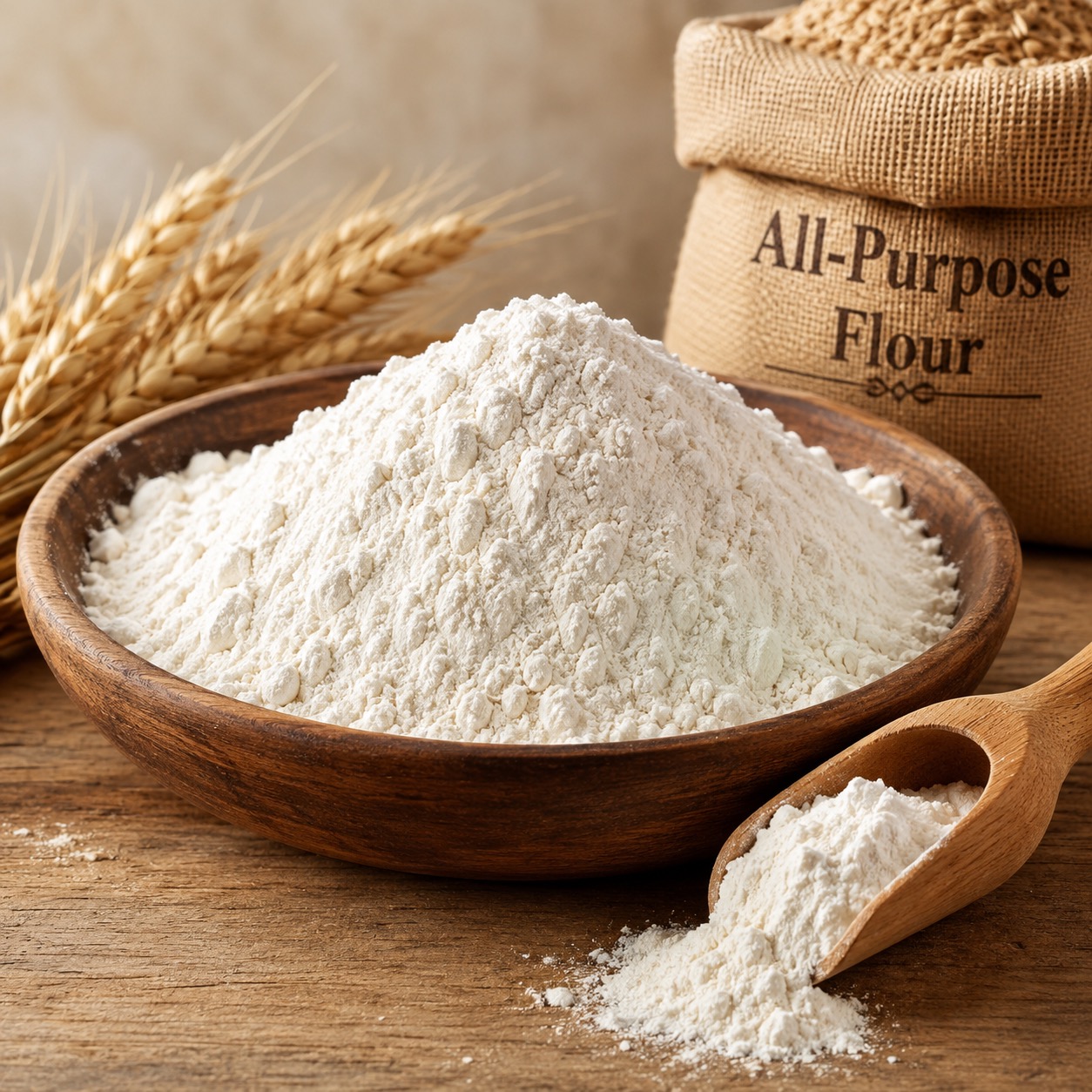
All-Purpose Flour
Inventory ID: all_purpose_flour
The most flexible flour in a commercial kitchen. It is appropriate for many savory and pastry applications when an extremely weak or extremely strong flour is not required.
- Batters, muffins, pancakes and many cookies
- Dredging, coating, roux and béchamel
- Croquettes and general kitchen production
Icon live
Fine Italian soft-wheat flour
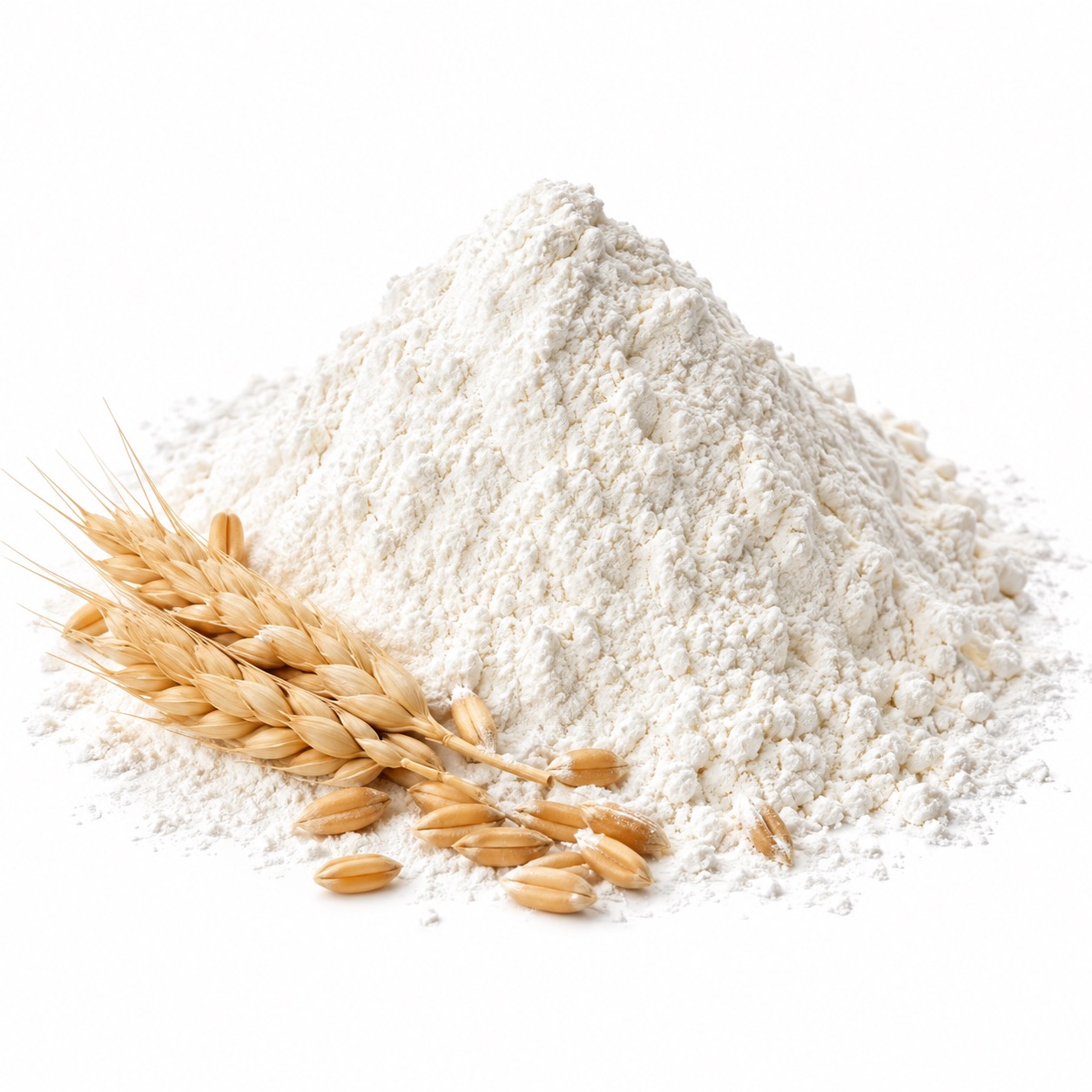
Italian 00 Type Flour
Inventory ID: 00_italian_flour
Italian 00 identifies a highly refined common-wheat flour type. It does not define strength by itself, so professional selection should still consider protein quality, W, P/L and the miller's technical specification.
- Fresh pasta and fine common-wheat pasta doughs
- Pizza when the selected 00 specification matches fermentation and hydration
- Pastry and bakery applications when the flour strength is appropriate
Icon live
Whole-grain flour
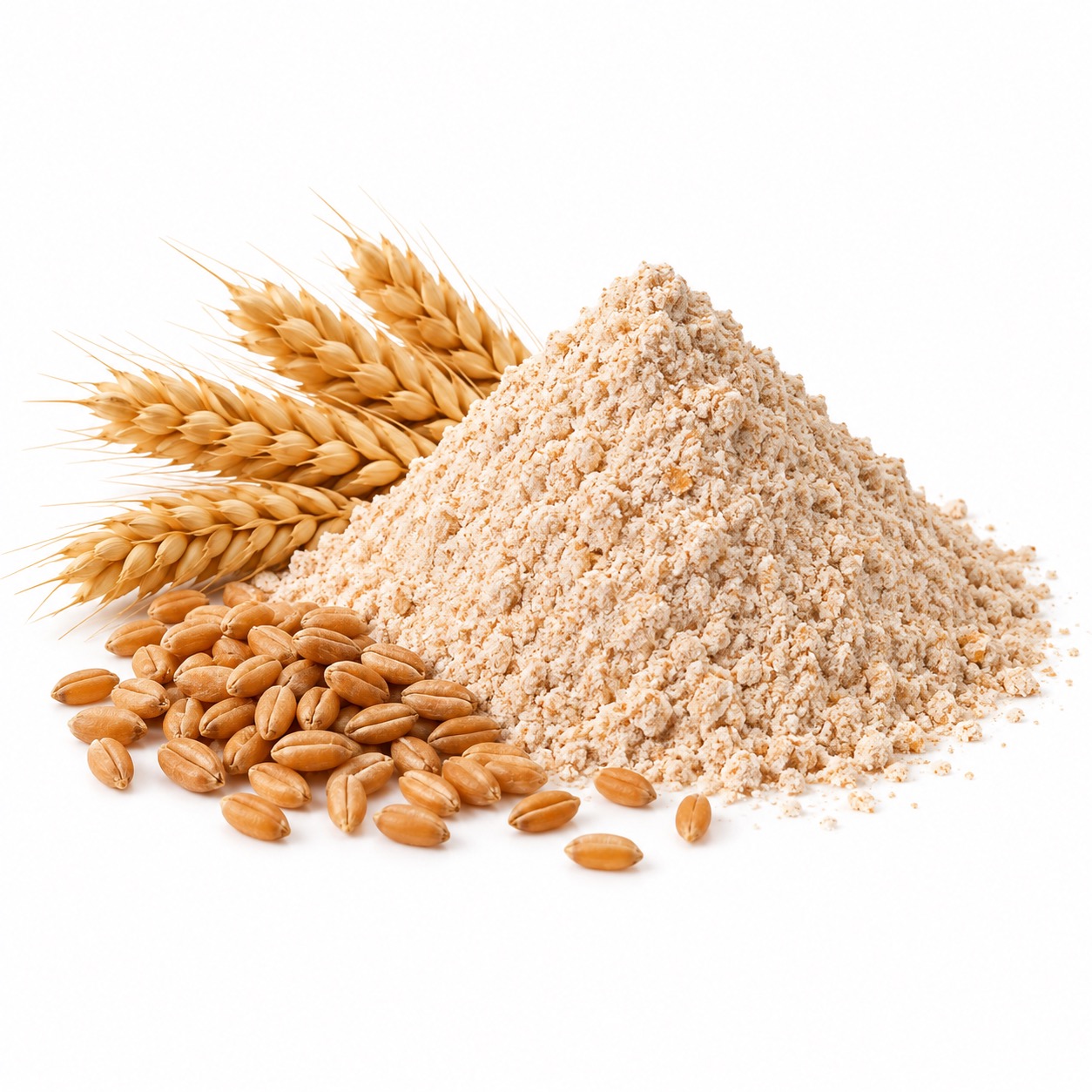
Whole Wheat Flour
Inventory ID: whole_wheat_flour
Whole wheat flour retains bran, germ and endosperm, giving doughs more grain flavor, fiber and mineral content while also changing hydration and gluten development. Bran particles can interrupt the gluten network, so formulas often need additional water, rest time or blending with refined flour.
- Whole-grain bread and rustic bakery doughs
- Whole wheat pasta and fresh pasta flour blends
- Higher-fiber doughs where stronger grain flavor is desired
Page planned
Bread production
Bread Flour
icon card coming next
icon card coming next
Bread Flour
Planned inventory ID:
bread_flour
Selected for lean bread and some pizza styles when stronger dough development, better gas retention and greater fermentation tolerance are required.
- Lean loaves and rolls
- Selected hearth breads
- Some pizza applications
Page planned
Tender dough
Pastry Flour
icon card coming next
icon card coming next
Pastry Flour
Planned inventory ID:
pastry_flour
More appropriate than bread flour for tart shells, short dough, brisée, biscuits and preparations where tenderness matters.
Page planned
Delicate crumb
Cake Flour
icon card coming next
icon card coming next
Cake Flour
Planned inventory ID:
cake_flour
Designed for delicate cakes and soft crumb structure where tenderness is more important than dough strength.
Page planned
Style specific
Pizza Flour
00 / 0 / style-specific
00 / 0 / style-specific
Pizza Flour
Planned inventory ID:
pizza_flour
Chosen by pizza style, fermentation time, hydration and opening method, not simply by the term 00.
Icon live
Coarse durum
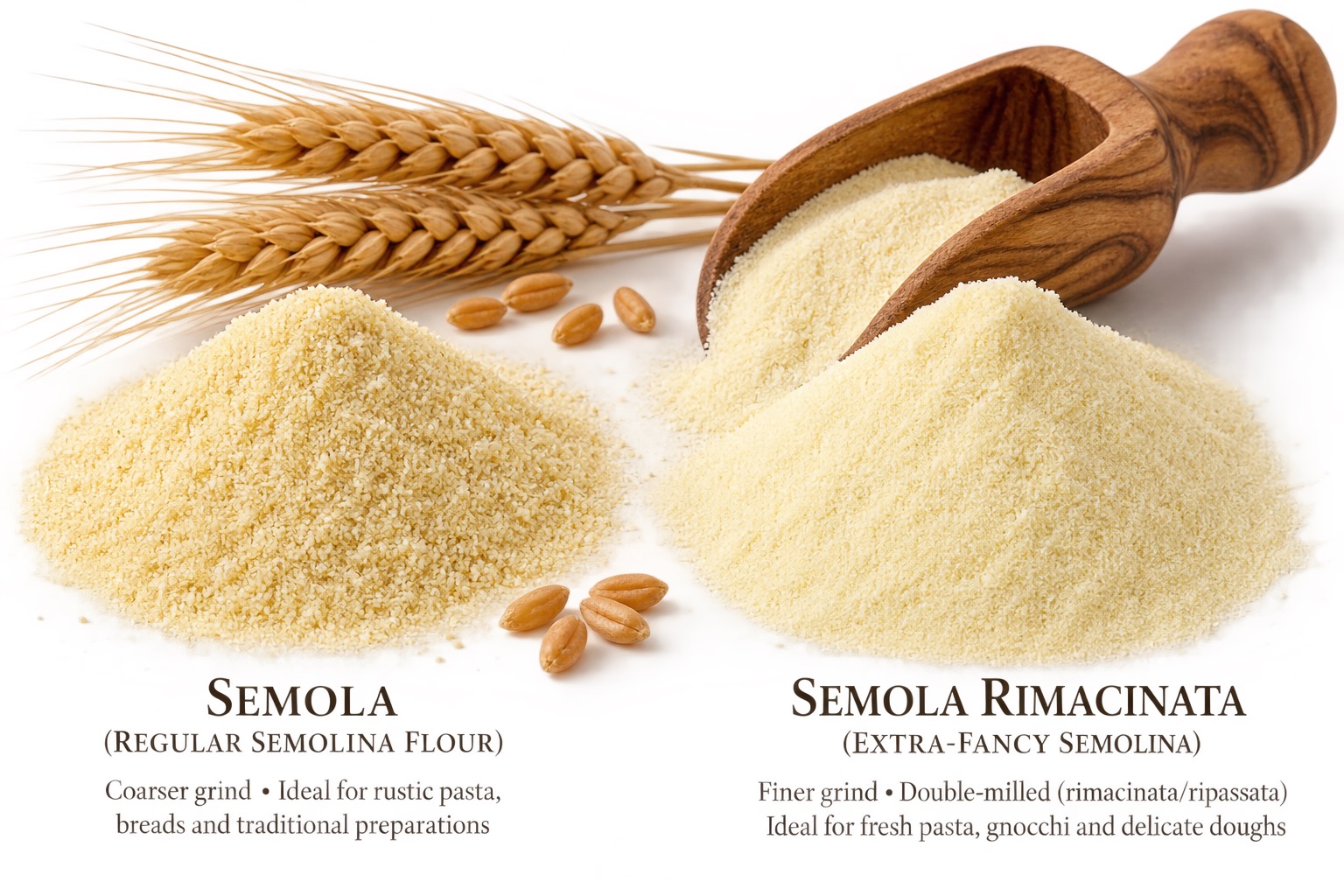
Durum Semolina — Semola
Inventory ID:
durum_semolina
Regular semolina is the coarser, granular milling product of durum wheat . The particles remain visibly larger than re-milled semolina. This texture gives semolina excellent characteristics for extruded pasta, dried pasta, couscous, dusting and selected rustic bread applications.
- Extruded pasta such as spaghetti, rigatoni and many dried shapes
- Traditional water-and-semola pasta doughs
- Couscous and related grain preparations
- Bench flour for pasta production
- Pizza peel and bread dusting because the grains remain relatively discrete
- Rustic durum breads when the formula is designed for coarse semolina
Because the particle is coarser, regular semolina absorbs water more slowly than rimacinata. Resting time can therefore be important when it is incorporated directly into fresh dough.
Icon live
Fine durum
Semola Rimacinata — Extra-Fancy Semolina
Inventory ID:
semola_rimacinata
Semola rimacinata is durum semolina that has been re-milled into a much finer particle size . In many professional and commercial kitchens, very fine durum semolina may also be described as extra-fancy semolina . Its finer texture hydrates more quickly, forms a more cohesive dough and is particularly valuable for fresh pasta and bread production.
- Fresh handmade pasta
- Orecchiette, cavatelli and regional Southern Italian pasta
- Filled pasta and delicate durum pasta dough
- Fresh extruded pasta when finer hydration is desired
- Pane di Altamura-style bread production
- Southern Italian durum-wheat loaves
- Durum focaccia and rustic bakery doughs
- Natural sourdough and lievito madre systems using durum wheat
Because the particles are finer, rimacinata integrates water more uniformly and is generally easier to develop into a continuous dough. For fresh pasta, this can produce a smoother surface while retaining the distinctive golden color, firmness and durum flavor.
Page planned
Great leavened doughs
Panettone / High-Strength Flour
very strong specialty flour
very strong specialty flour
Panettone / High-Strength Flour
Planned inventory ID:
panettone_flour
Specialty strong flour designed for long fermentation and enriched doughs such as Panettone, Colomba and Pandoro.
New flour graphics now live:
/academy/ibrary/pantry/flours/whole-wheat.webp now represents
whole_wheat_flour, and
/academy/ibrary/pantry/flours/00type-flour.webp now represents
00_italian_flour. The existing
/academy/ibrary/pantry/flours/semola.webp remains the family graphic for
regular durum semolina and semola rimacinata.
All four inventory identities remain separate so recipe costing, purchasing and production can distinguish each flour correctly.
From grain to flour
How Milling Changes Flour Performance
Modern roller milling separates the wheat kernel in stages. Wheat is cleaned, conditioned with moisture, opened through break rolls, sifted, reduced through finer rolls, classified and blended to achieve a target flour specification.
Cleaning & conditioning
Foreign material is removed and wheat is tempered with controlled moisture.
Break system
Corrugated rolls open the kernel and release endosperm.
Sifting & reduction
Plansifters classify particle sizes. Smooth reduction rolls progressively reduce purified endosperm into finer flour streams.
Extraction
Lower-extraction white flour contains mostly endosperm. Higher extraction introduces more outer-kernel material, increasing mineral content, flavor and often water demand.
Re-milling
Durum semolina can be passed through additional milling stages to create a much finer product. This is the principle behind semola rimacinata .
Quality control
Protein, ash, moisture, gluten quality, alveograph W/P-L, farinograph absorption and stability can help define performance.
Wheat terminology
Soft Wheat, Hard Wheat and Durum Wheat
Italian grano tenero and grano duro describe different wheat families. Durum wheat is not simply a stronger version of common wheat.
Grano tenero
Triticum aestivum supplies most bread, pizza, pastry and cake flour.
Hard common wheat
Hard common-wheat classes are frequently used for bread flour and stronger all-purpose flour.
Grano duro
Triticum durum has hard amber kernels and produces semolina, semola rimacinata and other durum milling products.
Durum wheat family
Regular Semolina vs Semola Rimacinata / Extra-Fancy Semolina
The two products begin with the same fundamental grain: durum wheat. The principal operational difference is the degree of milling and resulting particle size. That difference changes hydration, mixing behavior, surface texture and the products for which each flour is most practical.
Semola / Regular Semolina
Coarse durum milling productRegular semolina has a coarse, granular texture. The individual particles are larger and hydrate more slowly. Its natural durum pigments give it the characteristic cream-to-golden appearance associated with Italian pasta.
Best culinary applications
- Dried and extruded pasta
- Spaghetti
- Rigatoni
- Penne
- Bucatini
- Couscous
- Pasta bench dusting
- Bread and pizza peel dusting
- Selected rustic durum breads
In fresh pasta
Regular semolina can certainly be used in fresh pasta, particularly rustic, hand-shaped, water-based Southern Italian doughs. Because the particle is larger, the dough often benefits from more hydration time or resting.
In bread
Coarse semolina can be included in durum-wheat bread formulas for flavor, color and texture. However, it does not hydrate as uniformly as fine rimacinata and may produce a more rustic crumb and dough feel.
Semola Rimacinata
Fine re-milled durum · Extra-Fancy SemolinaSemola rimacinata is produced by taking durum semolina and reducing it further to a much finer particle size. The flour becomes smoother and behaves more like a conventional fine flour while maintaining the flavor, color and protein characteristics of durum wheat.
Best culinary applications
- Fresh pasta
- Orecchiette
- Cavatelli
- Malloreddus
- Filled pasta doughs
- Fresh extruded pasta
- Pane di Altamura-style bread
- Southern Italian durum breads
- Durum focaccia
- Natural-leavened durum bread
In fresh pasta
Fine rimacinata absorbs water more uniformly and creates a smoother, more cohesive dough. For this reason it is especially useful when producing fresh pasta where clean sheeting, shaping or filling is important. It can be used alone or blended with common-wheat flour depending on the desired bite and elasticity.
In Italian bread
Rimacinata is particularly important in Southern Italian bread traditions. Its finer particle size allows the durum flour to hydrate more completely, develop a continuous dough and support controlled fermentation. It produces bread with a characteristic golden crumb, durum aroma and excellent keeping qualities.
| Characteristic | Regular Semolina | Semola Rimacinata / Extra-Fancy |
|---|---|---|
| Wheat | Durum wheat | Durum wheat |
| Particle size | Coarse / granular | Fine / re-milled |
| Hydration speed | Slower | Faster and more uniform |
| Dough feel | Rustic, textured | Smoother and more cohesive |
| Extruded dry pasta | Excellent | Can be used, but coarse semolina is the classic production choice |
| Fresh pasta | Excellent for rustic hand-shaped pasta; may require longer hydration | Excellent for smooth fresh pasta and filled or shaped production |
| Dusting | Excellent because grains remain separate | Less useful than coarse semolina for peel dusting |
| Italian durum bread | Useful in selected rustic formulas and blends | Preferred for many traditional fine-durum bread systems |
| Sourdough / lievito madre | Possible | Particularly useful where durum flour is part of the bread identity |
| Tuscany Cuisine Inventory ID |
durum_semolina
|
semola_rimacinata
|
Fresh pasta production:
For a smooth fresh pasta dough,
semola rimacinata / extra-fancy semolina
generally integrates water
more rapidly and evenly.
Coarse semolina remains especially valuable
for extruded pasta,
rustic hand-shaped pasta
and dusting.
Italian bread production:
fine re-milled durum semolina
is particularly valuable
for Southern Italian bread systems.
The flour can be mixed with water,
salt
and natural sourdough
to produce
golden,
aromatic,
durum-forward bread.
Successful production depends on
the actual semolina specification,
hydration,
mixing,
dough temperature
and fermentation control.
Inventory rule:
do not substitute
durum_semolina
and
semola_rimacinata
silently.
They come from the same wheat family
but they are operationally different products.
For purchasing,
recipe costing
and production control,
Tuscany Cuisine should maintain
two distinct ingredient identities.
International flour language
Why Flour Names Change from Country to Country
Flour names are not universally interchangeable. Italy, France and Germany use flour type systems that differ from United Kingdom and North American use-name systems.
| System | Typical labels | What the label tells you | Professional interpretation |
|---|---|---|---|
| Italy — soft wheat | 00, 0, 1, 2, integrale | Refinement / ash and compositional limits | Strength must still be evaluated separately. |
| Italy — durum | semola, semolato, semola integrale, farina di grano duro, rimacinata | Durum-wheat milling products | Particle size and mill specification help determine pasta and bread applications. |
| United States / Canada | cake, pastry, all-purpose, bread, high-gluten, semolina, extra-fancy semolina | Use category plus mill specification | Product terminology varies by mill; verify technical data. |
Performance measurements
Protein, W, P/L, Stability and Extensibility
Protein percentage alone does not tell the entire story. Professional flour purchasing should consider protein quality, strength, extensibility, absorption and stability.
Protein %
Higher protein generally provides more potential structure, but protein quality matters.
W
W expresses dough strength through alveograph testing.
P/L
P represents resistance; L represents extensibility. A balanced dough requires both.
Chef's use matrix
Select Flour by the Product You Are Producing
All-Purpose Flour
Medium strength · flexible
General cooking, roux, béchamel, coating, batters, muffins, pancakes and many cookies.
Fresh Pasta — Semola Rimacinata
Fine durum · smooth hydration
Excellent for fresh handmade pasta, orecchiette, cavatelli, fresh extruded pasta and doughs where a smooth, cohesive durum structure is preferred.
Dried / Extruded Pasta
Regular durum semolina
Coarse or appropriately specified durum semolina is the classic raw material for many dried, extruded pasta shapes.
Pasta Dusting
Regular coarse semolina
Excellent for trays, benches, pasta surfaces and other situations where the flour must remain relatively dry and discrete.
Southern Italian Durum Bread
Semola rimacinata
Fine durum semolina is particularly suited to breads such as Pane di Altamura-style loaves and other Southern Italian durum-wheat bread traditions.
Durum Sourdough
Rimacinata + lievito madre
A mature natural starter can be refreshed with fine durum semolina where the flour forms part of the bread's production identity.
Pizza
Style-specific flour
Select by fermentation, hydration, dough temperature and desired opening behavior.
Pastry
Weak to medium flour
Tarts, shortcrust, biscuits and tender pastry require controlled gluten development.
Panettone
Very strong specialty flour
Long fermentation, high sugar, egg yolk and butter require extreme dough stability.
Water absorption
Why Different Flours Absorb Different Amounts of Water
Protein
Protein quantity and quality influence water absorption.
Particle size
Coarse semolina hydrates more slowly. Fine rimacinata hydrates faster and more uniformly.
Extraction
Higher-extraction flour and bran-rich flour generally demand more water.
Pasta production rule:
when moving from
regular semolina
to fine rimacinata,
do not assume the same mixing time
or hydration behavior.
Test the actual product
and record the final production formula.
Dough temperature control
Warm Water in Winter, Cold Water in Summer — But Always for a Reason
Water temperature should be selected to achieve the desired final dough temperature.
Desired Dough Temperature Water Calculator
Water temperature ≈ (Desired dough temperature × 3) − flour temperature − room temperature − mixer friction.
Suggested water temperature: 23.0 °C
Italian great leavened products
Panettone, Colomba and Other Rich Lievitati Need Specialized Flour
Panettone and Colomba require strong, stable flour capable of supporting long fermentation, sugar, egg yolks and butter.
Commercial kitchen operations
How a Restaurant or Bakery Should Control Flour
1. Use exact product identities
All-purpose,
regular semolina
and rimacinata
must remain separate inventory records.
2. Record manufacturer + lot
Track mill,
product name
and lot where dough consistency is critical.
3. Save technical specifications
Protein,
ash,
W,
P/L,
absorption
and stability belong in the vendor record when available.
4. Test hydration
Test a controlled production batch
whenever flour changes.
5. Control dough temperature
Bread,
pizza
and fermented dough recipes
should specify final dough temperature.
6. Separate dusting flour
Coarse semolina used on benches
and peels can be tracked separately
from dough flour.
7. Protect dry storage
Keep flour away from
heat,
humidity,
pests,
chemicals
and strong odors.
8. Wheat allergen control
Both regular semolina
and rimacinata contain
wheat and gluten.
Tuscany Cuisine Recommended Flour Identities
| Ingredient identity | Inventory ID | Icon | Main system use |
|---|---|---|---|
| All-Purpose Flour |
all_purpose_flour
|
allpourposeflour.png
|
General cooking, coating, batter, sauces and pastry |
| Italian 00 Type Flour |
00_italian_flour
|
00type-flour.webp
|
Fresh pasta, specification-matched pizza, fine common-wheat dough and selected pastry |
| Whole Wheat Flour |
whole_wheat_flour
|
whole-wheat.webp
|
Whole-grain bread, whole wheat pasta, fresh pasta blends and rustic doughs |
| Durum Semolina |
durum_semolina
|
semola.webp
|
Dried pasta, extruded pasta, couscous, dusting and selected breads |
| Semola Rimacinata |
semola_rimacinata
|
semola.webp
|
Fresh pasta, handmade pasta, Italian durum bread and sourdough |
| Bread Flour |
bread_flour
|
Planned | Lean bread and selected pizza |
| Panettone Flour |
panettone_flour
|
Planned | Panettone, Colomba and enriched long-fermented dough |
Nutrition & allergens
Flour Nutrition Depends on Extraction and Grain
Refined common wheat flour
Mostly endosperm, rich in starch with moderate protein.
Regular durum semolina
Durum wheat supplies characteristic yellow carotenoid pigments, protein and pasta-making properties.
Semola rimacinata
Nutritionally related to the durum semolina from which it is produced, but mechanically milled finer for different dough applications.
Allergen:
common wheat flour,
durum semolina
and semola rimacinata
contain wheat and gluten.
Tuscany Cuisine system record
Flour Family Identity & Platform Connections
The Flour Library now has five live ingredient identities: All-Purpose Flour, Italian 00 Type Flour, Whole Wheat Flour, Durum Semolina and Semola Rimacinata.
LIVE DURUM FAMILY
Semolina
Regular Semola + Semola Rimacinata
- Family Durum Wheat
-
Regular code
durum_semolina -
Rimacinata code
semola_rimacinata - Category Pantry / Flours / Durum Wheat
- Base unit g
-
Page
/academy/ibrary/pantry/flours/Farine.html#semolina -
Icon path
/academy/ibrary/pantry/flours/semola.webp - Allergens wheat, gluten
Live common-wheat identities:
00_italian_flour uses /academy/ibrary/pantry/flours/00type-flour.webp, and
whole_wheat_flour uses /academy/ibrary/pantry/flours/whole-wheat.webp.
Both are now ready for recipe icon synchronization, Live Inventory matching and purchasing references.
Recipe Library
Recipes can now connect specifically to All-Purpose, Italian 00, Whole Wheat, coarse semolina or fine rimacinata identities.
Recipes can now connect specifically to All-Purpose, Italian 00, Whole Wheat, coarse semolina or fine rimacinata identities.
Live Inventory
00_italian_flour,
whole_wheat_flour,
durum_semolina and
semola_rimacinata
remain separate operational identities.
Purchasing & Receiving
The vendor record can specify particle size, mill, protein and technical data.
The vendor record can specify particle size, mill, protein and technical data.
Pasta Production
Coarse semolina supports extruded and dried pasta; rimacinata supports smooth fresh pasta production.
Coarse semolina supports extruded and dried pasta; rimacinata supports smooth fresh pasta production.
Bread Production
Rimacinata supports Southern Italian durum bread and natural-leaven production.
Rimacinata supports Southern Italian durum bread and natural-leaven production.
Search & Academy
Visitors can now browse dedicated identities for 00 flour and whole wheat flour while still understanding why semolina and rimacinata are related but not interchangeable.
Visitors can now browse dedicated identities for 00 flour and whole wheat flour while still understanding why semolina and rimacinata are related but not interchangeable.
Flour FAQ
Questions Every Cook Should Know
What is the difference between regular semolina and semola rimacinata?
Both are durum-wheat milling products. Regular semolina is coarser and more granular. Semola rimacinata is re-milled to a significantly finer texture. The finer flour hydrates more uniformly and is especially useful for fresh pasta and Italian bread dough.
Is extra-fancy semolina the same as semola rimacinata?
In professional commercial terminology, extra-fancy semolina commonly refers to a very fine durum semolina product. Semola rimacinata is the Italian re-milled fine-semola concept. Because mills may use terminology differently, the purchasing specification should still verify particle size and intended application.
Which semolina should I use for fresh pasta?
Fine semola rimacinata is generally easier to hydrate and produces a smoother, more cohesive fresh dough. Coarse semolina is excellent for extruded pasta, rustic water-based pasta and dusting.
Can semola rimacinata make bread?
Yes. It is important in Southern Italian durum-wheat bread production and can be used with natural sourdough or lievito madre.
Can coarse semolina be used for bread?
Yes, particularly in rustic formulas and blends. Because it hydrates more slowly, the formula may require a different water level, resting period or mixing strategy than fine rimacinata.
Should semolina and rimacinata use the same inventory code?
No. They should remain separate because their particle size, hydration, purchasing specification and culinary applications differ.
Technical sources
Standards and Research Used for This Flour Library
- Italian Republic — DPR 9 February 2001, n. 187
- European Union — Pane di Altamura PDO specification
- European Union — Pagnotta del Dittaino PDO specification
- Scientific study — durum wheat breads, milling, sourdough and mother sponge
- Scientific study — durum and soft wheat flours in sourdough and straight-dough bread making
Technical values vary by mill, crop and product. For production, always use the supplier's current technical sheet and test the actual flour lot.