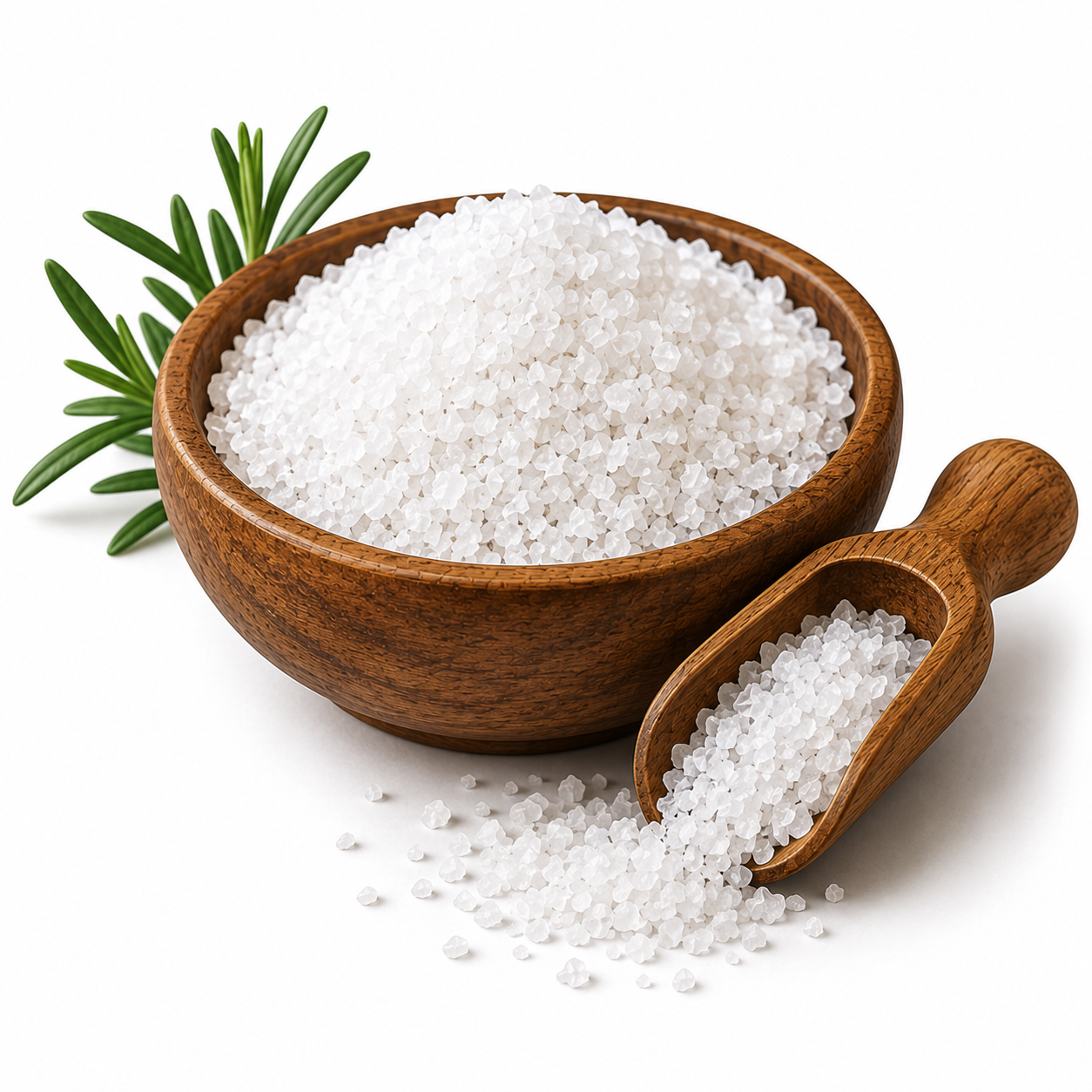
Coarse Sea Salt
Produced by evaporating seawater and retaining larger crystals. Commonly used for cooking water, salt crusts, grinders, roasting, brines and some dry-curing applications.
Cooking Brining CuringSalt is one of the most important ingredients in professional cooking. It seasons food, strengthens flavor, changes texture, controls moisture, supports fermentation, and has preserved fish and meat for centuries.
Join Chef David Giani on a journey from ancient preservation and the Roman Via Salaria to Pane Toscano, culinary salt varieties and the professional art of seasoning with intention.
Culinary salt is primarily sodium chloride. Its importance goes far beyond making food taste salty. Correct seasoning makes sweetness more visible, controls bitterness, balances acidity, improves the perception of aroma, and helps ingredients taste more like themselves.
Salt should be measured by weight whenever consistency matters. Different brands and crystal shapes occupy different volumes, so one tablespoon of fine table salt can contain much more salt than one tablespoon of large-flake kosher salt.
For recipe scaling, purchasing and inventory, record salt in grams.
Produced by evaporating seawater and retaining larger crystals. Commonly used for cooking water, salt crusts, grinders, roasting, brines and some dry-curing applications.
Cooking Brining CuringSea salt ground into smaller, more uniform particles. It dissolves quickly and distributes evenly in sauces, doughs, batters, dressings, soups and measured recipes.
Sauces Baking General cookingA popular professional kitchen salt with easy-to-handle crystals. Chefs value it for pinching, seasoning proteins, vegetables, pasta water and general mise en place. Crystal size varies by brand.
Daily seasoning Meat VegetablesVery fine refined salt with iodine added. It dissolves rapidly and is easy to measure, but its compact grains make it stronger by volume than many coarse salts. Some products contain anti-caking agents.
Table service Baking Household useFine, pure salt without iodine or anti-caking materials. It dissolves cleanly and helps avoid cloudy brines or unwanted discoloration in pickled and preserved foods.
Pickling Clear brines PreservationFleur de sel, flaky sea salt, sel gris, pink salts and other specialty salts are added near service for texture, appearance and a controlled burst of salinity rather than for bulk seasoning.
Finishing Texture PresentationMost culinary salts are predominantly sodium chloride. Differences in perceived flavor often come from crystal shape, moisture, trace minerals, dissolution speed and how the salt is used—not simply from the country printed on the package.
| Salt characteristic | Kitchen effect | Best professional use |
|---|---|---|
| Fine and dry | Dissolves quickly and tastes stronger by volume | Baking, sauces, dressings and precise formulas |
| Medium crystal | Easy to pinch and distribute by hand | General line cooking and protein seasoning |
| Coarse crystal | Dissolves more slowly and provides visible texture | Brines, grinders, salt crusts and selected cures |
| Thin flakes | Delicate crunch with rapid surface dissolution | Finishing meats, fish, vegetables and desserts |
| Moist mineral salt | Dense crystals with subtle mineral character | Finishing, roasting and regional preparations |
Salt draws water from food and lowers available moisture. In fish preservation, two major methods are dry salting—placing salt directly on the product—and brining, where the product is immersed in a salt-and-water solution. Salt also firms texture and concentrates flavor.
A measured salt cure or brine removes surface moisture, seasons the fish and helps create the correct texture before smoking.
Sea salt is combined with sugar and aromatics to draw moisture, transform texture and develop the clean flavor of gravlax-style salmon.
Mullet or tuna roe is carefully salted, pressed and dried. The salt controls moisture while producing the firm, concentrated ingredient.
Duck breast is cured under controlled refrigeration. Salt quantity, time, temperature, sanitation and drying conditions must be precise.
Salt is produced from seawater evaporation, inland brines, salt lakes and underground rock-salt deposits. Global leadership can change by year, but major producers include China, the United States, India and Germany, with important regional production across Australia, Mexico, Chile, France, Italy, Spain and other countries.
| Country or region | Important salt sources | Culinary identity or market role |
|---|---|---|
| China | Sea salt, lake salt, brines and rock salt | One of the world's largest overall producers |
| United States | Rock mines, brines, solar evaporation and salt lakes | Large industrial and food-grade production |
| India | Extensive coastal solar salt works and inland sources | Major producer of sea and industrial salt |
| Germany | Underground rock salt and brine deposits | Important European producer |
| France | Atlantic salt marshes including Guérande and Camargue | Known for fleur de sel and moist gray sea salt |
| Italy | Mediterranean solar salt works, including Sicily and Cervia | Sea salts used in regional cooking, preserving and finishing |
| Mexico and Chile | Coastal evaporation and desert salt deposits | Important American production and export supply |
The general salt icon can now identify salt in recipes. As the ingredient library grows, separate icons can be created for kosher salt, fine sea salt, coarse sea salt, iodized table salt, finishing salt and regulated curing salt so recipes, inventory and purchasing preserve the exact ingredient identity.
Return to Spices and Seasonings | Open the Recipe Directory | Open Live Inventory
The salt graphic is registered as the general culinary salt ingredient icon for recipes, inventory, kitchen stations, vendors, purchasing and receiving. Future salt varieties can receive separate ingredient codes and icons whenever exact product identity is required.
Culinary salt ingredient record is ready.