Host Trees & Soil
Oak, hazel, poplar, willow, lime, alder and other suitable hosts can support different Tuber species. Productive sites often depend on calcareous soil, drainage, aeration, moisture and the correct microbial environment.
From the extraordinary perfume of Tuber magnatum in Piedmont to the winter black truffle of Norcia, truffles are underground fungi shaped by soil, host trees, climate, maturity, tradition and the extraordinary partnership between the tartufaio and the trained dog.
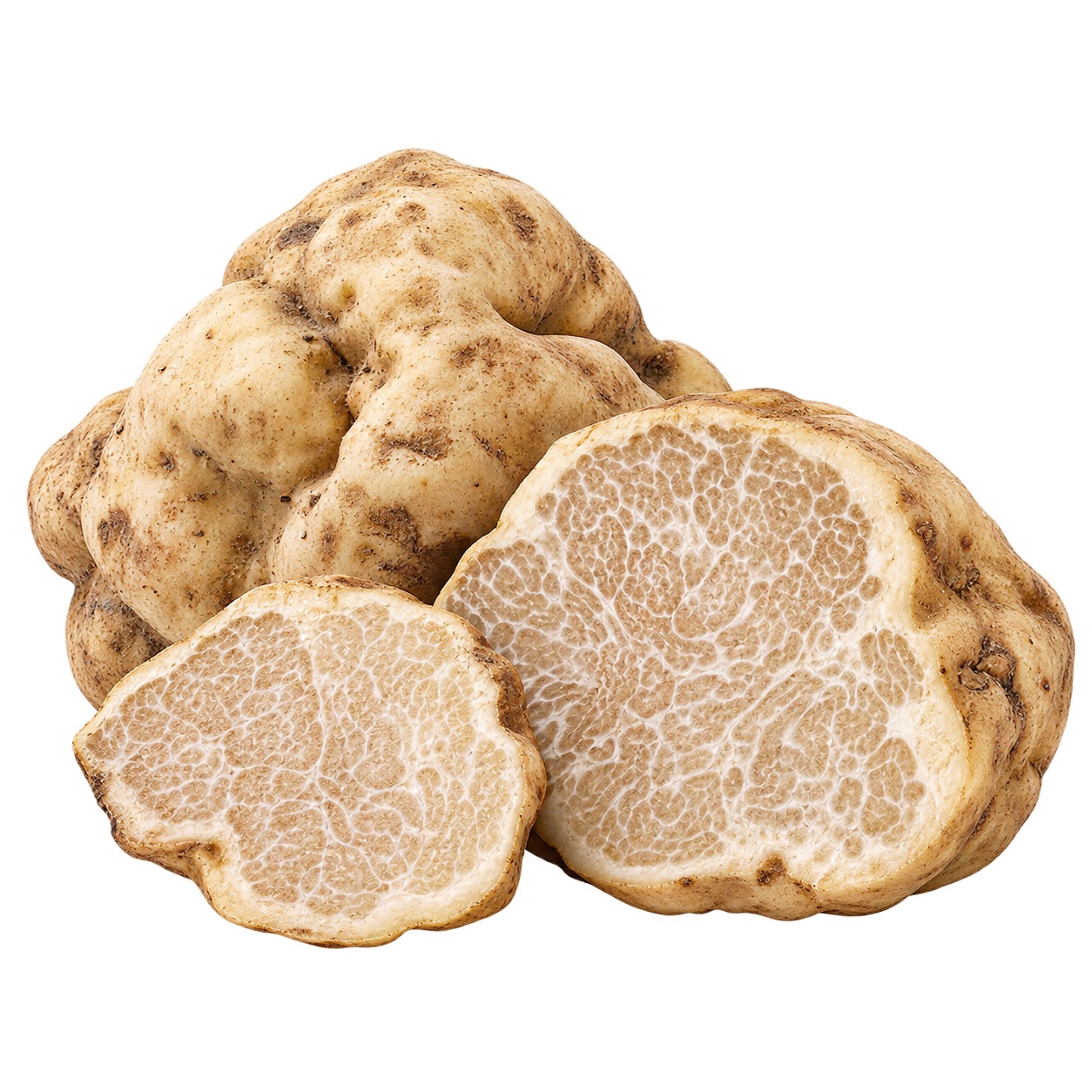
Truffles form their fruiting bodies below the soil surface. They live in ectomycorrhizal partnership with suitable trees and shrubs, exchanging nutrients with host roots while responding to soil chemistry, moisture, temperature and the wider ecosystem.
Oak, hazel, poplar, willow, lime, alder and other suitable hosts can support different Tuber species. Productive sites often depend on calcareous soil, drainage, aeration, moisture and the correct microbial environment.
The great culinary value of a truffle is not simply size. Maturity changes its volatile profile. A ripe truffle develops the complex perfume that allows trained dogs to locate it beneath the soil.
Tuber magnatum, T. borchii, T. melanosporum, T. aestivum and T. uncinatum are not interchangeable. They differ in aroma, season, market value, preferred technique and culinary intensity.
The word “white truffle” can refer to very different species. Professional purchasing must preserve the scientific identity because aroma, seasonality and market value differ dramatically.
Known as tartufo bianco pregiato and especially associated with Alba, Langhe, Roero and Monferrato in Piemonte. It can also occur in suitable habitats in other Italian regions. Its perfume is exceptionally complex, combining earthy, fermented, garlic-like, honeyed and savory impressions that change with maturity and origin.
In the kitchen it is treated as a finishing ingredient: shaved raw at the last moment over tajarin, fresh pasta, risotto, fonduta, eggs, potatoes, delicate cheese preparations and simple butter-based dishes that allow the aroma to dominate.
Bianchetto is generally smaller and less commercially prestigious than T. magnatum, but its perfume can be strikingly intense. Research on its volatile profile repeatedly identifies earthy, mushroom-like and distinctly garlic-like notes. This sharper character explains why a small amount can have a powerful effect in a finished dish.
Use it with restraint over eggs, potatoes, fresh pasta, risotto, butter, mild cheese or cream-based preparations. Its assertive aroma can overwhelm delicate ingredients more quickly than the rounder prestige profile associated with mature T. magnatum.
Black truffles range from the powerful winter T. melanosporum to milder summer and autumn species. Their culinary treatment can be more tolerant of gentle heat than the most fragile white truffles.

In Umbria, the prized black truffle is deeply associated with Norcia, Spoleto, Valnerina and surrounding mountain territories. The same species is internationally celebrated as the Périgord black truffle. At maturity its interior becomes dark violet-black with fine pale veining and an elegant, persistent aroma.
Professional kitchens use it with eggs, poultry, game, pasta, risotto, potato, butter, cream, foie gras-style preparations, sauces and stuffing. Gentle warming can help distribute its aroma through fats, but excessive heat still destroys the most delicate volatile compounds.
Summer Truffle / Scorzone — Tuber aestivum: milder, nutty and earthy, often harvested in summer with additional autumn windows depending on regional law. Excellent for butter, pasta, eggs, sauces and dishes where a more delicate truffle signature is desirable.
Burgundy / Uncinato — Tuber uncinatum: closely related to the summer-truffle group and prized in autumn and early winter for a fuller aroma than many summer specimens.
Winter Black — Tuber brumale: a winter species with a more direct, musky profile that should not be confused with T. melanosporum.
Smooth Black — Tuber macrosporum: an aromatic autumn truffle found in parts of Europe, including Italy.
Bagnoli / Ordinary Black — Tuber mesentericum: an autumn-winter species with a distinctive aroma whose quality varies strongly with maturity and origin.
This is a culinary planning guide, not a legal harvesting permit. Collection calendars are controlled regionally and can be revised for climate, conservation and local conditions.
T. magnatum enters its great restaurant season as temperatures cool. In Piemonte the current collection calendar begins October 1.
T. uncinatum, T. macrosporum and other autumn species add black-truffle options before peak winter melanosporum.
The prized black truffle reaches its classic season from winter into early spring, with Norcia and other European regions strongly identified with this period.
T. borchii extends the white-truffle style into late winter and spring with a smaller body and often sharper garlic-like perfume.
T. aestivum brings a milder summer black truffle with a wider culinary window and generally more accessible market pricing.
Black truffle orchards in Australia, New Zealand, Chile and other Southern Hemisphere locations can supply T. melanosporum during the Northern Hemisphere summer.
Frozen, preserved and processed truffle products can extend availability, but they do not reproduce the volatile complexity of a freshly harvested ripe truffle.
Chefs, buyers and hunters should verify the legal regional harvest calendar before purchasing or collecting fresh wild truffles.
Italian truffle hunting is not simply foraging. It is a body of ecological knowledge about trees, soil, weather, season, scent and careful extraction transmitted across generations.
Italy's truffle hunting and extraction tradition was inscribed by UNESCO in 2021 as intangible cultural heritage. The trained dog detects ripe underground truffles; the hunter reads the habitat and carefully extracts the fruiting body with a small specialized spade while protecting the soil and root environment.
Pigs, especially sows, naturally respond to truffle aromas and were historically used in parts of Europe to locate underground truffles. Their strength and instinct made them effective, but they could also eat the truffle and disturb a much larger area of soil.
Modern Italian practice shifted decisively toward trained dogs because dogs are easier to control and allow more selective extraction. Italian law has prohibited pig-based truffle hunting since the 1980s because uncontrolled digging can damage truffle grounds and immature fruiting bodies.
Researchers are developing non-invasive tools to detect truffle aroma and map underground mycelium. These methods are promising for orchard management, but the trained dog remains the practical field standard.
A 2026 proof-of-concept study used nine optical sensors plus one electrochemical sensor to identify T. melanosporum through volatile patterns in controlled tests, including truffles buried at 10 and 30 cm. The authors describe strong potential but note that real-field validation is still required.
Researchers can detect and quantify truffle mycelium in soil using molecular methods. This is valuable for checking orchard establishment, host-tree colonization and the persistence of target species even when no fruiting body is visible.
Modern truffle farming increasingly combines mycorrhized seedlings with soil analysis, irrigation management, climate monitoring, canopy control and molecular verification. Technology improves management, but truffle fruiting still depends on a complex living ecosystem.
Truffle cultivation is built around inoculated or mycorrhized host trees planted into suitable soils, then managed for years before consistent production can be expected.
Tuber melanosporum is the major success story of modern truffle farming. Oak and hazel seedlings can be inoculated in nurseries and planted in suitable calcareous soils. Production has expanded beyond France, Italy and Spain into Australia, Chile, New Zealand, South Africa, the United Kingdom and other emerging truffle regions.
T. aestivum and T. borchii are also cultivated. Successful orchards depend on correctly mycorrhized trees, soil suitability, competing fungi, water management, pruning, cultivation practices and long-term monitoring.
The prized white truffle has historically been much more difficult to cultivate reliably than T. melanosporum. Earlier plantations were complicated by incorrect identification or contamination of nursery mycorrhizae. Modern DNA tools now allow much more accurate verification of T. magnatum mycorrhization.
Recent European research has demonstrated genuine cultivated production under experimental and specialized orchard conditions, but white-truffle cultivation remains technically demanding and less predictable than established black-truffle systems.
Truffles are a global culinary product, but origin only has meaning when paired with the correct species, maturity and traceability.
Piemonte for T. magnatum; Umbria and Norcia for T. melanosporum; Tuscany, Marche, Emilia-Romagna, Abruzzo, Molise and other regions for multiple white and black species.
Major European centers for cultivated and wild T. melanosporum, with established orchard systems, protected markets and strong winter black-truffle traditions.
Southern Hemisphere orchards produce T. melanosporum in the Northern Hemisphere summer, extending seasonal access for international restaurants.
Chinese black truffles such as the Tuber indicum complex are commercially important but should be identified honestly and not represented as T. melanosporum.
Managed orchards demonstrate how European truffle species can be cultivated beyond their historic natural range when soils, climate and mycorrhized host trees are suitable.
Research and commercial plantings include cultivated T. aestivum, T. borchii and black-truffle systems adapted to local conditions.
Native truffle species and developing European-species orchards form a separate culinary landscape. Buyers should always verify scientific species and origin rather than using generic “white” or “black” labels.
Genera such as Terfezia and Tirmania are prized underground fungi in North Africa and the Middle East but are biologically and gastronomically distinct from European Tuber truffles.
The most expensive truffle can be wasted by the wrong technique. Aroma is volatile, so preparation should be designed around species, maturity and service temperature.
Shave raw immediately before service. Use warm—not aggressively hot—eggs, pasta, risotto, fonduta, potato, butter or mild cheese as an aromatic carrier. Simplicity protects the perfume.
Can be shaved, grated, layered, infused and gently warmed. Fat carries the aroma well. Butter, cream, eggs, poultry, game, potatoes, sauces and forcemeats are classic partners.
Bianchetto can be intense and should be dosed carefully. Summer truffle is milder and often benefits from butter, cheese, egg or a small amount of truffle-infused fat to amplify its more delicate profile.
Keep fresh truffles refrigerated, clean but not waterlogged, wrapped in absorbent paper inside a closed food-safe container. Change damp paper regularly and use quickly. Long storage weakens aroma and encourages moisture loss or spoilage.
Record the scientific species, country and region of origin, harvest date, supplier, weight, firmness, aroma and condition. A mature smaller truffle with excellent perfume may outperform a larger but immature specimen.
The truffle library connects ingredient science, culinary history and practical recipe use across the Tuscany Cuisine platform.
Tuscany Cuisine BlogContinue into the cultural story, mystery and gastronomic prestige surrounding truffles and the black diamond tradition.
Read the Black Diamond story → Ingredients Library · Oils
Learn the difference between fresh truffle, genuine truffle material, infused oils, added aroma compounds and professional finishing-oil use.
Open the Truffle Oil Library →The new fresh white-truffle identity connects directly to Recipe 232, where pappardelle, blue hare ragout and white truffle create a classic game-and-forest flavor relationship.
Harvest dates and regulations change. Tuscany Cuisine uses scientific and official regional references for current culinary education.