Clawed Lobsters
American and European lobsters belong to the clawed-lobster group. They provide tail meat plus valuable claw, knuckle and leg meat, giving chefs several textures from one animal.
Lobster is one of the world's most important luxury shellfish ingredients. Professional cooks must understand species, shell condition, market season, meat yield, cooking method and production handling—not only the purchase price per pound.
This Culinary Foundations page connects lobster knowledge to the Tuscany Cuisine ingredient system, recipe development, shellfish-stock production, Live Inventory, Purchasing, Receiving and Master Search.
Chef's production principle: buy for the dish. New-shell lobster offers exceptionally tender, sweet meat; hard-shell lobster generally provides better yield, firmer texture and stronger shipping durability.
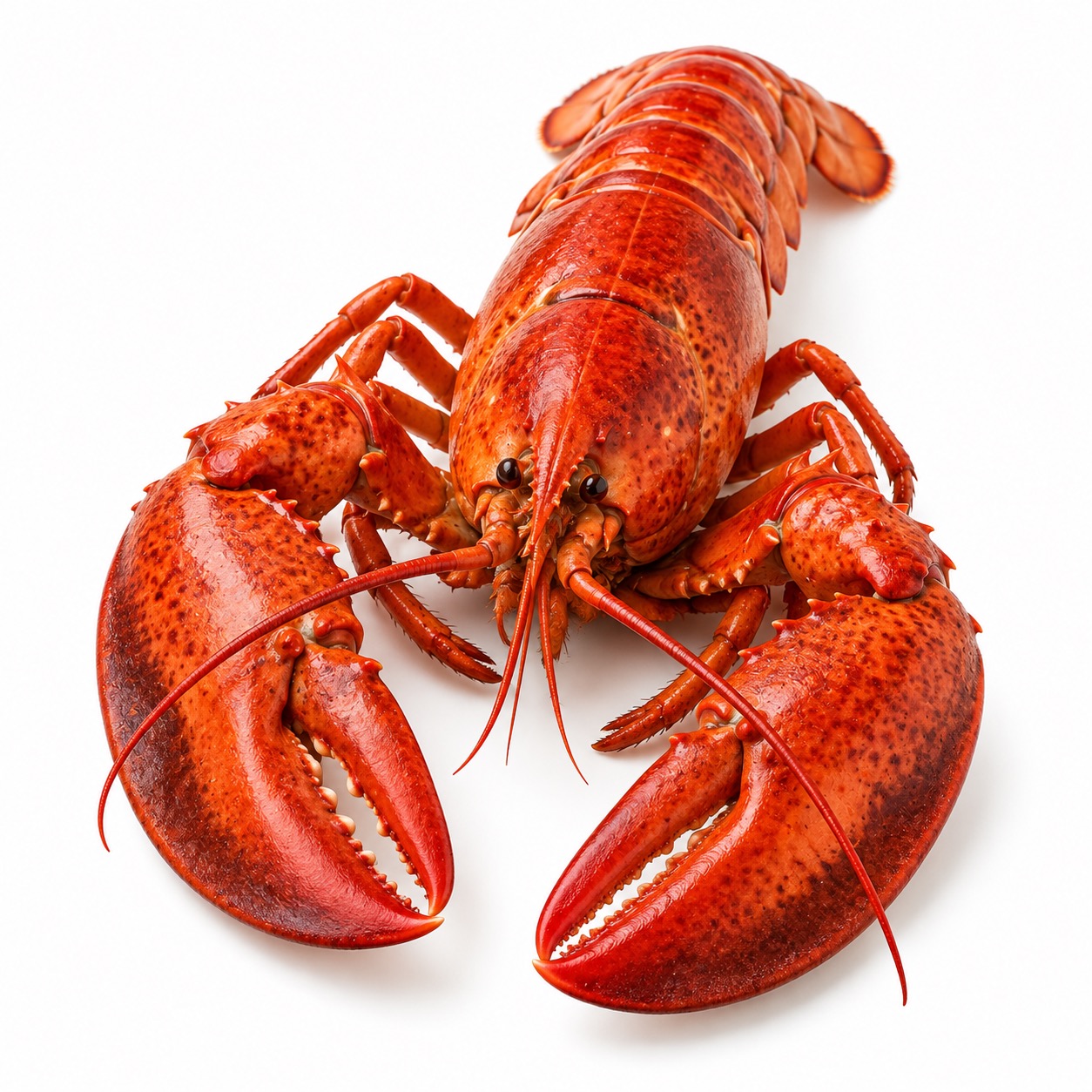 Ingredient Icon · lobster1.webp
Lobster is a market name covering several important groups with different anatomy, texture, flavor and culinary value.
American and European lobsters belong to the clawed-lobster group. They provide tail meat plus valuable claw, knuckle and leg meat, giving chefs several textures from one animal.
Spiny lobsters do not have the large crushing claws associated with American lobster. Their commercial value is concentrated heavily in the tail, making them especially important for grilling, broiling and plated center-of-plate applications.
Slipper lobsters and related market species broaden the global lobster category. Culinary names vary by country, so professional purchasing should always verify the scientific species and origin.
Representative commercial forms chefs may encounter in international markets.
Homarus americanus · Northwestern Atlantic. Large claws, sweet tail meat, claw and knuckle meat. Major source for Maine and Canadian lobster.
Homarus gammarus · Northeastern Atlantic and parts of the Mediterranean. Blue-black raw shell, firm sweet meat and prized culinary reputation.
Panulirus argus · Caribbean and western Atlantic. No large claws; prized primarily for the muscular tail.
Panulirus interruptus · Eastern Pacific. Firm tail meat well suited to grilling, roasting and coastal preparations.
Palinurus elephas · Eastern Atlantic and Mediterranean. Traditional Mediterranean luxury shellfish for grilling, pasta and rice dishes.
Jasus edwardsii · Australia and New Zealand. Dense, clean tail meat with strong international live-export value.
Panulirus cygnus · Western Australia. Important premium spiny lobster with strong whole-live and tail markets.
Panulirus ornatus · Indo-Pacific. Large tropical species used in luxury seafood markets.
Nephrops norvegicus · Northeastern Atlantic and Mediterranean. Smaller clawed species known as langoustine or scampi; delicate and sweet.
Scyllarides / Thenus spp. · Warm seas. Flattened body shape and no large claws; used regionally in grilling, curries, soups and rice preparations.
Seasonality is species- and fishery-specific. Maine American lobster provides a useful professional model for understanding shell condition and yield.
Purchase decisions should evaluate vitality, shell condition, yield, odor, cold-chain integrity and intended application.
Live clawed lobster should be responsive, with active legs or claws and a tail that curls when handled. Sluggish product should be prioritized for immediate cooking; non-responsive product requires rejection under the operation's receiving policy.
Look for intact shells, clean natural marine aroma and no sour, rancid or ammonia odor. Shell hardness strongly affects usable yield and price-per-ounce of picked meat.
Keep live lobster cold, moist and oxygenated according to supplier specifications. Do not immerse live saltwater lobster in fresh water. Record delivery temperature, source, lot and receiving condition.
Trade names vary by market, but weight is the most reliable purchasing language.
| Common Market Term | Approximate Live Weight | Typical Culinary Use |
|---|---|---|
| Chicken | About 1 lb / 454 g | Individual entrée, lobster roll, salad, pasta garnish |
| Quarter | About 1¼ lb / 567 g | Standard whole-lobster service |
| Select | About 1½–2½ lb / 680–1,134 g | Higher meat yield, sharing, grill, banquet production |
| Jumbo | Above roughly 2½–3 lb | Presentation service, larger portions, multi-dish production |
Times are production starting points, not substitutes for doneness checks. Start timing after boiling water returns to a full boil or active steam is restored.
| Live Weight | Boil | Steam | Equipment |
|---|---|---|---|
| 1 lb / 454 g | 6–7 min | 7–8 min | 8–12 qt stockpot / steamer |
| 1¼ lb / 567 g | 7–8 min | 8–9 min | Stockpot / rack / steamer basket |
| 1½ lb / 680 g | 8–9 min | 9–11 min | Stockpot / rack / steamer basket |
| 2 lb / 907 g | 10–12 min | 11–12 min | Large stockpot / steam kettle |
| 2½ lb / 1.13 kg | 11–13 min | 12–13 min | Large stockpot / steam kettle |
| 3 lb / 1.36 kg | 12–14 min | 12–14 min | Large stockpot / steam kettle |
| 4 lb / 1.81 kg | 15–17 min | 17–20 min | Large stockpot / high-capacity steamer |
| 5 lb / 2.27 kg | 18–20 min | 22–24 min | High-capacity stockpot / steamer |
Choose the method according to the desired texture, production volume and finishing application.
Use a heavy stockpot, rack or steamer basket with active steam. Steaming limits direct water contact and is excellent for whole lobster, banquet production and meat that will be picked for another dish.
Best for: whole lobster, production picking, salads, pasta mise en placeUse a stockpot large enough for rapid heat recovery. Boiling is fast and consistent for multiple lobsters, but the chef should avoid unnecessary overcooking and excessive water dilution of flavor.
Best for: traditional whole service, controlled batch cookingFor split lobsters up to about 3 lb, a useful starting point is roughly 4–6 minutes on the flesh side, then 5–8 minutes shell side, depending on grill intensity. Larger lobsters benefit from a preliminary steam/boil step before splitting and grilling.
Equipment: charbroiler, plancha or clean hot grillUse a sauté pan for picked tail, claw or knuckle meat. Raw or par-cooked pieces can finish gently in oil, butter, wine or sauce; fully cooked meat should be reheated very briefly to prevent toughness.
Best for: pasta, risotto, appetizers, warm saladsVacuum-seal shelled tail or claw meat with a small amount of butter or aromatic fat. Use the operation's validated seafood time/temperature program; a conservative endpoint is 145°F / 63°C. Chill rapidly if not served immediately.
Equipment: chamber/vacuum sealer, circulator, HACCP temperature controlsPoach picked lobster meat gently in clarified butter until just opaque and tender. This produces luxurious meat for lobster rolls, breakfast dishes, eggs Benedict, sandwiches, crostini and composed appetizers.
Equipment: sauté pan, small rondeau or controlled low-temperature bathA brief hot-water or steam step may be used in professional production to set the shell and facilitate meat extraction before a later finish. The exact time must be standardized by lobster size and the house HACCP procedure.
Not a final cook: rapid chilling and controlled finishing are mandatoryUseful for hotel or banquet volume when consistent humidity and controlled heat are needed. Arrange lobsters without crowding and verify the thickest tail section before releasing the batch.
Best for: high-volume kitchens and repeatable batch productionNot a cooking method, but essential production equipment. Rapid cooling stops carryover cooking, protects texture and supports safe storage before shell removal, portioning and later finishing.
Best for: prep-ahead shellfish productionYield is the number that converts a live-lobster purchase price into a true usable-food cost.
| Live Lobster | Live Weight | Hard-Shell Picked Meat 19–22% | New-Shell Picked Meat 16–18% |
|---|---|---|---|
| 1 lb | 454 g | 86–100 g | 73–82 g |
| 1.25 lb | 567 g | 108–125 g | 91–102 g |
| 1.5 lb | 680 g | 129–150 g | 109–122 g |
| 2 lb | 907 g | 172–200 g | 145–163 g |
| 2.5 lb | 1134 g | 215–249 g | 181–204 g |
| 3 lb | 1361 g | 259–299 g | 218–245 g |
The goal is to protect tenderness while allowing fast final execution for pasta, grill, appetizers, salads and banquet service.
One lobster can be directed into multiple preparations depending on which meat section and finishing method is used.
Add picked lobster at the end of the sauce or rice cookery so it warms through without becoming rubbery. Shellfish stock made from the shells can reinforce the same dish.
Split whole lobster or tail portions, brush with oil or clarified butter, and finish over high heat for smoke, char and presentation.
Use chilled claw, knuckle and tail meat for composed salads, crostini, seafood cocktails, tartlets and plated first courses.
Poached lobster meat is ideal for warm sandwiches, brioche rolls, breakfast plates, Benedict-style dishes, scrambled eggs and luxurious brunch applications.
Shells contribute aroma and color to stocks, bisques and sauce bases; finished lobster meat should be added late so its texture remains delicate.
Hard-shell lobster can provide more predictable picked-meat yield. Portion by actual cooked yield rather than assuming every live lobster returns the same usable weight.
Approximate values for cooked northern lobster, moist-heat preparation, per 100 g edible portion.
| Calories | 89 kcal |
| Protein | 19.0 g |
| Total fat | 0.86 g |
| Saturated fat | 0.21 g |
| Carbohydrate | 0 g |
| Fiber | 0 g |
| Sodium | Approx. 486 mg |
| Cholesterol | Approx. 146 mg* |
Lobster is naturally high in protein and very low in carbohydrate and fat before butter, sauces or breading are added.
It also contributes vitamin B12 and minerals such as selenium, copper, zinc and phosphorus. Sodium and cholesterol are naturally present and vary by species, analytical database and processing method.
*Nutrition note: nutrition databases and seafood-industry references report somewhat different cholesterol and calorie values. For menu nutrition, use the exact species/product record and preparation method used by your operation rather than a generic lobster estimate.
The lobster icon becomes the shared visual identity for recipes, Culinary Foundations, search and inventory-connected systems.
| Canonical name | Lobster |
|---|---|
| Italian terminology | Astice / Aragosta — species-dependent |
| Operational ingredient ID | lobster |
| Inventory ID | lobster |
| Category | Fish and Seafood |
| Subcategory | Shellfish / Lobster |
| Primary station | Seafood / Saucier |
| Icon | /academy/culinary-foundations/fishes/shellfish/lobster1.webp |
| Knowledge page | /academy/culinary-foundations/fishes/shellfish/lobster.html |
| Allergen | Crustacean shellfish |
| Formal MIR code | Pending registry verification — no invented code assigned on this page |
lobster, the published icon lobster1.webp, and this Culinary Foundations knowledge page. Lobster shells saved for stock production should be mapped separately as a shell/byproduct inventory identity rather than deducting edible lobster meat.
Selected sources used to verify species grouping, seasonality, yield and food-safety guidance.