Whole-muscle charcuterie
Each piece begins as a distinct lean muscle. The cut is kept intact through curing, then sliced across the grain into translucent sheets for service.
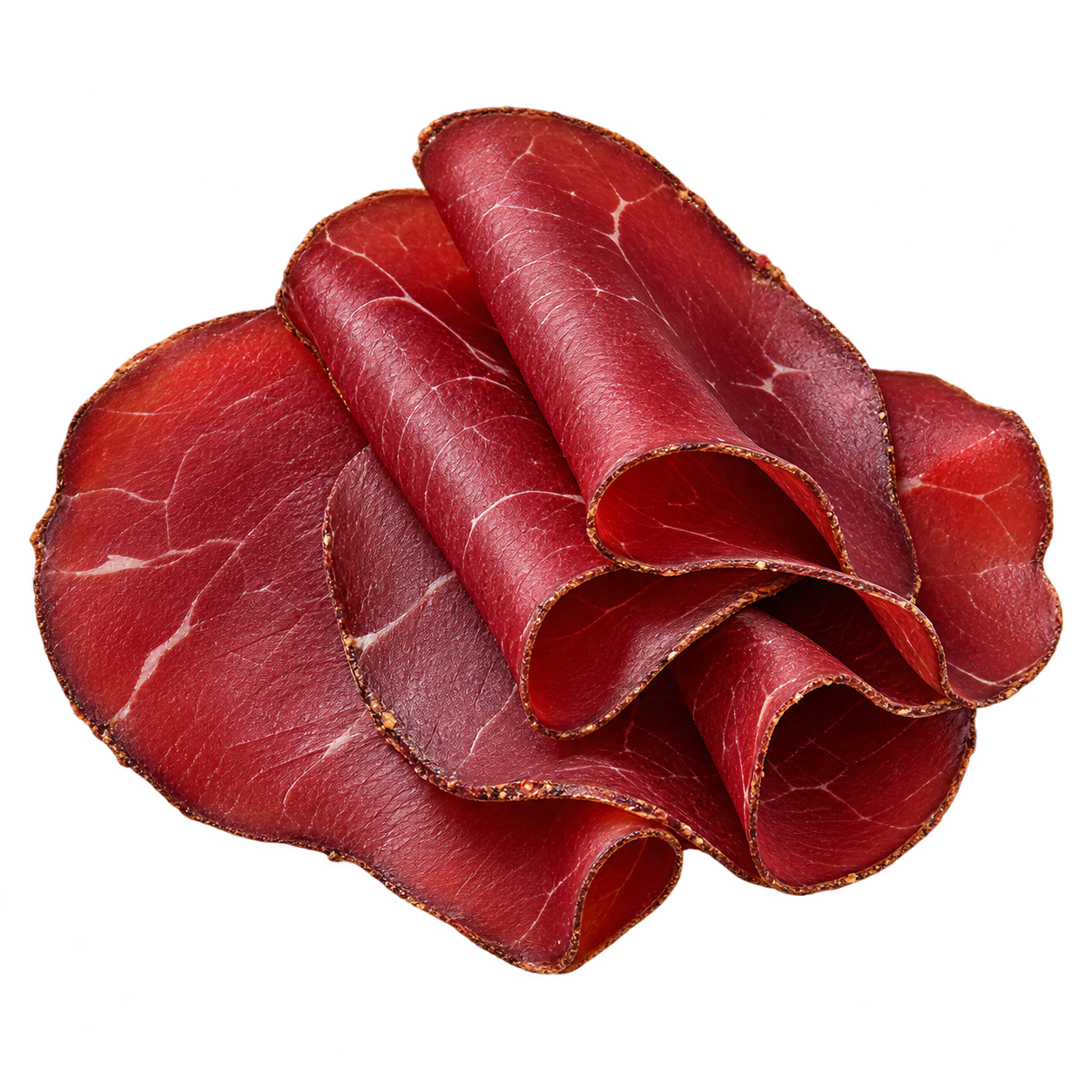
Bresaola is one of Italy's most elegant whole-muscle cured meats: deeply ruby red, exceptionally lean, gently aromatic and traditionally sliced paper-thin. The protected Bresaola della Valtellina PGI belongs to the Province of Sondrio in Lombardy, where selected beef hind-leg muscles are trimmed, dry-salted, dried and slowly cured.
 Bresaola icon active
Unlike salami, bresaola is not a ground-meat sausage. It is a whole muscle—most often beef— preserved by trimming, salting, drying and curing. Its finest examples remain compact and tender, with almost no visible fat inside the slice.
Each piece begins as a distinct lean muscle. The cut is kept intact through curing, then sliced across the grain into translucent sheets for service.
The best-known protected form is Bresaola della Valtellina PGI, produced in the Province of Sondrio. Its processing rules define the permitted beef cuts, salting, drying, curing and final quality characteristics.
The generic culinary term may appear on cured meats made outside the protected area or from other species. The PGI name must not be used as a synonym for every dried lean meat.
Salting and drying meat are much older than the written history of bresaola. In Valtellina, mountain climate and local butchery knowledge turned preservation into a distinctive regional craft.
Mountain communities preserved valuable meat through salt, cool air and drying long before refrigeration. Lean muscles were especially suitable because excess fat can oxidize and become rancid.
Written evidence from the 1400s documents the salting and drying of beef legs in Valtellina. The tradition itself is considered older than those surviving records.
For centuries bresaola remained largely a household and local craft, with families and butchers preserving meat through seasonal knowledge of salt, airflow and mountain conditions.
Specialized butchers and improved production methods expanded bresaola beyond domestic use, bringing the Valtellina product to regional and national markets.
Bresaola della Valtellina received European Protected Geographical Indication recognition, formally protecting its name, production area and specification.
The etymology is not certain. Valtellina sources discuss older dialect explanations connected to salting and to the word brisa; other popular explanations connect the name with brasa, or embers. Because the origin is debated, professional writing should present these as theories rather than a single proven derivation.
The protected product is made from selected muscles of the upper hind leg of beef cattle. All are relatively lean, but they differ in size, grain, tenderness and finished shape.
| Italian cut | Official anatomical description | Closest English / U.S. reference | Professional notes |
|---|---|---|---|
| Fesa Fesa |
Posteromedial portion of the thigh including the internal rectus, adductor and semimembranosus muscles. | Topside; broadly within the inside/top-round group. | Large, very lean muscle group suitable for clean whole-muscle curing and broad slices. |
| Premium Punta d'anca |
The portion of the fesa from which the adductor muscle is removed. | A refined part of the topside / inside-round group; often loosely compared with premium top round. | One of the most prized bresaola cuts. Uniform, lean and well suited to elegant thin slicing. |
| Outside Round Sottofesa |
Posterolateral section of the thigh; the biceps femoris muscle. | Silverside / outside round. | Lean and firm, with a different grain from fesa. Requires careful trimming of external connective tissue. |
| Eye of Round Magatello |
Posterolateral portion of the leg; the semitendinosus muscle. | Eye of round. | Long, cylindrical, very lean muscle that naturally produces a smaller, regular slice. |
| Anterior Thigh Sottosso |
Anterior band of the thigh formed by rectus and vastus muscles. | Often translated as thick flank; exact North American merchandising equivalence varies. | Smaller approved cut. Muscle-based anatomy is more reliable than forcing an exact retail-cut translation. |
Low intramuscular fat gives bresaola its clean ruby appearance and reduces the risk of fatty oxidation during curing. External fat and tendinous tissue are carefully removed before salting.
Large, thick muscles lose moisture differently from smaller cylindrical cuts. Curing time and airflow must therefore be managed according to piece size and production specification.
Thin slicing shortens muscle fibers and emphasizes tenderness. Cutting too thick makes even properly cured bresaola seem chewy and less delicate.
The protected Valtellina process is controlled rather than improvised. The goal is gradual moisture reduction while maintaining a compact, elastic texture and clean cured aroma.
Approved lean hind-leg muscles are selected according to size and quality. The muscle remains whole rather than being ground or reformed.
External fat and external tendinous portions are removed without unnecessarily cutting into the muscle. A clean surface encourages even salting and a refined finished slice.
Salt is applied with the permitted aromatic ingredients. The official specification describes an average salting period of about 10–15 days, adjusted to the weight of the piece.
Each piece is placed in natural or approved artificial casing. This supports shape and protects the surface as controlled drying begins.
Drying lasts about a week in the protected process, creating quicker moisture loss at the beginning without resorting to prohibited accelerated-dehydration techniques.
Curing continues in controlled rooms with air exchange. The specification gives an average temperature range of 12–18°C and a general drying-and-curing period of 4–8 weeks.
The PGI protection connects the product's reputation and transformation to the Province of Sondrio, including Valtellina and Valchiavenna. Certified producers must follow the official specification.
The protected production area is the Province of Sondrio in Lombardy. Alpine valleys, relatively dry air and local production knowledge are central to the product's reputation.
Bresaola della Valtellina PGI is made from beef cattle and only from the five specified upper hind-leg muscle groups. Horse bresaola is a different regional product and cannot be labeled as this PGI.
Trimming, dry salting, casing, drying, ageing, slicing, cutting and packaging are tied to the designated production area under the specification.
Firm and elastic, with a compact cut surface and no fissures.
Uniform red lean meat with only a slight dark edge and minimal visible fat.
Delicate, lightly aromatic, pleasantly savory and never sour.
Italy also preserves a distinct tradition of horse-meat bresaola. It is especially documented in Padua and the Veneto as a traditional food product, but it must be kept separate from the protected beef identity of Bresaola della Valtellina PGI.
Veneto agricultural documentation describes the use of several lean horse cuts including lombata (loin), noce, fesa and especially the coscia (hind leg/thigh). The objective is the same basic charcuterie logic: choose lean, clean muscle with little fat and connective tissue.
Traditional horse bresaola is typically darker red and can have a fuller, more assertive flavor. Regional methods use salting, aromatic seasoning, pressing or casing and maturation. Exact methods vary by producer and tradition.
If the product is horse bresaola, label it clearly as bresaola di cavallo. If it is the protected Valtellina product, identify it as beef and, when appropriate, use the full protected name Bresaola della Valtellina PGI.
For international guests, purchasing and menu language should also respect local laws, cultural expectations and the supplier's inspection and traceability requirements.
Bresaola is ready-to-eat charcuterie. Receiving and service therefore depend on intact packaging, cold-chain control, clean slicing equipment and protection from cross-contamination.
| Checkpoint | Accept | Reject or flag | Operational record |
|---|---|---|---|
| Identity | Correct species, producer, cut/style and PGI designation if ordered | Unlabeled species, wrong cured meat or false protected-origin claim | Vendor, item code, lot, origin |
| Package | Intact vacuum or approved package, readable label, no leaks | Swollen, leaking, punctured, warm or tampered package | Received date, use-by date, lot |
| Color | Deep ruby to uniform cured red with a slight darker edge | Abnormal green/gray spoilage tones, heavy surface slime or unexplained discoloration | Visual receiving note |
| Aroma | Clean cured-meat aroma, delicate spices | Sour, rancid, putrid or otherwise abnormal odor | Sensory check |
| Slice | Compact, tender and elastic; thin slice separates cleanly | Sticky, excessively wet, dried-out, cracked or unusually tough product | Opened date and slicer sanitation |
Store according to the manufacturer's refrigerated storage directions and local food code. Maintain traceability and rotate by the labeled date.
Protect the cut surface from drying and contamination, wrap or cover properly, date the package and follow the producer's opened-product instructions.
Use a clean, sanitized slicer and utensils. Slice only the amount needed for service so the meat does not dry, oxidize or warm unnecessarily.
Bresaola's appeal comes partly from its unusually lean profile compared with many other salumi. Sodium and curing ingredients, however, remain important considerations.
Consortium data for Bresaola della Valtellina report roughly 33 g protein per 100 g, with exact values varying by product.
A published consortium nutrition profile lists about 2 g fat per 100 g, reflecting the use of carefully trimmed lean muscles.
The same reference lists about 151 kcal per 100 g. Portion size and manufacturer label remain the correct basis for menu nutrition calculations.
Curing depends on salt, so bresaola can be sodium-dense. Taste the product before adding extra salt to salads, dressings or composed antipasti.
Bresaola is most expressive when sliced thin and served with acidity, good olive oil, aged cheese, fresh herbs or bitter greens rather than heavy sauces.
Dress lightly just before service. Too much acid for too long can tighten and discolor the surface.
Shaved aged cheese adds nuttiness and umami while keeping the plate dry and elegant.
Peppery or bitter leaves contrast the cured meat's sweetness and savory depth.
Use sparingly in vinaigrette or garnish so mustard supports rather than dominates the delicate meat.
Fold thin slices rather than compressing them. Air between folds preserves tenderness and visual volume.
Add bresaola late or off heat. Prolonged heat dries the lean meat quickly and can intensify saltiness.
Its leanness balances fatty prosciutto, coppa or salami and brings a different whole-muscle texture.
Favor wines with good acidity and moderate structure; an overly tannic red can overpower the delicate cured flavor.
The ingredient page uses the same bresaola identity already present in the recipe
and Live Inventory mapping so the new icon can flow through recipe, inventory and purchasing tools.
Thinly sliced bresaola is served with baby spinach, whole-grain mustard, lemon, extra virgin olive oil and shaved Parmigiano Reggiano.
Open Bresaola Recipe/academy/culinary-foundations/meats/charcuterie/bresaola.png and link the ingredient to
/academy/culinary-foundations/meats/charcuterie/bresaola.html.
This page preserves the current bresaola identity rather than creating a duplicate.
The new icon and page URL can now become the canonical educational and visual reference.
TC-ICON-BRESAOLA
Scale Bresaola by actual recipe weight while preserving the single bresaola identity.
Send slicing and plating quantities to the Antipasti or Garde Manger station without creating a duplicate cured-beef item.
Deduct actual grams from bresaola and cost from the received whole piece or pre-sliced pack.
Verify species, PGI claim when specified, producer, pack, lot, cold chain, use-by date and label declarations.
bresaola inventory identity. If Tuscany Cuisine adds horse bresaola operationally,
create a dedicated code, inventory ID and icon so purchasing, recipes and allergen/guest communication
remain unambiguous.
Use these distinctions when training cooks, writing menus, receiving product or connecting the ingredient to the Tuscany Cuisine system.
Top round is a useful American reference for part of the inside-round family, but the PGI specification is more precise. It permits fesa, punta d'anca, sottofesa, magatello and sottosso, each defined by actual muscle groups.
Magatello corresponds to the semitendinosus muscle and is the closest direct match to eye of round.
Yes, in separate regional traditions. Veneto documentation identifies bresaola di cavallo as a traditional product of Padua and province, using lean cuts such as loin, noce, fesa and especially the hind leg. This is not Bresaola della Valtellina PGI.
The product begins with lean hind-leg muscles, and external fat and tendinous tissue are trimmed before curing. That produces the characteristic compact ruby-red slice with very little visible fat.
Very thin slicing best expresses tenderness and aroma. The Valtellina Consortium has described approximately 0.6–0.8 mm as an ideal serving thickness for the protected product.
It is normally served ready-to-eat and sliced thin. If used in a warm dish, add it near the end because prolonged heat quickly dries such a lean cured meat.
Protected-origin rules, cut anatomy, history, curing parameters, nutrition and the horse-meat tradition were checked against official or institutional sources.
Educational notice: this page provides culinary and historical education and does not replace a validated commercial curing process, manufacturer storage directions, local food code or HACCP plan. Cured-meat formulas and legal requirements vary. For production, use inspected meat, approved curing controls, calibrated equipment and the requirements of the applicable authority.