Production Overview
Allow approximately 1 hour covered bulk rest, then portion into lightly oiled containers for 16–22 hours under refrigeration. Warm/temper covered portions as needed before shaping. The precise return-to-service temperature and prebake duration depend on your oven, dough strength and room conditions.
Ingredients · Baker's Percentage
 Strong wheat flour — Manitoba-style or high-protein tipo 00567 g · 70% flour blend
- Rice flour162 g · 20% flour blend
- Soy flour81 g · 10% flour blend
 Cold water648 g · 80% hydration, two additions
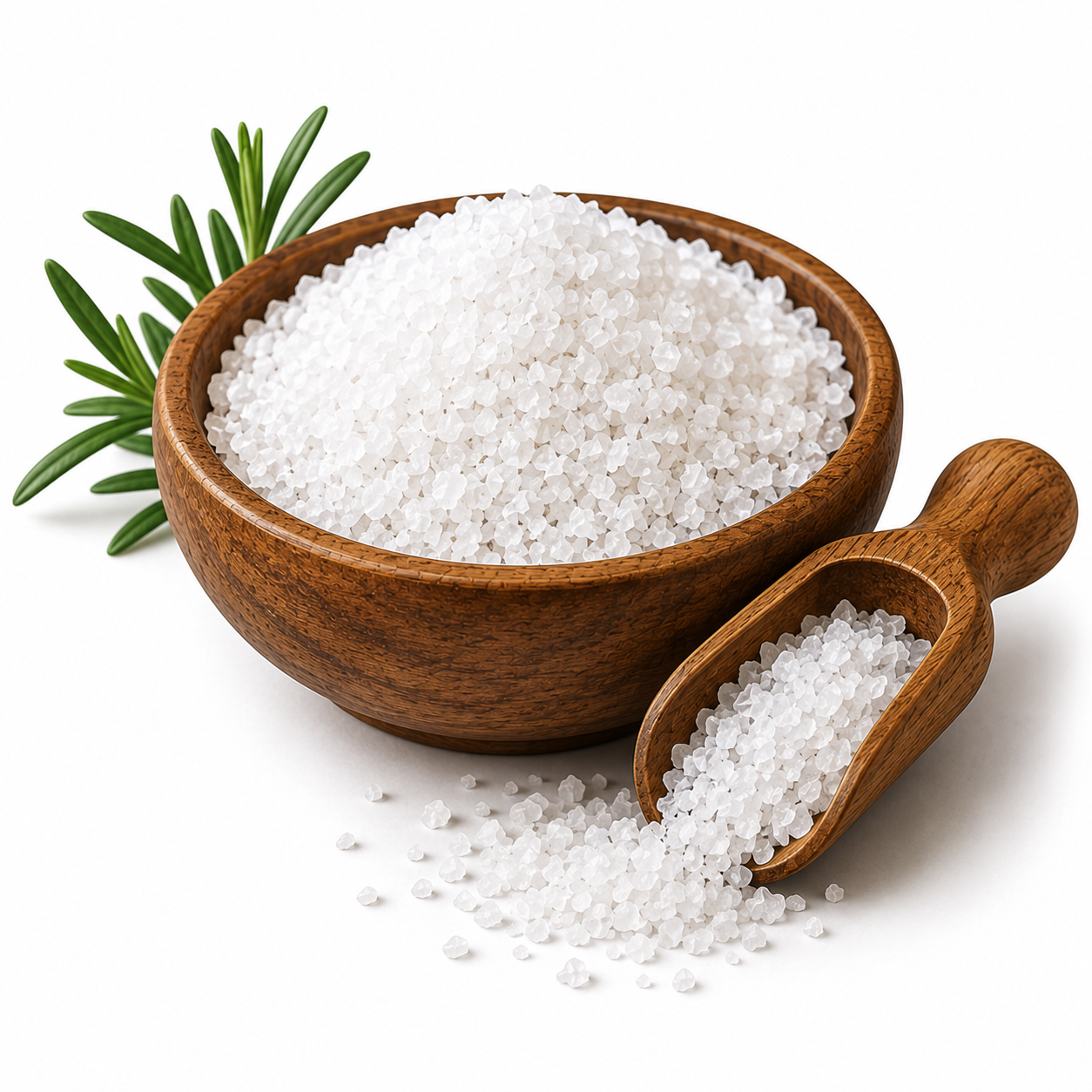 Fine sea salt20 g · 2.47% baker's percentage
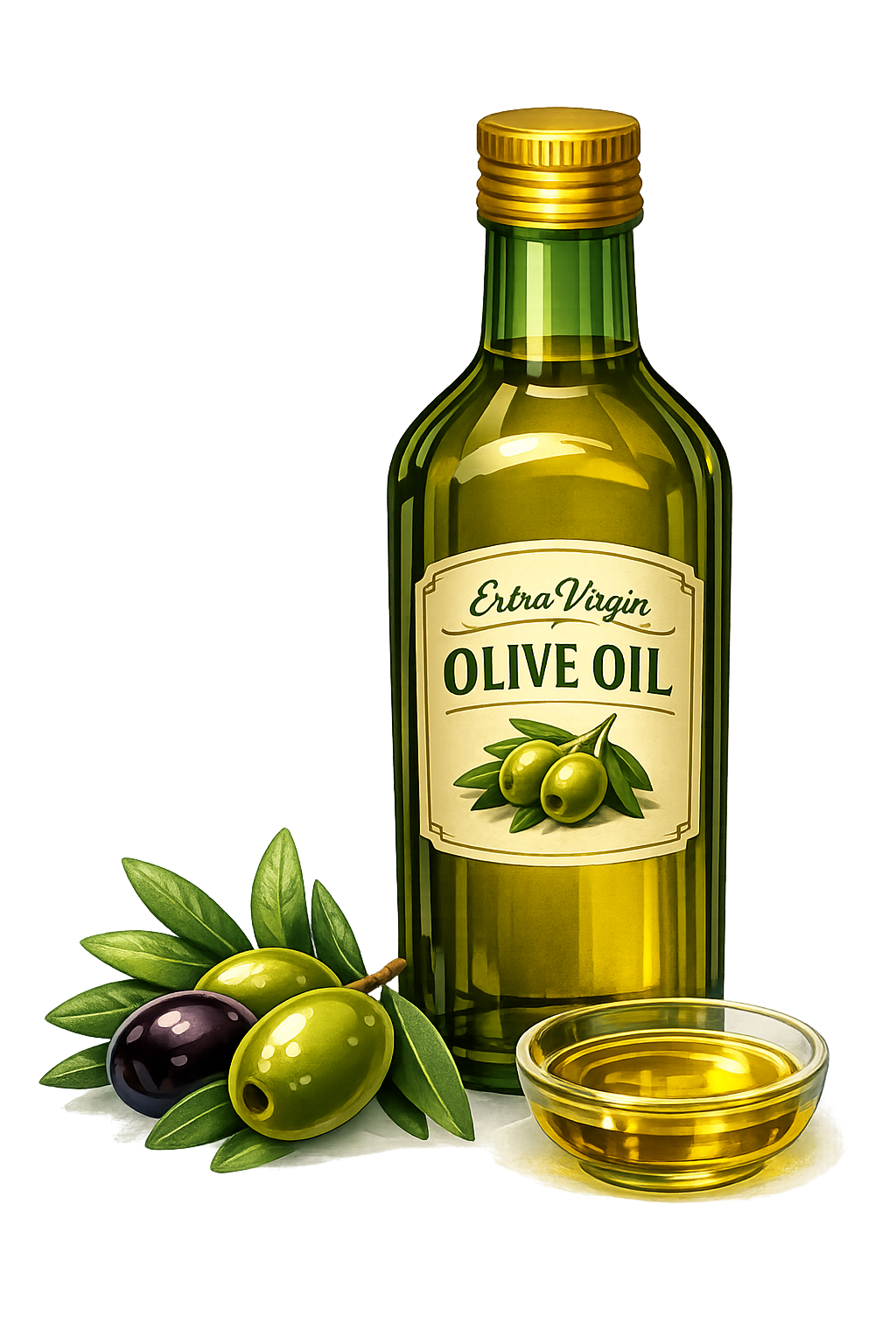 Extra-virgin olive oil (EVOO)20 g · 2.47% baker's percentage; extra for coating boxes
- Instant dry yeast2 g · 0.25% baker's percentage; provisional amount
Total dough: 1,500 g. Flour: 810 g. 80% hydration is calculated against the sum of wheat, rice and soy flours. Additional rice flour for dusting and olive oil for the containers are external handling ingredients, not included in the 1,500 g dough weight. Contains wheat and soy.
Why These Flours?
Strong Wheat Flour — 70%
Use high-protein flour with good gluten strength for water absorption and elastic structure. Manitoba flour is one suitable option; a strong tipo 00 can also work, but not every tipo 00 flour is strong enough. Check the flour's protein and W value.
Rice Flour — 20%
Part of the wheat–rice–soy Pinsa Romana tradition. It supports a delicate, crisp exterior and is useful for dusting the bench and dough.
Soy Flour — 10%
Adds flavor and contributes to the texture of the blended dough. Soy flour contains no gluten, so the wheat portion must carry the dough's gluten structure.
Controlled Fermentation
Keep the dough in covered, food-safe boxes in a refrigerator near 36–40°F / 2–4°C. During testing, adjust yeast and timing to maintain structure and avoid overproofing.
Fermentation Alternatives — Lievito Madre, Poolish & Biga
The standard working Pinsa formula above uses 2 g instant yeast for six 250 g portions. The methods here are separate development trials, not ingredients to add on top of the standard dough. Never add a preferment without subtracting the flour and water it already contains from the final mix. A live starter changes leavening speed, acidity and dough strength; verify timing by dough condition and temperature, not a fixed clock.
Lievito Madre — Natural Culture ↗
A maintained mother culture of flour, water, naturally occurring yeast and lactic-acid bacteria. A mature active culture brings layered aroma and natural acidity, but its leavening strength changes with feeding ratio, hydration and temperature. Refresh until predictably active before mixing. For long-fermented Pinsa, use strong wheat flour and protect the gluten structure from excessive acidity. Start with a controlled test batch instead of assuming the standard 16–22 h yeast schedule transfers unchanged.
Poolish — A Liquid Preferment
Poolish, historically associated with Polish baking influence, is traditionally equal flour and water by weight (100% hydration), with a small amount of commercial yeast and no salt. Prepare it ahead, cover, and mix it into the final dough when expanded, bubbly and fragrant. Often useful in pizza, rolls and sandwich breads for aroma and extensibility. It is not the same as a maintained sourdough mother culture.
Traditional Italian Biga
Biga is a separately fermented Italian pre-dough, commonly relatively firm. Compared with a liquid poolish it can give a different handling profile. Either can enrich aroma and structure; neither automatically guarantees greater digestibility or a superior result. Use the Biga Starter chapter as a related preparation.
Professional Control Points
Track starter hydration and vitality, total flour and water, dough exit temperature, acidity, proof volume, cold-storage temperature, and bake behavior. Reduce or omit commercial yeast in a fully naturally leavened version only after testing. Refrigerate cold dough around 2–4°C / 36–40°F and temper covered before shaping.
Illustrative Flour-and-Water Accounting — Not a Tested Replacement Formula
The base pinsa contains 810 g total flour and 648 g total water. Example: if a poolish uses 162 g of the strong wheat flour and 162 g water, the final mixer receives 405 g strong wheat flour, 162 g rice flour, 81 g soy flour and 486 g water, plus all 324 g ripe poolish, salt and oil. Poolish yeast must be selected for maturation time and temperature; do not automatically also use the base recipe’s 2 g instant yeast. For 100% hydration liquid madre, a 200 g ripe starter contributes 100 g flour and 100 g water; subtract both from the 810/648 g totals. For a 50% hydration stiff madre, a 150 g starter contributes 100 g flour and 50 g water. These are mass-balance teaching examples, not validated alternative Pinsa recipes.
Process: Build and ripen preferment separately → combine with remaining flour and counted water → develop the dough gradually, including bassinage for 80% hydration → rest and divide 250 g portions → cold ferment based on actual dough maturity → gently stretch and double bake. With mother culture, run side-by-side trials to determine whether the same 16–22-hour schedule is appropriate.
Study Lievito Madre Pizza Dough Fermentation Options Pane Arabo & Sandwich Breads
Technical reading: King Arthur Baking — Preferments.
Method — From Mixing to Double Bake
- Combine the flours. Mix 567 g strong wheat flour, 162 g rice flour and 81 g soy flour until homogeneous. Disperse 2 g instant dry yeast.
- Start at 60% hydration. Introduce 486 g cold water progressively and mix until coherent and the developing gluten network holds together. Avoid warming the dough excessively.
- Season and enrich. Add 20 g fine sea salt and 20 g extra-virgin olive oil, mixing until fully incorporated.
- Complete hydration to 80%. Slowly add the remaining 162 g cold water in small installments. Wait for each addition to absorb before adding more. This technique is commonly called bassinage.
- First rest. Transfer to an oiled or covered bowl and rest about 60 minutes in a controlled room. Observe dough development; if needed, perform a gentle fold instead of aggressively degassing.
- Scale and refrigerate. Portion six 250 g dough pieces, handling gently. Place each in its own lightly oiled food-safe plastic container. Cover and refrigerate for 16–22 hours. Record dough and refrigeration temperatures.
- Temper and unmold. Remove only the portions you need, allowing them to relax covered until stretchable. Turn onto a rice-floured or lightly floured workbench. Avoid pulling on chilled, tight dough.
- Stretch from the center outward. Press with fingertips to move and preserve the existing gas cells, pushing toward the front/edges. Shape into an elongated oval or softly rectangular pinsa—do not roll out with a pin or crush the bubbles.
- Flash prebake on stone. Preheat a professional stone deck to approximately 600°F / 316°C, only where the equipment manufacturer permits it. Transfer the dough to the stone and perform an initial rapid prebake. Chef's target is under one minute, but prebake duration must be tested: continue until the dough has set sufficiently to lift without collapse; some decks will require longer.
- Rest and stage. Cool prebaked bases appropriately before holding; do not seal them while steaming. Use sanitary, time-and-temperature-controlled staging in production.
- Finish for service. Re-bake the bare or lightly topped pinsa until fully cooked inside and crisp underneath. Add thin prosciutto, torn burrata and micro arugula after the final bake, followed by a light drizzle of extra-virgin olive oil and a restrained pinch of sea salt.
Chef's Pinsa — Prosciutto, Burrata & Micro Arugula
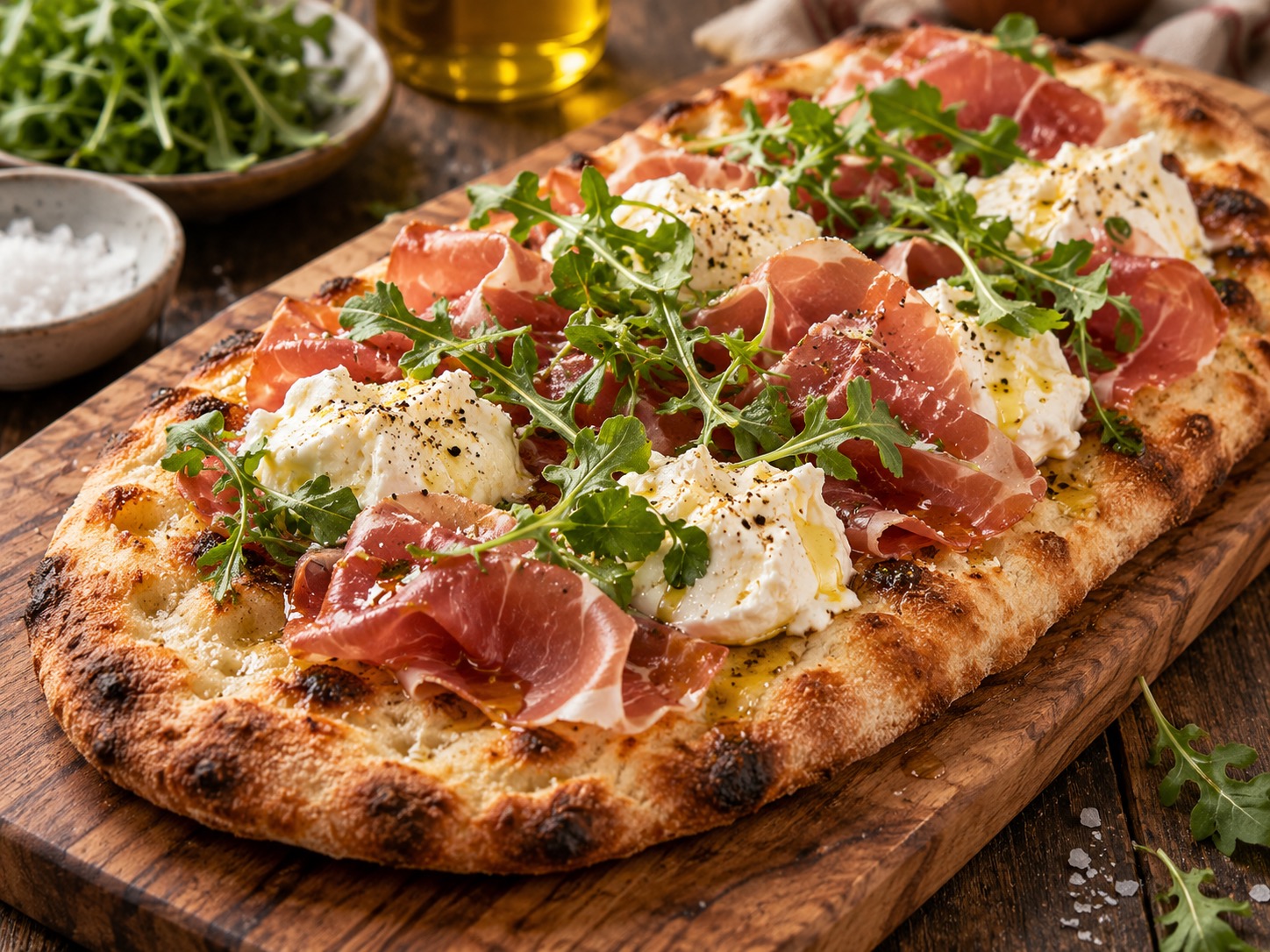
Finish each fully baked crisp base with thin slices of prosciutto crudo, small pieces of burrata, a delicate layer of micro arugula, flaky sea salt and a fine drizzle of extra-virgin olive oil. Burrata is soft and white inside; if desired, use the final hot bake for light toasted edges on the bread, not to brown the cold burrata itself.
Aperitivo wine: Prosecco for freshness, chilled Lambrusco with prosciutto, Vermentino with fresh cheese and herbs, or a light Sangiovese for savory charcuterie. Wine is an optional pairing; quantities for toppings and wine remain intentionally unspecified until the plated variation is tested.
Explore Wine PairingsHistory, Production & Food Safety
Modern Pinsa Romana
Pinsa Romana in its modern branded form was introduced by Corrado Di Marco in 2001. His proprietary blend centers on wheat, rice and soy flours, high hydration and a long fermentation—often 48–72 hours. This page uses Chef David's shorter 16–22-hour planned process, which is a distinct working variation and should not be described as Di Marco's certified formulation.
Official references: Di Marco — The Pinsa · Pinsa dough guidance.
Production & Allergen Notes
Contains wheat and soy; finished toppings add milk via burrata. The dough is not gluten-free. The suggested 600°F oven requires trained operation and an approved stone-deck setup. Service-ready bases must be fully baked, not merely surface-colored. For production planning, register measured dough temperature, cold-storage time, oven time, finished yield, cooling conditions and topping quantities before enabling Live Inventory costing.