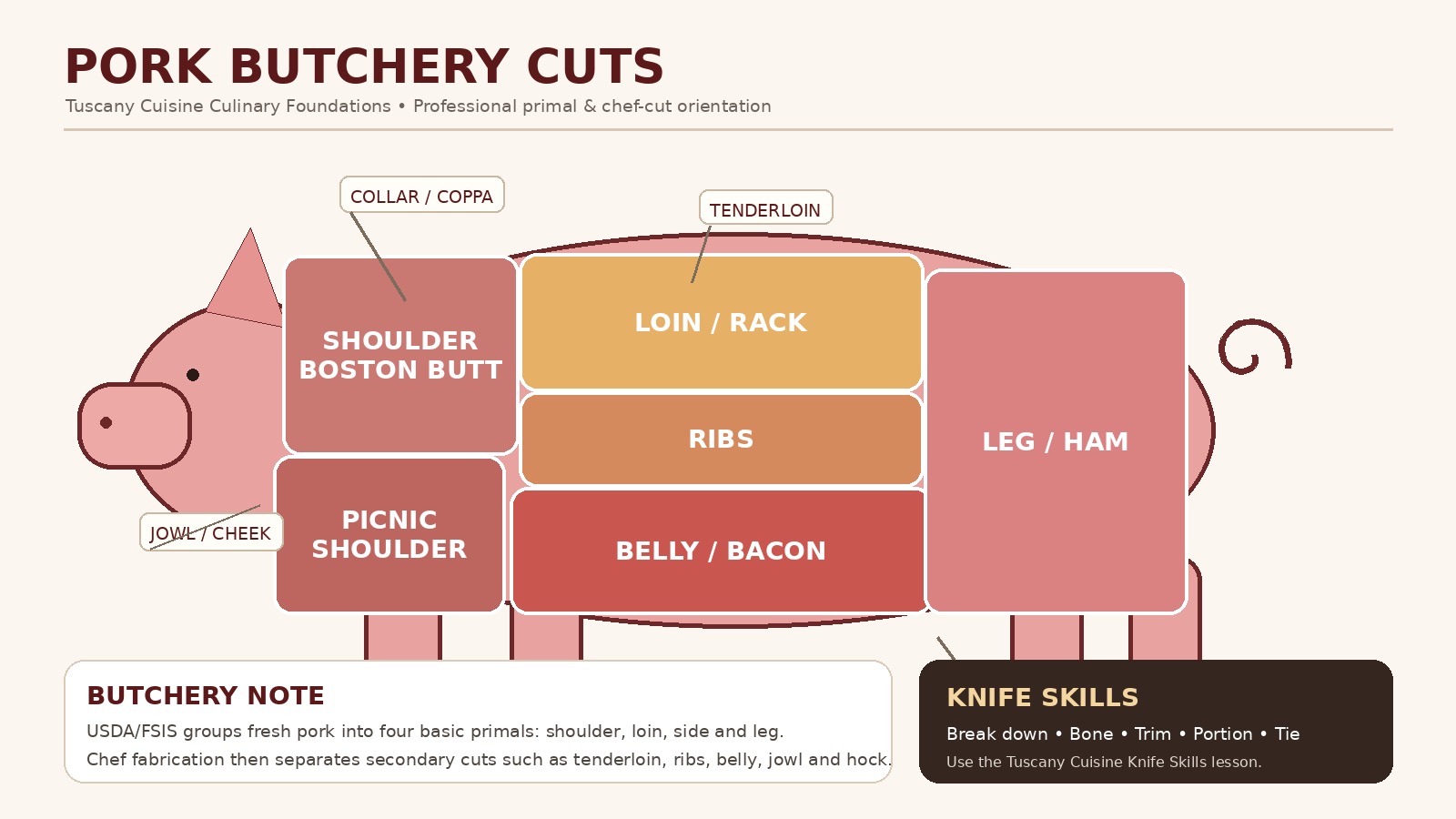
USDA primal structureFresh pork is grouped into shoulder, loin, side and leg; chef fabrication creates the secondary cuts used in restaurants.
Bacon identityTC-PORK-BACON-001 · inventory bacon · icon bacon.png.
Knife connectionBreaking, boning, trimming, slicing, tying and yield control connect directly to the Knife Skills lesson.
Whole-cut safetyUSDA guidance: 145°F / 62.8°C plus a 3-minute rest; ground pork 160°F / 71.1°C.
Foundation knowledge
Understanding Pork
The domestic pig is generally classified as Sus scrofa domesticus, derived from wild-boar ancestry.
Modern pork quality is shaped by genetics, feed, growth rate, animal handling, carcass composition,
intramuscular fat, pH, processing and the skill of the butcher and cook.
Lean muscles
Tenderloin, center loin and many leg muscles cook quickly and reward careful temperature control.
Working muscles
Shoulder, shank and hock contain more connective tissue and become luxurious through braising, smoking or slow roasting.
Fat-rich cuts
Belly, jowl and collar provide the marbling and fat needed for bacon, pancetta, guanciale, sausage and rich roasts.
Butcher logic: there is no single universal cutting system. American, Italian, Spanish, French, British and Japanese fabrication names differ.
Learn the anatomical location first; names can then be translated across markets.
Breeds, systems & related game
Types of Pork Around the World
Some names describe breeds, some describe production systems, and some describe protected geographic products.
For professional purchasing, do not treat those categories as interchangeable.
Large White / Yorkshire
Major international commercial type valued for productivity and lean meat; often used in crossbreeding.
Landrace
Long-bodied commercial breed family used globally, especially in maternal lines and lean pork systems.
Duroc
Red breed valued for growth, robustness and eating quality; common in premium crossbreeding programs.
Berkshire
English heritage breed recognized for marbling, juiciness and tenderness; the basis of premium Kurobuta programs.
Ibérico
Spanish breed family associated with marbled fresh cuts and world-famous cured products; breed percentage and feeding categories are legally regulated in Spain.
Cinta Senese
Ancient Tuscan breed with black coat and white belt. DOP meat is tied to Tuscany, outdoor/semi-outdoor husbandry and controlled traceability.
Mangalica
Curly-coated Hungarian heritage pig with substantial fat and strong charcuterie potential.
Meishan & Asian breeds
Asian pig genetics represent a different breeding history and are important to global swine biodiversity and regional cuisines.
Wild Boar · Cinghiale
Sus scrofa game meat is darker and typically leaner than domestic pork. Treat it as a separate game identity for purchasing, food safety, costing and recipes.
Anatomy & fabrication
Professional Pork Cuts Diagram
USDA FSIS recognizes four broad fresh-pork primals—shoulder, loin, side and leg.
The Tuscany Cuisine diagram expands those primals into practical restaurant cuts and charcuterie zones.
Knife Skills for Pork Butchery
Breaking · boning · trimming · silver-skin removal · portioning · slicing · tying · yield control
Open Knife Skills →
Cut-by-cut reference
Pork Butcher Cut Cards
Use these cards as the bridge between whole-animal anatomy, vendor specifications, recipe costing and the correct cooking method.
01
Shoulder Butt / Boston Butt
Spalla / Coppa zone
- Location
- Upper shoulder above the front leg
- Character
- Well marbled, connective tissue rich
- Best methods
- Low roasting, braising, smoking, slow cooking, pulled pork
- Common products
- Roasts, steaks, sausage trim, coppa-style fabrication
02
Picnic Shoulder
Spalla inferiore
- Location
- Lower shoulder and upper foreleg
- Character
- Flavorful, firm, collagen-rich
- Best methods
- Braise, smoke, roast, slow cook
- Common products
- Picnic roast, pulled pork, cured/smoked shoulder
03
Collar / Coppa
Coppa / Capocollo
- Location
- Neck-shoulder junction
- Character
- Rich marbling and deep flavor
- Best methods
- Roast, grill, low-temperature cook, cure
- Common products
- Coppa, capocollo, collar steaks
04
Loin / Rack
Lombo / Arista
- Location
- Back from shoulder to hip
- Character
- Lean to moderately marbled, tender
- Best methods
- Roast, grill, pan roast, sous vide
- Common products
- Loin roast, rack, center loin, rib chops
05
Tenderloin
Filetto di maiale
- Location
- Small internal muscle beneath the loin
- Character
- Very tender and lean
- Best methods
- Sear, roast, grill, sauté, sous vide
- Common products
- Whole tenderloin, medallions, tournedos
06
Pork Chops
Braciole / Costolette
- Location
- Portioned from loin and rib areas
- Character
- Varies by rib, center, sirloin or blade section
- Best methods
- Grill, pan sear, broil, roast
- Common products
- Rib chop, center chop, porterhouse-style chop, sirloin chop
07
Belly / Bacon
Pancia / Pancetta
- Location
- Lower side below the ribs
- Character
- High fat, succulent, layered
- Best methods
- Roast, braise, confit, cure, smoke, crisp
- Common products
- Bacon, pancetta, porchetta belly, fresh belly
08
Spare Ribs / St. Louis Ribs
Costine
- Location
- Rib section toward the belly
- Character
- Rich, flavorful, connective tissue
- Best methods
- Smoke, barbecue, braise, roast
- Common products
- Spareribs, St. Louis cut, rib tips
09
Back Ribs / Baby Back Ribs
Costine del lombo
- Location
- Ribs along the loin and back
- Character
- Smaller, curved and relatively tender
- Best methods
- Grill, smoke, roast, barbecue
- Common products
- Loin back ribs, baby back ribs
10
Leg / Fresh Ham
Coscia / Prosciutto
- Location
- Rear leg and hip
- Character
- Large lean muscles with moderate fat
- Best methods
- Roast, cure, smoke, braise selected muscles
- Common products
- Fresh ham, prosciutto, culatello-style muscles, cooked ham
11
Jowl / Cheek
Guancia / Guanciale
- Location
- Cheek and lower jaw
- Character
- Rich fat with intensely flavored meat
- Best methods
- Braise, cure, crisp, slow cook
- Common products
- Guanciale, braised cheek, charcuterie
- Location
- Lower leg above the foot
- Character
- Collagen-rich, firm
- Best methods
- Braise, smoke, slow roast
- Common products
- Pork hock, stinco, soup and bean preparations
13
Trotter / Foot
Piedino di maiale
- Location
- Foot
- Character
- Gelatin-rich skin, tendon and connective tissue
- Best methods
- Braise, simmer, debone, press
- Common products
- Terrines, stocks, traditional braises
14
Head / Face
Testa / Musetto
- Location
- Head, ear, snout and facial muscles
- Character
- Varied: lean cheek, collagen, skin and fat
- Best methods
- Braise, poach, press, roast
- Common products
- Coppa di testa, head cheese, porchetta di testa, crispy ears
Active Tuscany Cuisine ingredient identity
Bacon
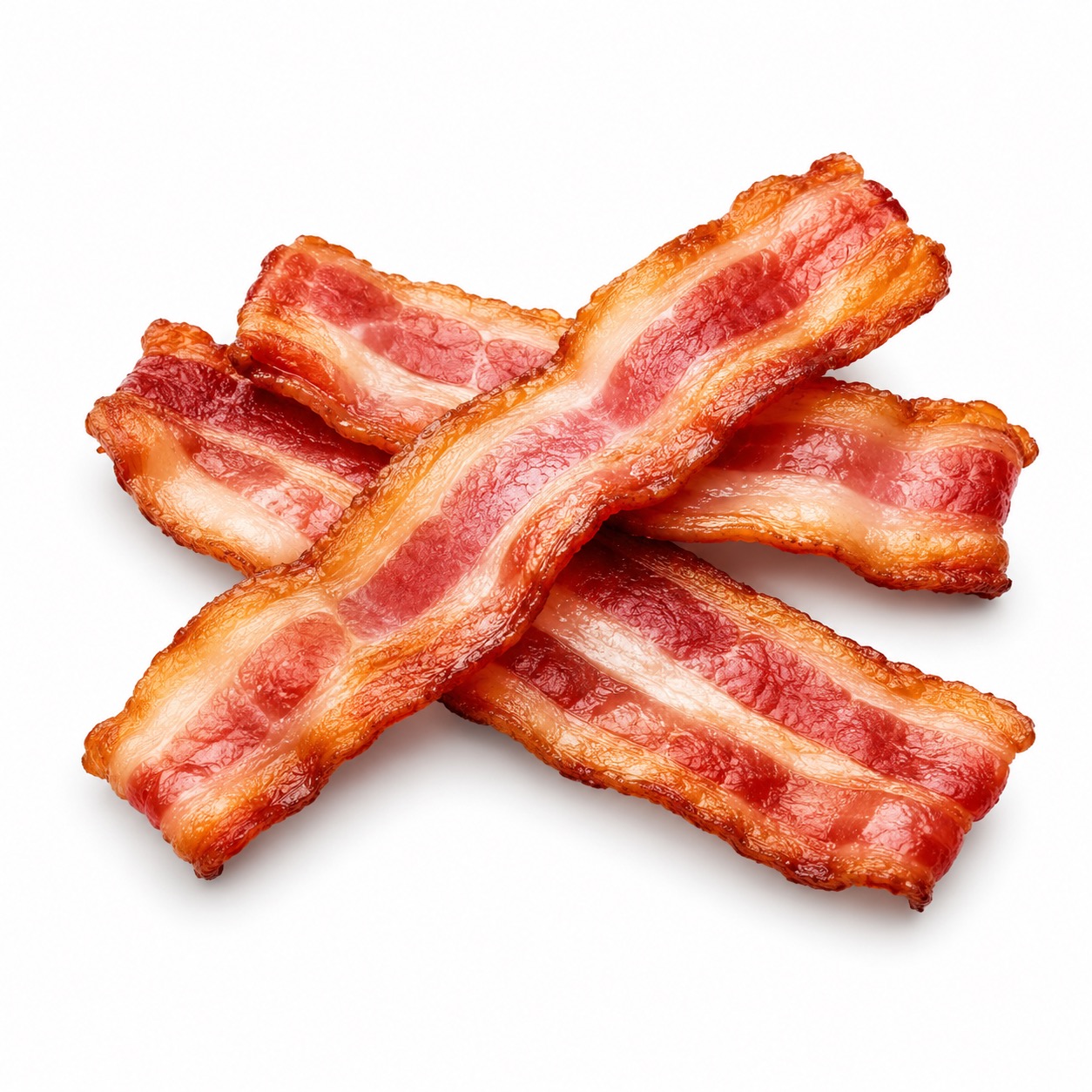
TC-PORK-BACON-001TC-ICON-PORK-BACONInventory: bacon
Bacon is a cured pork product; in the common American form it is produced from pork belly and may also be smoked.
It should not be confused with fresh pork belly, Italian pancetta or guanciale. The Tuscany Cuisine identity preserves the existing
inventory key bacon so recipe, inventory and purchasing records remain synchronized.
Fresh belly
Uncured side cut. Rich layers of meat and fat; roast, braise, confit or cure.
Bacon
Cured pork, commonly from belly; frequently smoked depending on style and producer.
Pancetta
Italian cured pork belly, traditionally seasoned and generally unsmoked.
Guanciale
Cured jowl rather than belly; especially important in Roman pasta traditions.
Premium pork traditions
Recognized High-Quality Pork Around the Globe
There is no objective single “best pork.” Quality depends on the dish, cut, breed, feeding, age, husbandry, slaughter,
processing and the chef’s objective. These are internationally recognized premium breeds or production traditions worth knowing.
Tuscany, Italy
Cinta Senese DOP
Ancient Tuscan black pig with a white belt. The DOP applies to meat from pure Cinta Senese animals born, raised and slaughtered in Tuscany under the specification. Slow growth, outdoor systems and strong traceability make it one of Italy’s most distinctive premium pork traditions.
Chef use: Roasts, ragù, salumi, rigatino, guanciale, capocollo
Spain
Ibérico de Bellota
Premium Iberian pork associated with intramuscular fat and the dehesa feeding system. Spanish quality rules regulate breed percentage, feeding and sales designations for fresh and cured Iberian products.
Chef use: Secreto, presa, pluma, fresh cuts, jamón, paleta, lomo
United Kingdom heritage · USA · Japan
Berkshire / Kurobuta
Berkshire is a heritage breed prized for marbling, juiciness and tenderness. In Japan, the Kurobuta name is tied to pure Berkshire genetics, creating a premium pork identity with rich, sweet fat.
Chef use: Chops, collar, loin, belly, tonkatsu, roasts
Hungary & Central Europe
Mangalica / Mangalitsa
Historic curly-coated Hungarian pig renowned for abundant, flavorful fat and charcuterie potential. Official herdbooks preserve Blonde, Red, Swallow-Belly and Black Mangalica lines.
Chef use: Cured meats, lardo-style fat, roasting, sausage, slow cooking
USA · Europe · Global
Duroc
A widely used red heritage/commercial breed valued for growth, marbling and eating quality. Duroc genetics are frequently used in premium crossbreeding programs.
Chef use: Loin, chops, shoulder, ribs, fresh premium pork
Europe, Asia & introduced ranges
Wild Boar
Wild boar is Sus scrofa and is game rather than a domestic pork grade. The meat is generally darker, leaner and more intensely flavored than commercial pork, with age and diet strongly affecting tenderness.
Chef use: Salmì, ragù, braises, sausages, slow-cooked game dishes
Purchasing principle: buy the certification or specification, not just the marketing name.
For DOP, Ibérico, registered Berkshire and other premium programs, verify breed, origin, feeding category, traceability and producer documentation.
Receiving & purchasing
How to Judge Pork Quality
USDA FSIS advises looking for fresh pork that is firm, grayish-pink and has a relatively small amount of exterior fat,
with some marbling for flavor and tenderness. Professional kitchens add pH, purge, odor, trim, fat quality and specification control.
ColorFresh, even pink to grayish-pink appropriate to the cut; reject abnormal discoloration or spoilage.
FirmnessMeat should hold shape and not feel excessively soft or watery.
MarblingIntramuscular fat generally supports juiciness and flavor, especially in shoulder, collar and heritage pork.
FatAssess clean aroma, color, firmness and distribution; fat character strongly affects premium pork.
PurgingExcessive liquid loss can indicate handling or meat-quality issues and reduces usable yield.
TraceabilityConfirm supplier, lot, breed or certification claims, receiving date and storage conditions.
Cut specificationDefine bone-in/out, skin-on/off, fat cap, trim level, weight range and portion thickness.
YieldJudge value by edible yield and cooked yield, not only purchase price per pound or kilogram.
Technique selection
Match the Cooking Method to the Cut
| Cut family | Structure | Best techniques | Chef objective |
|---|
| Tenderloin | Lean, very tender | Sear, roast, grill, sauté, sous vide | Protect moisture; avoid overcooking |
| Loin / chops | Lean to moderate marbling | Pan roast, grill, roast, brine, sous vide | Juicy center, browned exterior |
| Shoulder / collar | Marbled, collagen-rich | Braise, smoke, slow roast, confit | Convert collagen, preserve richness |
| Belly / jowl | High fat | Roast, braise, cure, smoke, crisp | Render fat while building texture |
| Ribs | Bone, collagen, fat | Smoke, barbecue, roast, braise | Tender meat with structure around bone |
| Leg / ham | Large lean muscles | Roast, cure, smoke, portion muscles | Control seasoning, cure and slicing texture |
| Hock / trotter / head | High collagen and skin | Braise, simmer, press, smoke | Build gelatin, stocks, terrines and traditional dishes |
| Wild boar | Usually leaner, variable by age | Marinate selectively, braise, stew, ragù, salmì | Manage game flavor and toughness without drying |
Food safety & storage
Pork Safety in the Professional Kitchen
Whole-muscle pork
USDA FSIS recommends 145°F / 62.8°C followed by a minimum 3-minute rest for whole pork cuts.
Ground pork
Ground pork should reach 160°F / 71.1°C because grinding distributes surface contamination through the product.
Slow-cooked cuts
Shoulder, ribs and hocks may be cooked well beyond the safety minimum when the culinary goal is collagen conversion and pull-apart tenderness.
Wild boar: game handling introduces additional variables—source, inspection, parasites and field handling.
Follow applicable local regulations, approved sourcing and specific game-meat safety procedures rather than treating wild boar exactly like inspected domestic pork.
Professional FAQ
Pork Butchery Questions
What are the four basic pork primal cuts?
USDA FSIS lists shoulder, loin, side and leg. Restaurant and retail fabrication subdivides those primals into butt, picnic, collar, chops, tenderloin, belly, bacon, ribs, ham, jowl, hock and other cuts.
Why is Boston butt called “butt” if it comes from the shoulder?
It is an upper-shoulder cut, not the rear of the animal. The historical name is a trade term; always identify the anatomical shoulder location when training staff.
Is bacon the same as pork belly?
No. Pork belly is the fresh side cut. Bacon is cured pork, commonly made from belly and often smoked. Pancetta is Italian cured belly; guanciale comes from the jowl.
Is wild boar a pork grade?
No. Wild boar is game and should have its own purchasing, costing and safety identity even though it is closely related biologically to domestic pigs.
What makes premium pork better?
There is no single universal ranking. Genetics, marbling, fat quality, feed, age, husbandry, pH, processing, traceability, cut specification and the intended culinary technique all influence quality.
References
Professional & Regulatory Sources